
Matter
Class 8 - Concise Physics Selina Solutions — complete Exercise 1 solutions with explanations, tables, experiments and a case study.
Interactive molecular model
Watch how particle spacing and movement change from solids to liquids and gases.
Solid
Strong attraction • least space
Particles vibrate about fixed positions.
Liquid
Weaker attraction • more space
Particles move within the container.
Gas
Least attraction • maximum space
Particles move freely in all directions.
Exercise 1
Objective Type Questions
Question 1(a)The inter-molecular force is maximum in:
The inter-molecular force is maximum in:
solids
gases
liquids
none of the above
solids
Reason — When inter-molecular force is very strong and kinetic energy is very low, the inter-molecular space is reduced and matter exists as a solid.
Question 1(b)The inter-molecular space is maximum in:
The inter-molecular space is maximum in:
liquids
solids
gases
none of the above
gases
Reason — In gases, inter-molecular force is negligible and kinetic energy is very high. Due to this inter-molecular space is maximum in gases.
Question 1(c)The molecules can move freely anywhere in:
The molecules can move freely anywhere in:
gases
liquids
solids
none of the above
gases
Reason — The inter-molecular force of attraction between the molecules is least and the inter-molecular space is maximum in gases so the molecules can move freely anywhere.
Question 1(d)The molecules move only within the boundary in:
The molecules move only within the boundary in:
liquids
gases
solids
none of the above
liquids
Reason — The inter-molecular forces, although weak, are sufficient to keep the molecules of the liquid within the boundary of the vessel.
Question 1(e)The temperature at which a liquid gets converted into its vapour state is called its :
The temperature at which a liquid gets converted into its vapour state is called its :
melting point
boiling point
dew point
freezing point
boiling point
Reason — The constant temperature at which a substance changes from the liquid state to its vapour state by absorbing heat is called its boiling point.
Question 1(f)Rapid conversion of water into steam is an example of:
Rapid conversion of water into steam is an example of:
evaporation
freezing
melting
vaporization
vaporization
Reason — Vaporization is a rapid and violent process where liquid changes into vapour at constant temperature by absorbing heat.
Question 1(g)Evaporation takes place from the
Evaporation takes place from the
from the surface of liquid
throughout the liquid
from the mid-portion of the liquid
from the bottom of liquid
surface of liquid
Reason — Evaporation is a surface phenomenon and the molecules on the surface have highest kinetic energy so the molecules can escape more easily and liquids get converted into gaseous state.
Question 1(h)Boiling takes place:
Boiling takes place:
from the surface of the liquid
throughout the liquid
from mid-portion of liquid
from none of the above
throughout the liquid
Reason — Boiling is not a surface phenomenon and boiling takes place at a fixed temperature when the whole liquid reaches that fixed temperature.
Question 1(i)Identify the correct statement.
Identify the correct statement.
(1) The molecules of water move faster than ice.
(2) The molecules are more closely packed in ice than water.
(3) The molecules of water vibrate to and fro only but those of ice are free to move within the boundary of the vessel in which it is kept.
(4) The molecules have more intermolecular space in ice than in water.
(1), (2) and (3)
(2), (3) and (4)
(1) and (2)
all are correct
(1) and (2)
Reason —
(1) Correct because water is in liquid state, so its molecules have more kinetic energy and move faster than those in solid ice.
(2) Correct as ice is in solid state where intermolecular spaces between the particles are very low than those of water which is in liquid state.
(3) Incorrect since in ice (solid), particles vibrate in fixed positions (to and fro) but in water (liquid), molecules are free to move within the vessel.
(4) Incorrect because water has more intermolecular space than ice.
Exercise 1
Assertion Reason Type
Question 2(a)Assertion (A) : We often pour tea in a saucer to cool it faster.
Assertion (A) : We often pour tea in a saucer to cool it faster.
Reason (R) : Evaporation takes place at all temperatures.
Both A and R are true and R is the correct explanation of A
Both A and R are true and R is not the correct explanation of A
Assertion is true but reason is false
Assertion is false but reason is true
Both A and R are true and R is not the correct explanation of A
Explanation
Assertion (A) is true because the rate of evaporation increases if the area of surface exposed increases so pouring tea into a saucer increases the surface area, which enhances evaporation, allowing the tea to cool more quickly.
Reason (R) is true because evaporation is a surface phenomenon which occurs at any temperature, not just at the boiling point.
But here reason does not explain the assertion.
Hence, both A and R are true and R is not the correct explanation of A.
Question 2(b)Assertion (A) : The molecules in a liquid can move within the boundary of the vessel.
Assertion (A) : The molecules in a liquid can move within the boundary of the vessel.
Reason (R) : A liquid has a definite volume and a definite shape.
Both A and R are true and R is the correct explanation of A
Both A and R are true and R is not the correct explanation of A
Assertion is true but reason is false
Assertion is false but reason is true
Assertion is true but reason is false
Explanation
Assertion (A) is true because according to molecular model of liquids, the liquid molecules can move about freely within the boundary of the vessel in which the liquid is kept.
Reason (R) is false because liquids do not have a definite shape, but they have a definite volume.
Exercise 1
Fill in the blanks
Question 3Fill in the blanks:
Fill in the blanks:
(a) Evaporation takes place at ............... temperatures.
(b) ............... process is just the reverse of melting.
(c) ............... is a process that involves direct conversion of a solid into its vapour on heating.
(d) The temperature at which a solid converts into a liquid is called its ............... .
(e) The smallest unit of matter that exists freely in nature is called ............... .
(f) Molecules of a substance are always in a state of ............... and so they possess ............... .
(g) Inter-molecular space is maximum in ............... less in ............... and the least in ............... .
(h) Inter-molecular force of attraction is maximum in ............... , less in ............... and the least in ............... .
(a) Evaporation takes place at all temperatures.
(b) Freezing process is just the reverse of melting.
(c) Sublimation is a process that involves direct conversion of a solid into its vapour on heating.
(d) The temperature at which a solid converts into a liquid is called its melting point.
(e) The smallest unit of matter that exists freely in nature is called molecule.
(f) Molecules of a substance are always in a state of motion and so they possess kinetic energy.
(g) Inter-molecular space is maximum in gases less in liquids and the least in solids.
(h) Inter-molecular force of attraction is maximum in solids, less in liquids and the least in gases.
Exercise 1
Match the Columns
Question 4Match the following:
Match the following:
| Column A | Column B |
|---|---|
| (a) Molecules | (i) water boils |
| (b) 100°C | (ii) evaporation |
| (c) 0°C | (iii) changes from solid to gas |
| (d) At all temperatures | (iv) matter |
| (e) Camphor | (v) water freezes |
| Column A | Correct match in Column B |
|---|---|
| (a) Molecules | (iv) matter |
| (b) 100°C | (i) water boils |
| (c) 0°C | (v) water freezes |
| (d) At all temperatures | (ii) evaporation |
| (e) Camphor | (iii) changes from solid to gas |
Exercise 1
True or False
Question 5Write true or false for each statement:
Write true or false for each statement:
(a) The temperature of a substance remains unaffected during its change of state.
(b) Ice melts at 100°C.
(c) Water at 100°C has more heat than steam at 100°C.
(d) Evaporation of a liquid causes cooling.
(e) Water evaporates only at 100°C.
(f) Boiling takes place at all temperatures.
(g) Evaporation takes place over the entire mass of the liquid.
(h) The process of a gas converting directly into solid is called vaporization.
(i) At high altitudes, water boils above 100°C.
(j) The melting point of ice is 0°C.
(a) True
(b) False
Correct Statement — Ice melts at 0°C.
(c) False
Correct Statement — Steam at 100°C has more heat than water at 100°C.
(d) True
(e) False
Correct Statement — Water evaporates at all temperatures.
(f) False
Correct Statement — Boiling takes place at a fixed temperature which is 100°C.
(g) False
Correct Statement — Evaporation takes place only at the surface of the liquid.
(h) False
Correct Statement — The process of a gas converting directly into solid is called deposition or solidification.
(i) False
Correct Statement — At high altitudes, water boils below 100°C because atmospheric pressure is lower.
(j) True
Exercise 1
Short Answer Type Questions
Question 1Define the term matter. What is it composed of?
Define the term matter. What is it composed of?
Matter is anything that has mass, occupies space and can be perceived by our senses. It is composed of tiny particles called molecules.
Question 2State three properties of molecules of matter.
State three properties of molecules of matter.
The three properties of molecules of matter are
- They are very small in size.
- They have spaces between them.
- They possess kinetic energy so they are in constant motion.
Question 3What do you mean by inter-molecular spaces? How do they vary in different states of matter?
What do you mean by inter-molecular spaces? How do they vary in different states of matter?
The space between the molecules of matter is called inter-molecular space. In solids the inter-molecular space is the least so the molecules are tightly packed. In liquids the spacing is more than solids where molecules can move freely but within the boundary of the vessel. In gases the inter-molecular space is the most so the molecules can move freely anywhere.
Question 4What is meant by inter-molecular forces of attraction? How do they vary in solids, liquids and gases?
What is meant by inter-molecular forces of attraction? How do they vary in solids, liquids and gases?
The molecules of matter exert a force of attraction on each other known as inter-molecular forces of attraction. This force of attraction is maximum in solids, less in liquids and the least in gases.
Question 5Which of the following are correct?
Which of the following are correct?
(a) Solids have definite shape and definite volume.
(b) Liquids have definite volume but no definite shape.
(c) Gases have definite volume but no definite shape.
(d) Liquids have both definite shape and definite volume.
The correct options are
(a) Solids have definite shape and definite volume.
Reason — In solids the inter-molecular space is the least and the molecules remain in their fixed positions due to strong inter-molecular force of attraction so solids have definite shape and definite volume.
(b) Liquids have definite volume but no definite shape.
Reason — The molecules in liquid are less closely packed, their positions are not fixed and they move freely. Although the inter-molecular force of attraction is weak as compared to solids but it is sufficient to keep them within the boundary of the vessel. So liquids have definite volume but no definite shape.
Question 6A liquid can change into vapour state
A liquid can change into vapour state
(a) at a fixed temperature and
(b) at all temperatures
Name the processes involved in the two cases.
The processes involved in the two cases are —
(a) Boiling
(b) Evaporation
Question 7State
State
(a) the melting point of ice and
(b) the boiling point of water
(a) The melting point of ice is 0°C.
(b) The boiling point of water is 100°C.
Question 8What is evaporation?
What is evaporation?
Evaporation is the process by which a liquid changes into vapour at all temperatures from the surface of liquid.
Question 9State three factors which affect the rate of evaporation of a liquid.
State three factors which affect the rate of evaporation of a liquid.
Three factors which affect the rate of evaporation of a liquid are —
- The temperature of liquid — If temperature of liquid is high, rate of evaporation is also high.
- The area of exposed surface — Rate of evaporation increases with increase in the area of exposed surface.
- The presence of moisture or humidity — Evaporation is faster in dry air than in humid air.
Question 10Why are volatile liquids such as alcohol and spirit stored in tightly closed bottles?
Why are volatile liquids such as alcohol and spirit stored in tightly closed bottles?
Rate of evaporation depends upon the nature of liquid. Volatile liquids like alcohol and spirit have low boiling point, so they evaporate much faster than water. So they are stored in tightly closed bottles to avoid their evaporation.
Question 11Why is cooling produced on evaporation of a liquid?
Why is cooling produced on evaporation of a liquid?
During evaporation process a liquid changes into gas by absorbing heat from the surroundings. This results in fall of temperature of the surroundings. So cooling is produced on evaporation of a liquid.
Question 12Give two applications of evaporation.
Give two applications of evaporation.
The two applications of evaporation are —
Water kept in earthen pots gets cooled in summer. Water gets evaporated through the pores of pot by absorbing heat from the water present inside the pot leading to cooling.
Tea in saucer gets cooled faster than in cup because the rate of evaporation increases with increase in surface area.
Question 13What do you mean by sublimation? Explain with an example.
What do you mean by sublimation? Explain with an example.
Sublimation is the process by which a solid when heated, directly changes into vapour without first changing into liquid.
For example, when ammonium chloride is heated it directly changes into vapour without changing into liquid.
Question 14Why does the size of naphthalene balls decrease when left open?
Why does the size of naphthalene balls decrease when left open?
Naphthalene balls when left open, directly change into vapour without heating due to sublimation. Hence, with time they become small in size.
Exercise 1
Long Answer Type Questions
Question 1Discuss the three states of matter: solid, liquid and gas on the basis of molecular model.
Discuss the three states of matter: solid, liquid and gas on the basis of molecular model.
Molecular Model of Solids
The molecular model of solids is shown in the figure below:
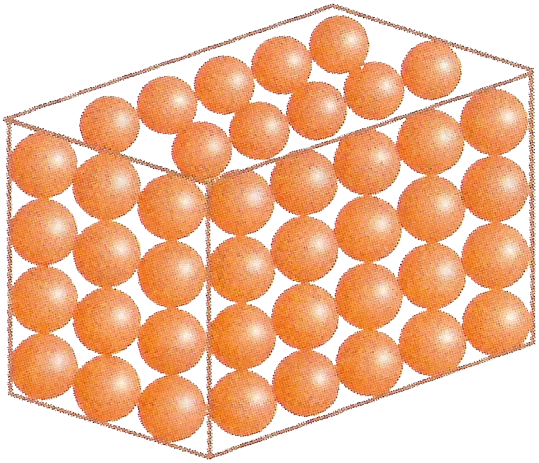
Each solid is made up of very tiny particles called molecules that are in a rigid arrangement.
The inter-molecular space is very small in case of solids.
The molecules in a solid can only vibrate to and fro about their mean positions. They do not leave their positions.
The molecules in a solid are closely packed due to strong inter-molecular force of attraction between them.
Solids have definite shape and volume.
Molecular Model of Liquids
The molecular model of liquids is shown in the figure below:
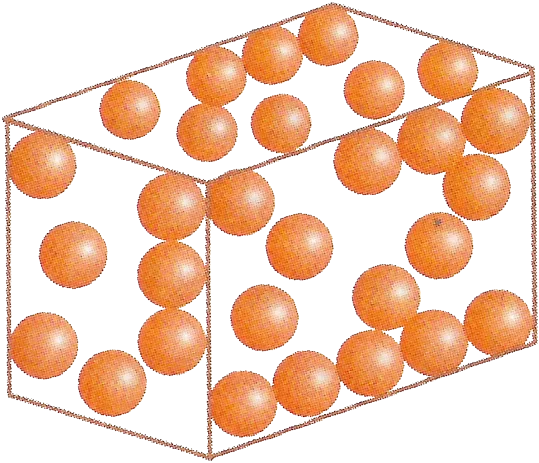
Each liquid is made up of very tiny particles called molecules that are not in a rigid arrangement.
The inter-molecular spaces in liquids are more than that in solids.
The molecules in a liquid are less closely packed and their positions are not fixed as they are free to move within the boundary of the vessel in which the liquid is kept.
Although the inter-molecular force of attraction is weak as compared to solids but it is sufficient to keep them within the boundary of the vessel.
Liquids have definite volume but no definite shape.
Molecular Model of Gases
The molecular model of gases is shown in the figure below:
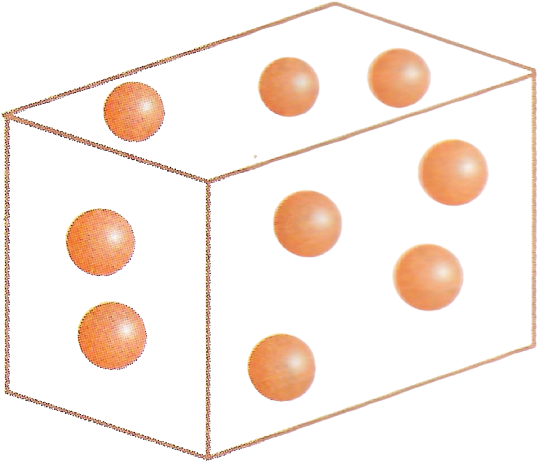
Gases are made up of very tiny particles called molecules that are not in a rigid arrangement.
In gases the inter-molecular space is maximum and the force of attraction is least as compared to solids and liquids.
The position of these molecules are not fixed. The molecules can move randomly anywhere due to weak inter-molecular forces.
Gases have neither definite shape nor definite volume.
Question 2What do you mean by 'the change of state'? Write the flowchart showing the complete cycle of change of...
What do you mean by 'the change of state'? Write the flowchart showing the complete cycle of change of state of matter.
The process of change from one state to another state either by absorption or rejection of heat at a constant temperature is called change of state.
Flowchart showing the complete cycle of change of state is shown below:
Question 3Differentiate between melting point and boiling point, giving at least one example of each.
Differentiate between melting point and boiling point, giving at least one example of each.
| Sl. No. | Melting point | Boiling point |
|---|---|---|
| 1 | The temperature at which a solid changes into liquid without further increase in temperature is called the melting point of the solid. | The temperature at which a liquid changes into vapour without further increase in temperature is called the boiling point of the liquid. |
| 2 | Ice (solid) changes into water (liquid) at 0°C by absorbing heat. | Water (liquid) changes into steam (gas) at 100°C by absorbing heat. |
Question 4Describe the process of condensation and sublimation with examples.
Describe the process of condensation and sublimation with examples.
The change from vapour state to liquid state at a constant temperature on releasing heat (or on cooling) is called condensation.
Example — Steam (gas) at 100°C condenses to water (liquid) at 100°C on cooling (i.e. by rejecting heat).
Sublimation is the process by which a solid when heated directly changes into its vapour (gaseous state) without first changing into liquid.
Example — When camphor (solid) is heated it directly changes into its vapours (gaseous state).
Question 5Explain the terms melting and melting point.
Explain the terms melting and melting point.
The change from solid state to liquid state on heating at a fixed temperature is called melting.
The temperature at which a solid changes into liquid without further increase in temperature is called the melting point of the solid.
Example — Ice (solid) at 0°C melts to form water (liquid) at 0°C by absorbing heat.
Question 6Describe an experiment to demonstrate that a substance absorbs heat during melting without change in i...
Describe an experiment to demonstrate that a substance absorbs heat during melting without change in its temperature.
The following experiment demonstrates that a substance absorbs heat during melting without change in its temperature —
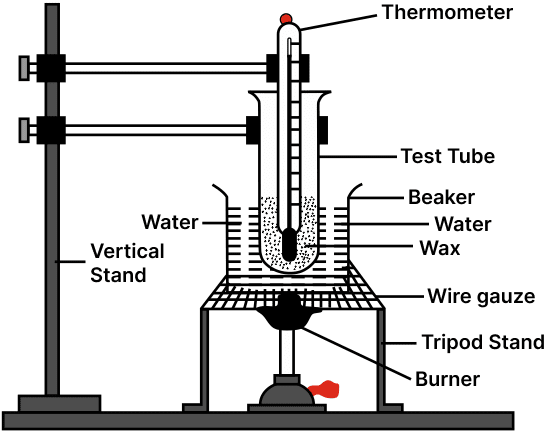
Take a test tube with some wax in it.
Clamp the test tube in a vertical stand and place the test tube in a beaker of water.
Place the beaker on a wire gauze which is kept on a tripod stand.
Clamp a thermometer in the same vertical stand and insert the thermometer in the test tube such that the bulb of the thermometer is inside the wax as shown in the figure above.
Heat the beaker over the flame of a burner.
Record the temperature of the wax from the thermometer after every minute.
Observations:
| Time (minute) | Temperature of wax (°C) |
|---|---|
| 0 | 25 |
| 1 | 30 |
| 2 | 35 |
| 3 | 40 |
| 4 | 45 |
| 5 | 50 |
| 6 | 55 |
| 7 | 55 |
| 8 | 55 |
| 9 | 55 |
| 10 | 60 |
| 11 | 65 |
| 12 | 70 |
Conclusion: From the above observations, we can conclude that wax melts at 55°C during which heat is supplied but the temperature does not rise. Hence, wax absorbs heat during melting without change in its temperature.
Question 7Explain the terms vaporization and boiling point.
Explain the terms vaporization and boiling point.
The change from liquid state to gaseous state on heating at a constant temperature by absorption of heat is called vaporization.
The temperature at which a liquid changes into vapour without further increase in temperature is called the boiling point of the liquid.
Example — Water (liquid) at 100°C changes into steam (gas) at 100°C by absorbing heat.
Question 8Describe an experiment to demonstrate that water absorbs heat during boiling at a constant temperature.
Describe an experiment to demonstrate that water absorbs heat during boiling at a constant temperature.
The following experiment demonstrates that water absorbs heat during boiling at a constant temperature —
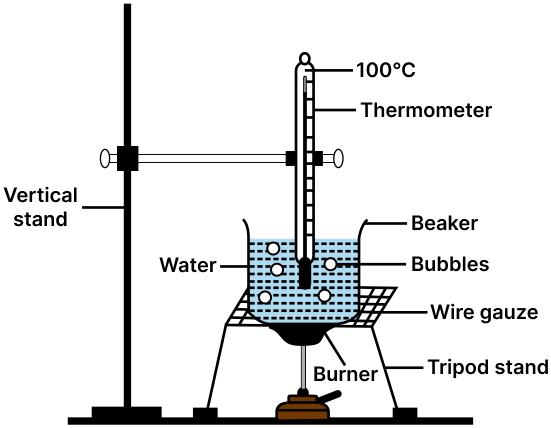
Take a beaker and pour some water in it.
Place the beaker on a wire gauze placed over a tripod stand.
Clamp a thermometer in a vertical stand and insert it in the beaker.
Heat the beaker over the flame of a burner.
Record the temperature of water after every minute.
Observation — The temperature of water gradually rises and when it reaches 100°C, water starts boiling. Once the water starts boiling, its temperature does not rise any further, although heat is still being supplied.
Conclusion — From the above experiment we can conclude that, at 100°C water begins to boil and changes into steam by absorbing the heat being supplied to it without further rise in temperature.
Question 9Wet clothes dry more quickly on a warm dry day than on a cold humid day. Explain.
Wet clothes dry more quickly on a warm dry day than on a cold humid day. Explain.
Evaporation depends upon the presence of moisture or humidity and temperature. Rate of evaporation is faster in dry air than in humid air. It also increases with increase in temperature. So wet clothes dry more quickly on a warm dry day than on a cold humid day.
Question 10Explain with an example that when a liquid evaporates, it takes heat from its surroundings.
Explain with an example that when a liquid evaporates, it takes heat from its surroundings.
If some alcohol (or spirit) is poured on some cotton (or wool) wrapped around the bulb of a thermometer, the reading of the thermometer falls. The reason for this observation is that, to evaporate, alcohol requires heat which it absorbs from the cotton wrapped around the thermometer (its surroundings) producing a cooling effect that is recorded by the thermometer as a fall in temperature.
Question 11Explain why in hot summer days water remains cool in earthen pots?
Explain why in hot summer days water remains cool in earthen pots?
Water seeps out on the surface through the pores in the earthen pot and it evaporates. The heat required for evaporation is taken from water inside the pot which therefore gets cooled.
Question 12Describe an experiment to demonstrate the process of sublimation.
Describe an experiment to demonstrate the process of sublimation.
The process of sublimation is demonstrated by the following experiment —
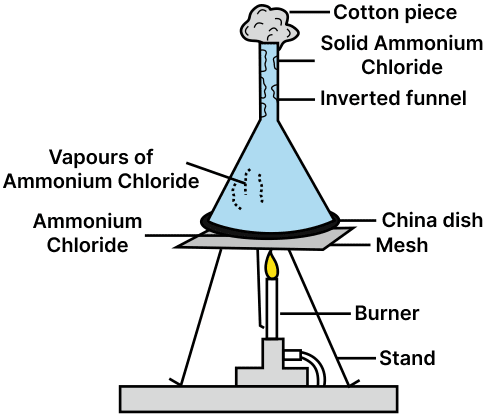
Take some ammonium chloride and powder it.
Keep the powder in a china dish.
Cover the china dish with an inverted funnel as shown in the figure.
Close the end of the funnel with a piece of cotton.
Place the china dish on a wire mesh kept on a tripod stand and heat it by a burner.
Observations — We will observe that vapours of ammonium chloride are formed in the inverted funnel above the dish. These vapours upon rising, get cooled and change to solid ammonium chloride which gets deposited on the inner walls of the inverted funnel.
Conclusion — Ammonium chloride on heating changes directly into gaseous state and when these vapours are cooled they get converted back into solid state. This demonstrates the process of sublimation.
Exercise 1
Think and Answer
Question 1Some ice is taken in a beaker and its temperature is recorded after each one minute interval. The obse...
Some ice is taken in a beaker and its temperature is recorded after each one minute interval. The observations are listed below:
| Time (minute) | Temperature (°C) |
|---|---|
| 0 | 0 |
| 1 | 0 |
| 2 | 0 |
| 3 | 0 |
| 4 | 0 |
| 5 | 0 |
| 6 | 3.8 |
| 7 | 7.6 |
| 8 | 11.4 |
From the above observations what conclusion do you draw about the melting point of the ice?
From the above observations it is concluded that the melting point of ice is 0°C.
At 0°C ice starts melting by absorbing heat without any rise in its temperature. After 5 minutes, when the whole ice melts into water, the temperature of this water starts rising further.
Question 2Water in a dish evaporates faster than in a bottle. Give reason.
Water in a dish evaporates faster than in a bottle. Give reason.
Rate of evaporation increases with increase in area of the exposed surface. So water in a dish evaporates faster than in bottle as the area exposed in dish is more than that in bottle.
Question 3A patient suffering from high fever is advised to put wet cloth strips on his forehead. Why?
A patient suffering from high fever is advised to put wet cloth strips on his forehead. Why?
A patient suffering from high fever is advised to put wet cloth strips on his forehead because when water from cloth strips evaporates it takes away heat from the body of the patient thus reducing the temperature of the body.
Question 4When we put some acetone or petrol on our palm, it feels cold. Give reason.
When we put some acetone or petrol on our palm, it feels cold. Give reason.
Acetone or petrol evaporates quickly when applied to the palm so the liquid particles absorb heat energy from the skin to overcome intermolecular forces and escape into the air and this absorption of heat from the palm causes a cooling sensation.
Question 5On a humid day, you sweat more and feel less cool in comparison to a breezy day where sweating makes y...
On a humid day, you sweat more and feel less cool in comparison to a breezy day where sweating makes you feel much cooler. Give reason.
On a humid day, the air already contains a high amount of moisture, so the rate of evaporation of sweat from the skin is slower. Since evaporation causes cooling, less evaporation means less cooling effect. On a breezy day, the dry moving air enhances the evaporation of sweat, which draws more heat from the body and makes us feel cooler.
Question 6A certain quantity of water is heated from 20°C to 100°C. Its temperature is recorded after each 1 min...
A certain quantity of water is heated from 20°C to 100°C. Its temperature is recorded after each 1 minute. The observations are:
| Time (minute) | Temperature (°C) |
|---|---|
| 0 | 20 |
| 1 | 30 |
| 2 | 40 |
| 3 | 50 |
| 4 | 60 |
| 5 | 70 |
| 6 | 80 |
| 7 | 90 |
| 8 | 100 |
| 9 | 100 |
| 10 | 100 |
| 11 | 100 |
| 12 | 100 |
What conclusion do you draw from the above table about the boiling point of water? Explain.
From the above table it is concluded that the boiling point of water is 100°C.
At 100°C, water begins to boil and changes into steam by absorbing the heat being supplied to it without further rise in temperature.
Exercise 1
Case Study
Question 1A group of students went out on a scout camp in a hilly area. The nights were extremely cold. During t...
A group of students went out on a scout camp in a hilly area. The nights were extremely cold. During the camp, Adit noticed several things:
(I) During dinner, steam rising from the hot soup quickly turned into tiny droplets in the cold air.
(II) A thin layer of frost formed on their tents every night even though there was no dew.
(III) The wet towel Adit left outside became stiff and frozen by early morning.
(IV) When they exhaled warm breath into the cold air, a white cloud formed instantly and disappeared just as quickly.
(V) Metal chairs kept outside the tents appeared wet early in the mornings.
Answer the following :
(i) Identify the process responsible for steam turning into droplets.
(ii) Which change of state leads to frost formation? Explain briefly.
(iii) Using kinetic theory, explain why Adit's wet towel became stiff and frozen.
(iv) Why did a white cloud appear when they exhaled?
(v) Why did the metal chairs appear wet in the morning?
(i) The process is condensation. When steam or water vapour from the hot soup came in contact with the cold air, it lost heat and changed into tiny liquid water droplets.
(ii) Frost is formed by deposition. In this process, water vapour present in the air changes directly into ice without first becoming liquid water. This happens when the surface temperature is below 0°C.
(iii) According to kinetic theory, the water molecules in the wet towel had kinetic energy and were moving randomly. As the temperature fell below 0°C, their kinetic energy decreased. The molecules became arranged in fixed positions to form ice. Hence, the towel became stiff and frozen.
(iv) Exhaled breath contains warm water vapour. When it came in contact with the cold air, the water vapour condensed into tiny water droplets, forming a white cloud. The cloud disappeared quickly as the droplets evaporated or dispersed in the surrounding air.
(v) The metal chairs appeared wet due to condensation. During the night, the metal surface became very cold. When water vapour from the surrounding air came in contact with the cold metal surface, it condensed into tiny water droplets, making the chairs appear wet.
Frequently Asked Questions
Quick revision answers for the most important ideas in this chapter.
What is matter?
Matter is anything that has mass, occupies space and can be perceived by our senses. It is made of tiny particles called molecules.
How do intermolecular spaces vary in solids, liquids and gases?
Intermolecular space is least in solids, greater in liquids and maximum in gases.
What is evaporation?
Evaporation is the change of a liquid into vapour from its surface at all temperatures.
What is the difference between evaporation and boiling?
Evaporation occurs only at the surface and at all temperatures, while boiling occurs throughout a liquid at a fixed temperature.
Why does evaporation cause cooling?
The faster molecules absorb heat from the liquid and surroundings to escape, lowering the temperature of what remains.
What is sublimation?
Sublimation is the direct change of a solid into vapour without passing through the liquid state.
What are the melting point of ice and boiling point of water?
At standard atmospheric pressure, ice melts at 0°C and water boils at 100°C.
Why does water boil at a lower temperature at high altitudes?
Atmospheric pressure is lower at high altitudes, so water reaches its boiling condition below 100°C.





0 Comments