
Physical Quantities and Measurement
Interactive objective questions, short and long answers, solved numericals, a crossword, a thinking question, and a case study—carefully formatted for clear learning on mobile and desktop.
Find a Question
Showing all 52 questions.
Study Progress
0 of 52 questions studied
Text Size
Adjust the lesson without changing your browser settings.
Formula Calculator
Choose a relationship, enter values in compatible units, and check the calculated result.
Objective Type Questions
Tap a question to open it, then reveal the answer when you are ready.
One litre is equal to:
10−3 m3
Reason — 1 litre = 10−3 m3
A metallic piece displaces water of volume 15 mL. The volume of piece is:
15 cm3
Reason — Volume of body is equal to volume of liquid displaced = 15 mL.
Since
1 mL = 1 cm3,
So
15 mL = 15 cm3
Hence, the volume of piece is 15 cm3.
A piece of paper of dimensions 1.5 m × 20 cm has area:
0.3 m2
Reason — 20 cm = 0.2 m
Area of paper = 1.5 m × 0.2 m = 0.3 m2
Hence, the area of the paper is 0.3 m2.
The correct relation is:
M = d × V
Reason — Mass = Volume × density
The density of alcohol is 0.8 g cm−3. In S.I. unit, it will be:
800 kg m−3
Reason — As
1 g cm−3 = 1000 kg m−3
Then
0.8 g cm−3 = 0.8 × 1000 = 800 kg m−3
The density of aluminium is 2.7 g cm−3 and of brass is 8.4 g cm−3. For the same mass, the volume of:
aluminium will be more than that of brass
Reason — For a given mass of a substance, volume is inversely proportional to density.
As density of aluminium is less than that of brass, so volume of aluminium will be more than that of brass.
A block of wood of density 0.8 g cm−3 has a volume of 60 cm3. The mass of block will be:
48 g
Reason — Given,
So, mass of block is 48 g.
The correct relation for speed is:
Answer: Speed = distancetime
Reason: Speed of a body = distance travelled by the bodytime of travel
A boy travels a distance of 150 m in 1 minute. His speed is:
Answer: 2.5 m s−1
Given: Distance = 150 m; time = 1 minute = 60 s.
Hence, the speed of the boy is 2.5 m s−1.
The density of a substance ............... with the increase in the temperature.
decreases
Reason — When a substance is heated, its particles move faster and spread farther apart, causing the substance to expand so its volume increases.
Since density is defined as mass ÷ volume and the mass remains the same while the volume increases, the density decreases.
Hence, the density of a substance decreases with the increase in the temperature.
Assertion (A): The density of water decreases when it is cooled from 4 °C to 0 °C.
Reason (R): Volume of water increases on cooling from 4 °C to 0 °C.
Answer: Both A and R are true and R is the correct explanation of A.
Assertion (A) is true because water shows anomalous expansion between 4 °C and 0 °C, so its density decreases.
Reason (R) is true because the volume of water increases as it cools from 4 °C to 0 °C.
With mass constant, an increase in volume causes density to decrease. Therefore, R correctly explains A.
Fill in the blanks:
(a) 1 m3 = ............... cm3.
(b) The volume of an irregular solid is determined by the method of ............... .
(c) Volume of a cube = ............... .
(d) The area of an irregular lamina is measured by using a ............... .
(e) Equal masses of different substances have different ............... .
(f) The S.I. unit of density is ............... .
(g) 1 g cm−3 = ............... kg m−3.
(h) 36 km h−1 = ............... m s−1.
(i) Speed of a vehicle at a particular instant is shown by ............... .
(a) 1 m3 = 106 cm3.
(b) The volume of an irregular solid is determined by the method of displacement of liquid.
(c) Volume of a cube = (one side)3.
(d) The area of an irregular lamina is measured by using a graph paper.
(e) Equal masses of different substances have different volumes.
(f) The S.I. unit of density is kg m−3.
(g) 1 g cm−3 = 1000 kg m−3.
(h) 36 km h−1 = 10 m s−1.
(i) Speed of a vehicle at a particular instant is shown by speedometer.
Write true or false for each statement:
(a) The S.I. unit of volume is litre.
(b) A measuring beaker of capacity 200 mL can measure only the volume of 200 mL of a liquid.
(c) cm2 is a smaller unit of area than m2.
(d) Equal volumes of two different substances have equal masses.
(e) The S.I. unit of density is g cm−3.
(f) 1 g cm−3 = 1000 kg m−3.
(g) The density of water is maximum at 4 °C.
(h) The speed 5 m s−1 is less than 25 km h−1.
(i) The S.I. unit of speed is m s−1.
(a) False
Correct Statement — The S.I. unit of volume is cubic metre (m3).
(b) True
(c) True
(d) False
Correct Statement — Equal volumes of two different substances have different masses.
(e) False
Correct Statement — The S.I. unit of density is kg m−3.
(f) True
(g) True
(h) True
(i) True
Match the following:
| Column A | Column B |
|---|---|
| (a) Volume of a liquid | (i) kg m−3 |
| (b) Area of a leaf | (ii) m3 |
| (c) S.I. unit of volume | (iii) graph paper |
| (d) S.I. unit of density | (iv) m s−1 |
| (e) S.I. unit of speed | (v) measuring cylinder |
| Column A | Column B |
|---|---|
| (a) Volume of a liquid | (v) measuring cylinder |
| (b) Area of a leaf | (iii) graph paper |
| (c) S.I. unit of volume | (ii) m3 |
| (d) S.I. unit of density | (i) kg m−3 |
| (e) S.I. unit of speed | (iv) m s−1 |
Short Answer Type Questions
Tap a question to open it, then reveal the answer when you are ready.
Define the term volume of an object.
The space occupied by an object is called its volume.
State and define the S.I. unit of volume.
The S.I. unit of volume is cubic metre (m3).
One cubic metre is the volume of a cube with each side 1 metre long.
State two smaller units of volume. How are they related to the S.I. unit?
The two smaller units of volume are cubic centimetre (cm3) and cubic decimetre (dm3).
So, 1 m3 = 106 cm3
So, 1 m3 = 103 dm3
How will you determine the volume of a cuboid? Write the formula you will use.
The volume of a cuboid is determined by finding its three dimensions i.e., length, breadth and height.
The formula for volume of cuboid is length × breadth × height
You are required to take out 200 mL of milk from a bucket full of milk. How will you do it?
A measuring beaker of 200 mL is used to measure 200 mL of milk from a bucket full of milk.
Define the term density of a substance.
The density of a substance is defined as the mass of a unit volume of that substance.
State the S.I. and C.G.S. units of density. How are they related?
The S.I. unit of density is kg m−3 and its C.G.S. unit is g cm−3.
1 g cm−3 = 1000 kg m−3.
'The density of brass is 8.4 g cm−3'. What do you mean by the statement?
The statement means one cubic centimeter volume of brass has mass of 8.4 g.
Arrange the following substances in order of their increasing density:
Cork < Water < Iron < Brass < Mercury.
How does the density of water change when:
(a) it is heated from 0 °C to 4 °C,
(b) it is heated from 4 °C to 10 °C ?
(a) Water when heated from 0°C to 4°C, it contracts so density of water increases and becomes maximum at 4°C.
(b) When water is heated from 4°C to 10°C it expands, so density decreases.
Write the density of water at 4 °C.
The density of water at 4°C is 1 g cm−3 or 1000 kg m−3.
Explain the meaning of the term speed.
Speed of the body is distance travelled by the body in unit time. It tells us about the motion of the body i.e. how fast or slow it is moving.
Write the S.I. unit of speed.
The S.I. unit of speed is metre per second (m s−1).
A car travels at 12 m s−1, while a scooter travels at 36 km h−1. Which travels faster?
Given: Speed of car = 12 m s−1; speed of scooter = 36 km h−1.
Since 10 m s−1 < 12 m s−1, the car travels faster than the scooter.
Long Answer Type Questions
Tap a question to open it, then reveal the answer when you are ready.
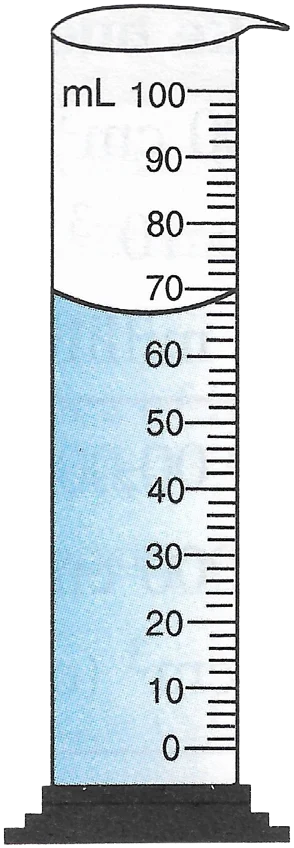
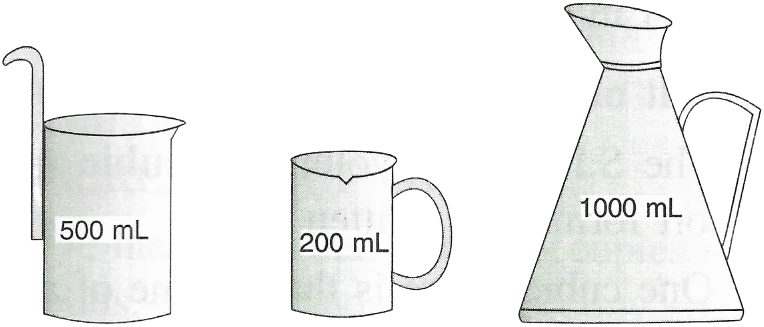
Name two devices which are used to measure the volume of an object. Draw their neat diagrams.
The two devices which are used to measure the volume of an object are:
Measuring cylinder
Measuring beaker
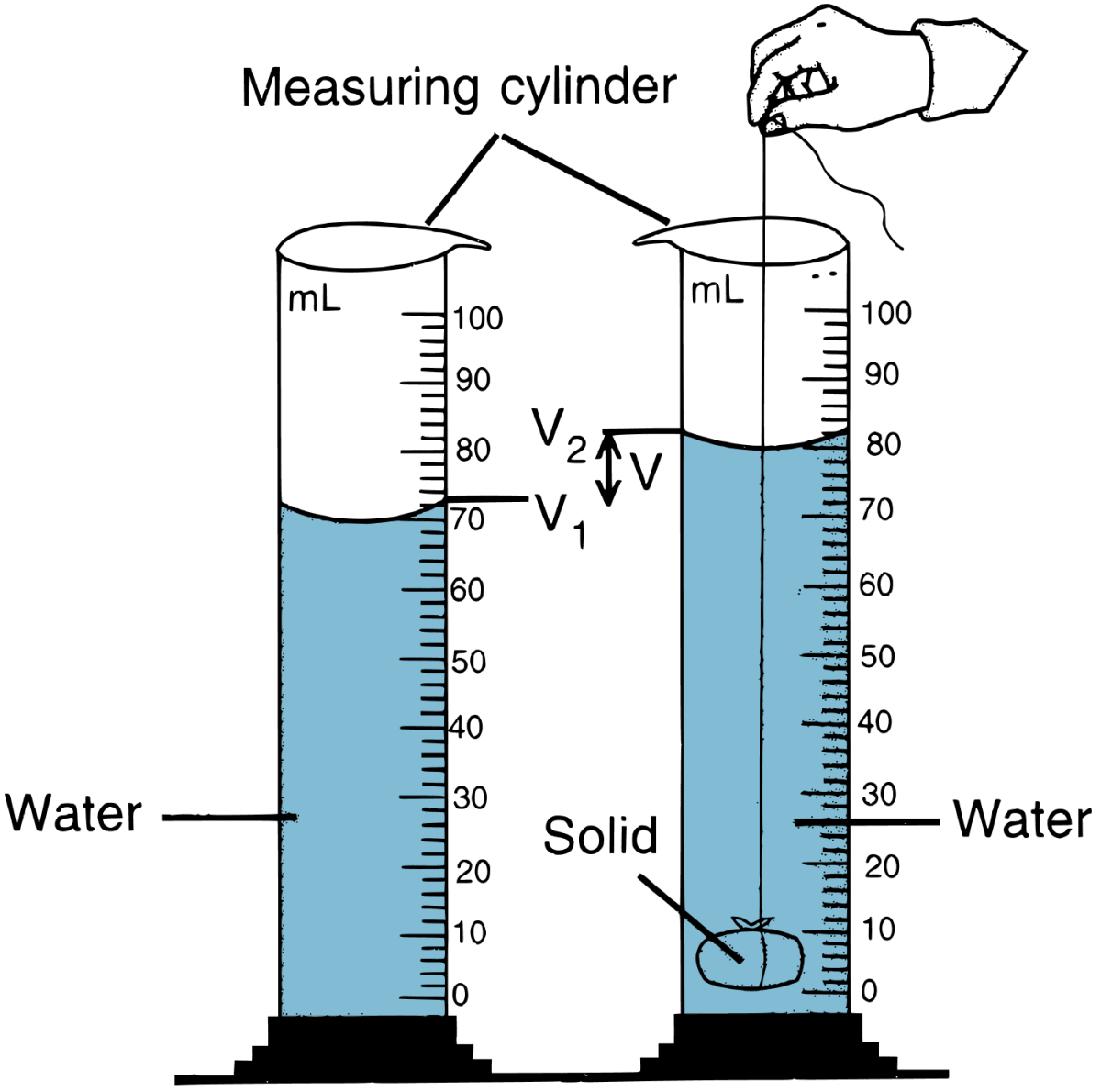
How can you determine the volume of an irregular solid (say a piece of brass)? Describe in steps with neat diagrams.
The volume of an irregular solid can be measured by using a measuring cylinder by the method of displacement of liquid.
Place a measuring cylinder on a flat horizontal surface.
Fill it partially with water.
Note the reading of water level very carefully. Let it be V1.
Now tie the piece of brass with a thread and dip it completely into water.
The level of water rises. Note the reading of new water level V2. The difference in the two levels of water gives the volume of the piece of brass.
Describe the method in steps to find the area of an irregular lamina using a graph paper.
To find the area of an irregular lamina using a graph paper.
Place the lamina over a graph paper.
Draw its boundary line on the graph paper with a pencil.
Remove the lamina.
Count and note the number of complete squares, half squares and more than half squares within the boundary line. Ignore the squares which are less than half.
The sum of the areas of the number of complete squares and the number of incomplete squares gives the approximate area of the irregular object.
Numericals
Tap a question to open it, then reveal the answer when you are ready.
The length, breadth and height of a water tank are 5 m, 2.5 m and 1.25 m respectively. Calculate the capacity of the water tank in:
(a) m3
(b) litre
Given,
So, capacity of water tank is 15.625 m3
(b) As
1 m3 = 1000 L
15.625 m3 = 15.625 × 1000 = 15625 L
So, capacity of water tank in litres is 15,625 L
A solid silver piece is immersed in water contained in a measuring cylinder. The level of water rises from 50 mL to 62 mL. Find the volume of silver piece.
Given,
So, volume of silver piece is 12 cm3.
Find the volume of a liquid present in a dish of dimensions 10 cm × 10 cm × 5 cm.
Given,
Now,
Volume of liquid = Volume of dish
= 500 cm3
Since
1 cm3 = 1 mL
Then
500 cm3 = 500 mL
So, volume of a liquid present in the dish is 500 mL.
A rectangular field is of length 60 m and breadth 35 m. Find the area of the field.
Given,
So, area of the field is 2100 m2.
Find the approximate area of an irregular lamina of which boundary line is drawn on the graph paper shown in figure below.
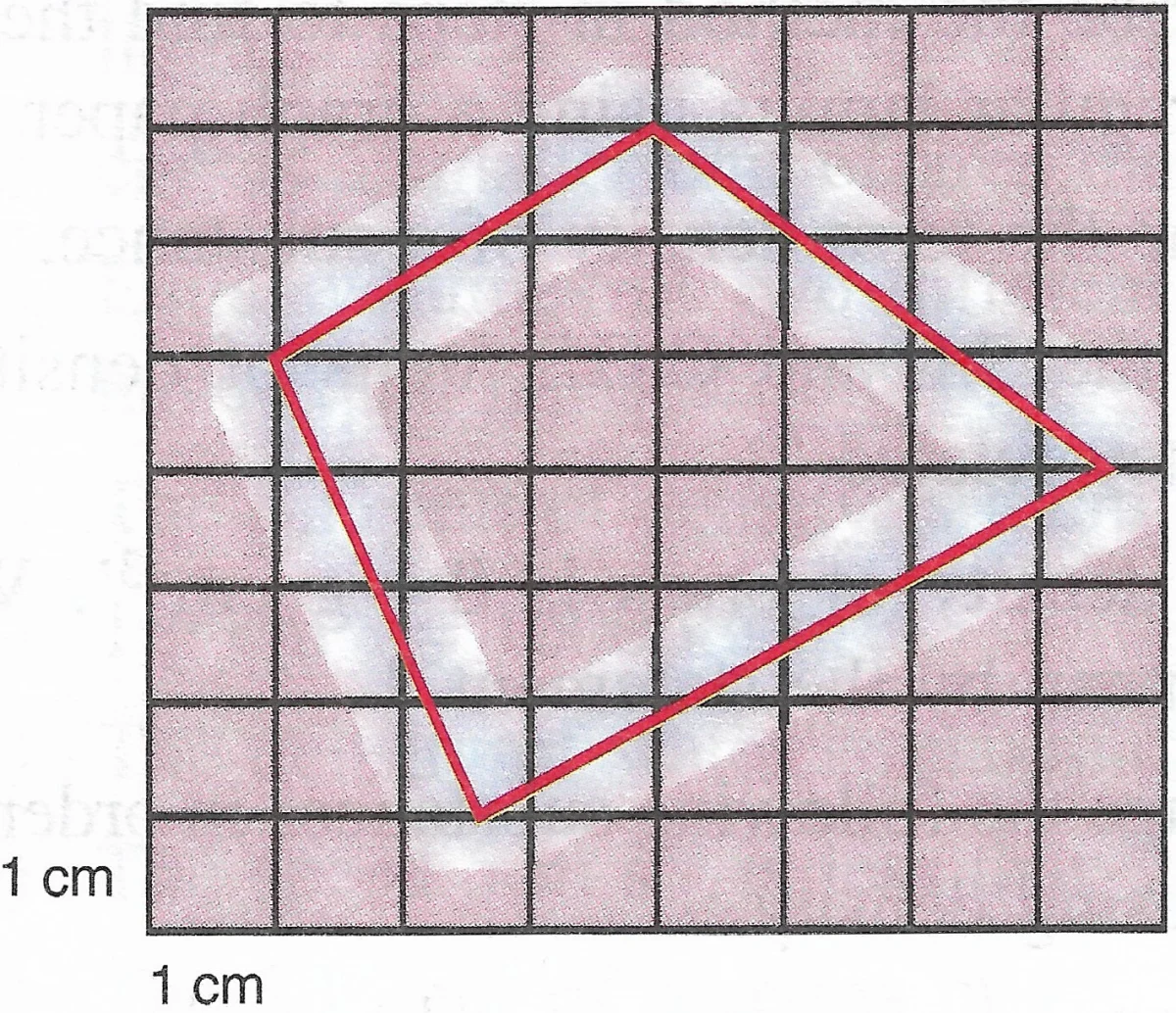
From the figure,
Total number of squares = 11 + 8 + 2 = 21
Since
Area of the square = 1 cm × 1 cm = 1 cm2
Then,
Area of 21 squares = 21 × 1 = 21 cm2
So, approximate area of lamina is 21 cm2.
A piece of brass of volume 30 cm3 has a mass of 252 g. Find its density in (i) g cm−3 and (ii) kg m−3.
Given: Mass = 252 g; volume = 30 cm3.
(i) Density = 8.4 g cm−3.
(ii) Density = 8400 kg m−3.
The mass of an iron ball is 312 g. The density of iron is 7.8 g cm−3. Find the volume of the ball.
Given: Mass = 312 g; density = 7.8 g cm−3.
So, the volume of the ball is 40 cm3.
A cork has a volume of 25 cm3. Its density is 0.25 g cm−3. Find its mass.
Given: Volume = 25 cm3; density = 0.25 g cm−3.
So, the mass of the cork is 6.25 g.
The mass of 5 litres of water is 5 kg. Find the density of water in g cm−3.
Given: Mass = 5 kg; volume = 5 L.
Since 1 kg = 1000 g and 1 L = 1000 cm3:
So, the density of water is 1 g cm−3.
A cubical tank of side 1 m is filled with 800 kg of a liquid. Find (i) the tank volume and (ii) the liquid density in kg m−3.
Given: Side = 1 m; mass of liquid = 800 kg.
(i) Tank volume = 1 m3.
(ii) Liquid density = 800 kg m−3.
A block of iron has dimensions 2 m × 0.5 m × 0.25 m. The density of iron is 7.8 g cm−3. Find its mass.
Given: Dimensions = 2 m × 0.5 m × 0.25 m; density = 7.8 g cm−3.
So, the mass of the iron block is 1950 kg.
A lead piece has a mass of 115 g. In a measuring cylinder, the water level rises from 20 mL to 30 mL. Find (i) its volume and (ii) its density in kg m−3.
Given: Mass = 115 g; initial volume V1 = 20 mL; final volume V2 = 30 mL.
(i) Volume = 10 cm3.
(ii) Density = 11500 kg m−3.
The density of copper is 8.9 g cm−3. What will be its density in kg m−3?
Given,
Density of copper = 8.9 g cm−3
As
1 g cm−3 = 1000 kg m−3
Then
8.9 g cm−3 = 8.9 × 1000 = 8900 kg m−3
So, density of copper = 8900 kg m−3
A car travels 15 km in 20 minutes. Find its speed in (i) km h−1 and (ii) m s−1.
Given: Distance = 15 km; time = 20 min.
(i) Speed = 45 km h−1.
(ii) Speed = 12.5 m s−1.
How long will a train take to travel 200 km at 60 km h−1?
Given: Distance = 200 km; speed = 60 km h−1.
One-third of an hour = 20 minutes. Therefore, the train takes 3 h 20 min.
A boy travels at 10 m s−1 for 30 minutes. How much distance does he travel?
Given: Speed = 10 m s−1; time = 30 min = 1800 s.
So, the distance travelled is 18000 m = 18 km.
Express 36 km h−1 in m s−1.
Therefore, 36 km h−1 = 10 m s−1.
Express 15 m s−1 in km h−1.
As
1 m s−1 = 3.6 km h−1
Then
15 m s−1 = 3.6 × 15 = 54 km h−1
So, 15 m s−1 = 54 km h−1
Crossword Puzzle
Tap a question to open it, then reveal the answer when you are ready.
Read the clues across and clues downwards and fill up the blank squares.
Across :
The device is used to measure the atmospheric pressure.
The area of a regular object can be found by measuring its
The S.I. unit of volume is ............... metre.
Down :
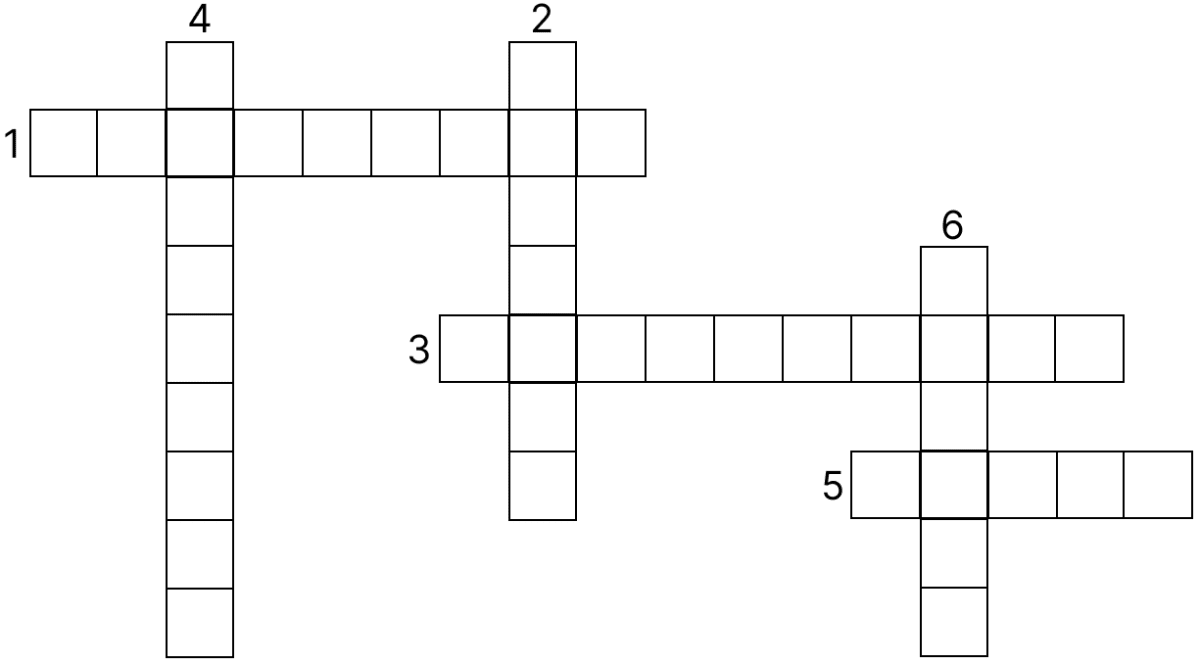
The solved crossword puzzle is given below:
Think and Answer
Tap a question to open it, then reveal the answer when you are ready.
1 kg of salt occupies more space than 1 kg of copper. Give reason.
1 kg of salt occupies more space than 1 kg of copper because the density of salt is less than that of copper. Therefore, for the same mass, salt occupies more volume, while copper, being denser, occupies less volume.
Case Study
Tap a question to open it, then reveal the answer when you are ready.
Gunjan visits a wood shop and examines wooden cubes, each measuring 5 cm × 5 cm × 5 cm. One cube has a mass of 150 g and another has a mass of 250 g.
Answer the following:
- What can she conclude about their materials?
- Calculate the density of the 250 g block.
- Which property explains why equal-sized objects can feel heavier or lighter?
- What happens to mass if another block has the same density but double the volume?
- They have the same volume but different masses, so they are made of different materials and have different densities.
- Volume = 5 × 5 × 5 = 125 cm3Density = 250125 = 2 g cm−3The density of the heavier block is 2 g cm−3.
- The property is density.
- At constant density, mass is directly proportional to volume. Doubling the volume doubles the mass, so it becomes 500 g.
Follow Speed Up Science on Instagram
Get visual science explanations, revision posts, and student-friendly learning content.
Frequently Asked Questions
Quick revision answers from this chapter.
What is the S.I. unit of volume?
The S.I. unit of volume is cubic metre, written as m³.
How is the volume of an irregular solid measured?
It is measured by the displacement of liquid using a measuring cylinder. The volume is V₂ − V₁.
What is density?
Density is the mass per unit volume of a substance. Density = mass ÷ volume.
What is the S.I. unit of density?
The S.I. unit of density is kilogram per cubic metre, written as kg m⁻³.
At what temperature is the density of water maximum?
The density of water is maximum at 4 °C.
What is the formula for speed?
Speed equals distance travelled divided by time taken.
How do you convert km h⁻¹ to m s⁻¹?
Multiply the value in km h⁻¹ by 5/18.





0 Comments