
Rational and Irrational Numbers
Complete, clean and step-by-step solutions for Exercise 1(A), Exercise 1(B), Exercise 1(C), Test Yourself and the case-study questions.
\(p/q\), where \(p,q\in\mathbb Z\) and \(q\ne0\).
In lowest form, the denominator must be \(2^m5^n\).
A non-terminating, non-recurring decimal.
For \(a+b\sqrt c\), use \(a-b\sqrt c\).
Exercise 1(A)
Rational numbers, decimal expansions, ordering and the terminating-decimal test.
Question 1(a)
SolvedLet \(0=\dfrac{p}{q}\), where \(p\) and \(q\) are integers. What additional condition makes it a rational number?
View step-by-step solution+
A rational number has the form \(\dfrac{p}{q}\), where \(p,q\in\mathbb Z\) and the denominator is non-zero.
Correct option: C — \(q\ne0\).
Question 1(b)
SolvedEvery non-terminating decimal number is a:
View step-by-step solution+
A non-terminating decimal may be recurring (rational) or non-recurring (irrational), but in both cases it is a real number.
Correct option: B — real number.
Question 1(c)
Solved\(7.478478478\ldots\) is a:
View step-by-step solution+
The block \(478\) repeats continuously:
Therefore, it is a recurring decimal and hence rational.
Correct option: B.
Question 1(d)
SolvedClassify \(\dfrac{71}{75}\).
View step-by-step solution+
The decimal is recurring (periodic).
Correct option: C.
Question 1(e)
SolvedWhich of the following fractions has a terminating decimal expansion?
View step-by-step solution+
After reducing a fraction, its decimal terminates only when the denominator contains no prime factor other than \(2\) and \(5\).
Each denominator has a prime factor other than \(2\) or \(5\).
Correct option: D — none of these.
Question 2
SolvedState whether each statement is true or false, with a reason.
- Every whole number is a natural number.
- Every whole number is a rational number.
- Every integer is a rational number.
- Every rational number is a whole number.
View step-by-step solution+
- False. \(0\) is a whole number but, under the convention used here, it is not a natural number.
- True. Every whole number \(n\) can be written as \(\dfrac{n}{1}\).
- True. Every integer \(z\) can be written as \(\dfrac{z}{1}\).
- False. For example, \(\dfrac25\) is rational but is not a whole number.
Question 3
SolvedArrange \(-\dfrac59,\;\dfrac7{12},\;-\dfrac23,\;\dfrac{11}{18}\) in ascending order. Also find the difference between the largest and smallest numbers, correct to one decimal place.
View step-by-step solution+
The LCM of \(9,12,3,18\) is \(36\).
Therefore,
Difference between the largest and smallest:
Answer: \(-\dfrac23<-\dfrac59<\dfrac7{12}<\dfrac{11}{18}\); difference \(=1.3\).
Question 4
SolvedArrange \(\dfrac58,\;-\dfrac3{16},\;-\dfrac14,\;\dfrac{17}{32}\) in descending order. Find the sum of the largest and smallest numbers, correct to two decimal places.
View step-by-step solution+
The LCM of \(8,16,4,32\) is \(32\).
Sum of the largest and smallest:
Answer: \(\dfrac58>\dfrac{17}{32}>-\dfrac3{16}>-\dfrac14\); sum \(=0.38\).
Question 5
SolvedWithout actual division, identify which fractions have terminating decimal representations:
- \(\dfrac7{16}\)
- \(\dfrac{23}{125}\)
- \(\dfrac9{14}\)
- \(\dfrac{32}{45}\)
- \(\dfrac{43}{50}\)
View step-by-step solution+
In lowest form, a rational number terminates exactly when its denominator is \(2^m5^n\), where \(m,n\) are non-negative integers.
Terminating fractions: \(\dfrac7{16},\dfrac{23}{125},\dfrac{43}{50}\).
Exercise 1(B)
Irrational numbers, surd expressions, number sets and proof-based questions.
Question 1(a)
SolvedThe negative of an irrational number is:
View step-by-step solution+
If \(x\) is irrational and \(-x\) were rational, then \(x=-(-x)\) would also be rational, a contradiction.
Correct option: B — an irrational number.
Question 1(b)
Solved\(\sqrt8(\sqrt8-1)\) is always:
View step-by-step solution+
Since \(\sqrt8\) is irrational, \(8-\sqrt8\) is irrational.
Correct option: B.
Question 1(c)
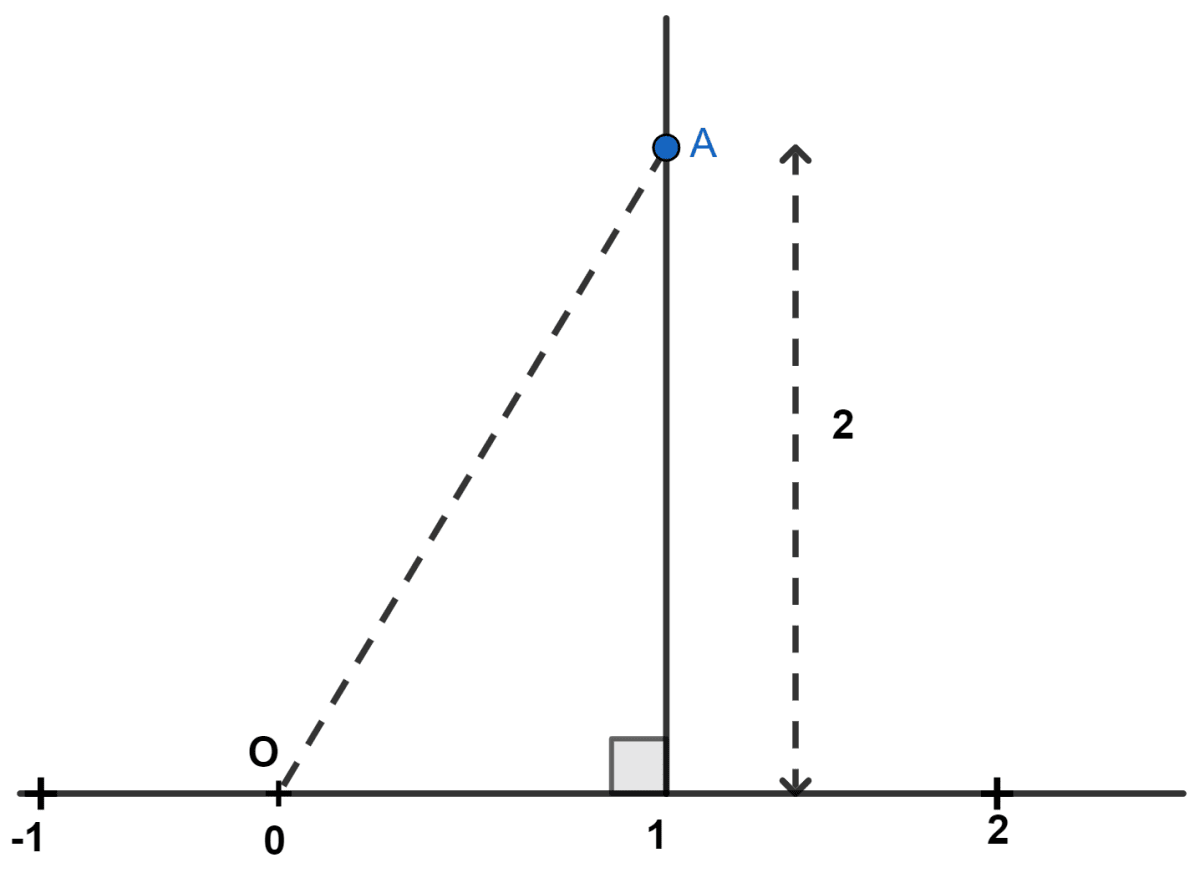
SolvedIn the given right-triangle figure, \(OB=1\) unit and \(AB=2\) units. Find \(OA\).
View step-by-step solution+
By Pythagoras’ theorem:
Correct option: A.
Question 1(d)
SolvedClassify \(2\sqrt3\times3\sqrt8\).
View step-by-step solution+
Because \(\sqrt6\) is irrational and the coefficient is non-zero rational, the product is irrational.
Correct option: B.
Question 1(e)
SolvedChoose two irrational numbers lying between \(8\) and \(11\).
View step-by-step solution+
Both radicands are non-perfect squares, so both numbers are irrational and lie between \(8\) and \(11\).
Correct option: A.
Question 2
SolvedState whether each expression is rational or irrational.
- \((2+\sqrt2)^2\)
- \((3-\sqrt3)^2\)
- \((5+\sqrt5)(5-\sqrt5)\)
- \((\sqrt3-\sqrt2)^2\)
View step-by-step solution+
- \((2+\sqrt2)^2=4+2+4\sqrt2=6+4\sqrt2\): irrational.
- \((3-\sqrt3)^2=9+3-6\sqrt3=12-6\sqrt3\): irrational.
- \((5+\sqrt5)(5-\sqrt5)=25-5=20\): rational.
- \((\sqrt3-\sqrt2)^2=3+2-2\sqrt6=5-2\sqrt6\): irrational.
Question 3
SolvedFind the square of each expression.
- \(\dfrac{3\sqrt5}{5}\)
- \(\sqrt3+\sqrt2\)
- \(\sqrt5-2\)
- \(3+2\sqrt5\)
View step-by-step solution+
- \(\left(\dfrac{3\sqrt5}{5}\right)^2=\dfrac{45}{25}=\dfrac95=1\dfrac45\).
- \((\sqrt3+\sqrt2)^2=3+2+2\sqrt6=5+2\sqrt6\).
- \((\sqrt5-2)^2=5+4-4\sqrt5=9-4\sqrt5\).
- \((3+2\sqrt5)^2=9+20+12\sqrt5=29+12\sqrt5\).
Question 4
SolvedState whether each statement is true or false.
- \(\sqrt2+\sqrt3=\sqrt5\)
- \(2\sqrt4+2=6\)
- \(3\sqrt7-2\sqrt7=\sqrt7\)
- \(\dfrac27\) is irrational.
- \(\dfrac5{11}\) is rational.
- All rational numbers are real numbers.
- All real numbers are rational numbers.
- Some real numbers are rational numbers.
View step-by-step solution+
- False. \(\sqrt2+\sqrt3\approx3.146\), whereas \(\sqrt5\approx2.236\).
- True. \(2\sqrt4+2=2(2)+2=6\).
- True. Like surds combine: \((3-2)\sqrt7=\sqrt7\).
- False. It is of the form \(p/q\), with \(q\ne0\).
- True. It is a rational number.
- True. Rational numbers are a subset of real numbers.
- False. Real numbers also include irrational numbers.
- True. In fact, every rational number is real.
Question 5
SolvedGiven the universal set
Find the sets of (i) rational numbers, (ii) irrational numbers, (iii) integers and (iv) non-negative integers.
View step-by-step solution+
- Rational numbers: \(\left\{-6,-5\frac34,-\sqrt4,-\frac35,-\frac38,0,\frac45,1,1\frac23,3.01,8.47\right\}\). Note that \(-\sqrt4=-2\).
- Irrational numbers: \(\{\sqrt8,\pi\}\).
- Integers: \(\{-6,-\sqrt4,0,1\}=\{-6,-2,0,1\}\).
- Non-negative integers: \(\{0,1\}\).
Question 6
SolvedProve that each number is irrational.
- \(\sqrt3+\sqrt2\)
- \(3-\sqrt2\)
View step-by-step solution+
(i) Assume \(x=\sqrt3+\sqrt2\) is rational. Squaring,
The right side would be rational, but \(\sqrt6\) is irrational. This contradiction proves \(\sqrt3+\sqrt2\) is irrational.
(ii) Assume \(x=3-\sqrt2\) is rational. Then
The right side would be rational, contradicting the irrationality of \(\sqrt2\). Hence \(3-\sqrt2\) is irrational.
Question 7
SolvedWrite a pair of irrational numbers whose sum is irrational.
View step-by-step solution+
One suitable pair is \(\sqrt3+2\) and \(\sqrt2-3\).
The result is irrational.
Question 8
SolvedWrite a pair of irrational numbers whose sum is rational.
View step-by-step solution+
Take \(\sqrt3+2\) and \(5-\sqrt3\).
Thus, the sum is rational.
Question 9
SolvedWrite a pair of irrational numbers whose difference is irrational.
View step-by-step solution+
Take \(\sqrt5+5\) and \(\sqrt2+5\).
The difference is irrational.
Question 10
SolvedWrite a pair of irrational numbers whose difference is rational.
View step-by-step solution+
Take \(\sqrt3+5\) and \(\sqrt3+2\).
The difference is rational.
Question 11
SolvedWrite a pair of irrational numbers whose product is irrational.
View step-by-step solution+
Take \(\sqrt2\) and \(\sqrt3\).
Since \(6\) is not a perfect square, \(\sqrt6\) is irrational.
Question 12
SolvedWrite a pair of irrational numbers whose product is rational.
View step-by-step solution+
Take the conjugate pair \(5+\sqrt2\) and \(5-\sqrt2\).
The product is rational.
Exercise 1(C)
Rationalisation, conjugates, surds and algebraic simplification.
Question 1(a)
SolvedIf \(x=\sqrt5-2\), find \(x+\dfrac1x\).
View step-by-step solution+
Correct option: A.
Question 1(b)
SolvedIf \(x=1+\sqrt2\), find \(\left(x+\dfrac1x\right)^2\).
View step-by-step solution+
Correct option: B.
Question 1(c)
SolvedEvaluate \(\dfrac{2\sqrt{27}+3\sqrt{12}}{4\sqrt3}\).
View step-by-step solution+
Correct option: C.
Question 1(d)
SolvedExpand \((\sqrt5-\sqrt3)^2\).
View step-by-step solution+
Correct option: D.
Question 1(e)
SolvedRationalize \(\dfrac3{4+\sqrt7}\).
View step-by-step solution+
Correct option: A.
Question 1(f)
SolvedRationalize \(\dfrac1{7-\sqrt5}\).
View step-by-step solution+
Correct option: B.
Question 1(g)
SolvedIf \(x=\sqrt2-1\), find \(\left(x-\dfrac1x\right)^2\).
View step-by-step solution+
Correct option: C.
Question 1(h)
SolvedEvaluate \(\dfrac{5-\sqrt7}{5+\sqrt7}-\dfrac{5+\sqrt7}{5-\sqrt7}\).
View step-by-step solution+
Correct option: D.
Question 2
SolvedState, with reasons, which expressions are surds.
- \(\sqrt{180}\)
- \(\sqrt[4]{27}\)
- \(\sqrt[5]{128}\)
- \(\sqrt[3]{64}\)
- \(\sqrt[3]{25}\cdot\sqrt[3]{40}\)
- \(\sqrt[3]{-125}\)
- \(\sqrt\pi\)
- \(\sqrt{3+\sqrt2}\)
View step-by-step solution+
A surd is an irrational root of a rational number.
Question 3
SolvedWrite the lowest rationalizing factor of each expression.
- \(5\sqrt2\)
- \(\sqrt{24}\)
- \(\sqrt5-3\)
- \(7-\sqrt7\)
- \(\sqrt{18}-\sqrt{50}\)
- \(\sqrt5-\sqrt2\)
- \(\sqrt{13}+3\)
View step-by-step solution+
- \(\sqrt2\), since \(5\sqrt2\cdot\sqrt2=10\).
- \(\sqrt6\), since \(\sqrt{24}=2\sqrt6\) and \(2\sqrt6\cdot\sqrt6=12\).
- \(\sqrt5+3\), the conjugate.
- \(7+\sqrt7\), the conjugate.
- \(\sqrt2\), because \(\sqrt{18}-\sqrt{50}=3\sqrt2-5\sqrt2=-2\sqrt2\).
- \(\sqrt5+\sqrt2\), the conjugate.
- \(\sqrt{13}-3\), the conjugate.
Question 4
SolvedRationalize the denominators.
- \(\dfrac{2\sqrt3}{\sqrt5}\)
- \(\dfrac{\sqrt6-\sqrt5}{\sqrt6+\sqrt5}\)
View step-by-step solution+
(i)
(ii)
Question 5(i)
SolvedIf \(\dfrac{2+\sqrt3}{2-\sqrt3}=a+b\sqrt3\), find \(a\) and \(b\).
View step-by-step solution+
Comparing with \(a+b\sqrt3\):
\(a=7,\quad b=4\).
Question 5(ii)
SolvedIf \(\dfrac{\sqrt7-2}{\sqrt7+2}=a\sqrt7+b\), find \(a\) and \(b\).
View step-by-step solution+
\(a=-\dfrac43,\quad b=\dfrac{11}{3}\).
Question 5(iii)
SolvedIf \(\dfrac3{\sqrt3-\sqrt2}=a\sqrt3-b\sqrt2\), find \(a\) and \(b\).
View step-by-step solution+
Comparing with \(a\sqrt3-b\sqrt2\), we get
\(a=3,\quad b=-3\).
Question 6(i)
SolvedSimplify \(\dfrac{22}{2\sqrt3+1}+\dfrac{17}{2\sqrt3-1}\).
View step-by-step solution+
Question 6(ii)
SolvedSimplify \(\dfrac{\sqrt2}{\sqrt6-\sqrt2}-\dfrac{\sqrt3}{\sqrt6+\sqrt2}\).
View step-by-step solution+
Question 7
SolvedIf
find (i) \(x^2\), (ii) \(y^2\), (iii) \(xy\), and (iv) \(x^2+y^2+xy\).
View step-by-step solution+
Since \((\sqrt5+2)(\sqrt5-2)=1\),
- \(x^2=(9-4\sqrt5)^2=161-72\sqrt5\).
- \(y^2=(9+4\sqrt5)^2=161+72\sqrt5\).
- \(xy=1\).
- \(x^2+y^2+xy=(161-72\sqrt5)+(161+72\sqrt5)+1=323\).
Question 8
SolvedIf
find (i) \(m^2\), (ii) \(n^2\), and (iii) \(mn\).
View step-by-step solution+
Because \((3-2\sqrt2)(3+2\sqrt2)=1\),
- \(m^2=17+12\sqrt2\).
- \(n^2=17-12\sqrt2\).
- \(mn=1\).
Question 9
SolvedIf \(x=2\sqrt3+2\sqrt2\), find (i) \(1/x\), (ii) \(x+1/x\), and (iii) \((x+1/x)^2\).
View step-by-step solution+
(i)
(ii)
(iii)
Question 10
SolvedIf \(x=1-\sqrt2\), find \(\left(x-\dfrac1x\right)^3\).
View step-by-step solution+
Question 11
SolvedIf \(x=5-2\sqrt6\), find \(x^2+\dfrac1{x^2}\).
View step-by-step solution+
Question 12
SolvedUsing \(\sqrt2=1.4\) and \(\sqrt3=1.7\), evaluate each expression correct to one decimal place.
- \(\dfrac1{\sqrt3-\sqrt2}\)
- \(\dfrac1{3+2\sqrt2}\)
- \(\dfrac{2-\sqrt3}{\sqrt3}\)
View step-by-step solution+
- \(\dfrac1{\sqrt3-\sqrt2}=\sqrt3+\sqrt2\approx1.7+1.4=3.1\).
- \(\dfrac1{3+2\sqrt2}=3-2\sqrt2\approx3-2.8=0.2\).
- \(\dfrac{2-\sqrt3}{\sqrt3}=\dfrac{2\sqrt3-3}{3}\approx\dfrac{3.4-3}{3}=0.133\ldots\approx0.1\).
Question 13
SolvedEvaluate \(\dfrac{4-\sqrt5}{4+\sqrt5}+\dfrac{4+\sqrt5}{4-\sqrt5}\).
View step-by-step solution+
Question 14
SolvedIf
find \(x^2-y^2\).
View step-by-step solution+
Test Yourself
MCQs, assertions, constructions, identities and mixed revision.
Question 1(a)
SolvedSince \(90=2\times3\times3\times5\), the fraction \(\dfrac{23}{90}\) is not a terminating decimal.
View step-by-step solution+
The denominator contains the prime factor \(3\), so it is not of the form \(2^m5^n\).
Correct option: A — True.
Question 1(b)
Solved\(\sqrt{27}\) and \(\sqrt3\) are irrational. Which expression is rational?
View step-by-step solution+
Correct option: C.
Question 1(c)
SolvedIf \(x=\sqrt6-\sqrt5\), find \(x-\dfrac1x\).
View step-by-step solution+
Correct option: D.
Question 1(d)
SolvedEvaluate \(\dfrac{2+\sqrt3}{2-\sqrt3}-\dfrac{2-\sqrt3}{2+\sqrt3}\).
View step-by-step solution+
Correct option: D.
Question 1(e)
SolvedStatement 1: If \(a=3\sqrt3\) and \(b=\dfrac5{\sqrt{12}}\), then \(ab\) is irrational.
Statement 2: \(ab=\dfrac{15}{2}\).
View step-by-step solution+
The product is rational. Thus Statement 1 is false and Statement 2 is true.
Correct option: D.
Question 1(f)
SolvedStatement 1: If \(x=\sqrt5+2\), then \(x-\dfrac1x=4\).
Statement 2: \(\dfrac1x=\sqrt5-2\).
View step-by-step solution+
Both statements are true.
Correct option: A.
Question 1(g)
SolvedAssertion (A): If \(x+\dfrac1x=4\) and \(\dfrac1x=2+\sqrt3\), then \(x=2-\sqrt3\).
Reason (R): Substituting \(1/x=2+\sqrt3\) into \(x+1/x=4\) gives \(x=2-\sqrt3\).
View step-by-step solution+
Also, \(1/(2+\sqrt3)=2-\sqrt3\). Both A and R are true, and R is the correct explanation.
Correct option: C.
Question 1(h)
SolvedAssertion (A): \(\sqrt{22},\sqrt{23},\sqrt{24},\sqrt{25},\sqrt{26},\sqrt{27}\) are irrational numbers between \(\sqrt{21}\) and \(\sqrt{28}\).
Reason (R): \(\sqrt{25}=5\), which is rational.
View step-by-step solution+
Although all six values lie between \(\sqrt{21}\) and \(\sqrt{28}\), \(\sqrt{25}=5\) is rational. Therefore A is false and R is true.
Correct option: B.
Question 2
SolvedSimplify
View step-by-step solution+
Question 3
SolvedEvaluate \(\dfrac5{\sqrt{20}-\sqrt{10}}\), correct to one decimal place, using \(\sqrt5=2.2\) and \(\sqrt{10}=3.2\).
View step-by-step solution+
Use the stated approximations directly:
Answer: \(4.2\) correct to one decimal place.
Because the supplied square-root values are rounded, rationalising first and then substituting can produce a different rounded result. Direct substitution follows the wording of the question.
Question 4
SolvedIf \(x=\sqrt3-\sqrt2\), find (i) \(x+1/x\), (ii) \(x^2+1/x^2\), (iii) \(x^3+1/x^3\), and (iv) \(x^3+1/x^3-3(x^2+1/x^2)+x+1/x\).
View step-by-step solution+
Since \(1/x=\sqrt3+\sqrt2\):
- \(x+1/x=2\sqrt3\).
- \(x^2+1/x^2=(2\sqrt3)^2-2=10\).
- \(x^3+1/x^3=(x+1/x)^3-3(x+1/x)=24\sqrt3-6\sqrt3=18\sqrt3\).
- \(18\sqrt3-3(10)+2\sqrt3=20\sqrt3-30=10(2\sqrt3-3)\).
Question 5
SolvedState true or false.
- The negative of an irrational number is irrational.
- The product of a non-zero rational number and an irrational number is rational.
View step-by-step solution+
- True. Example: \(\sqrt3\) and \(-\sqrt3\) are both irrational.
- False. For example, \(2\) is non-zero rational and \(\sqrt2\) is irrational, while \(2\sqrt2\) is irrational.
Question 6
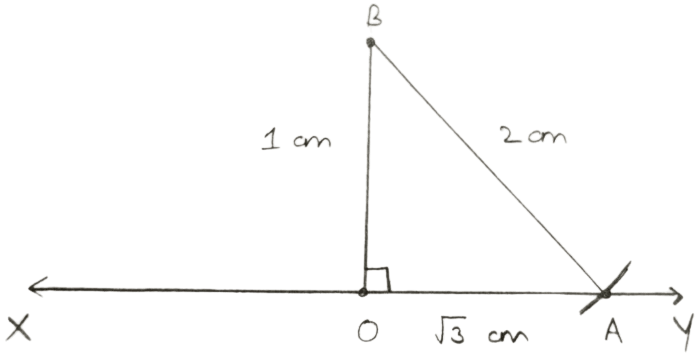
SolvedConstruct a line segment of length \(\sqrt3\) cm.
View step-by-step solution+
- Draw a straight line \(XY\) and mark a point \(O\).
- At \(O\), draw \(OB\perp XY\) with \(OB=1\) cm.
- With centre \(B\) and radius \(2\) cm, cut the line at \(A\), so \(AB=2\) cm.
- Join \(OA\).
Question 7
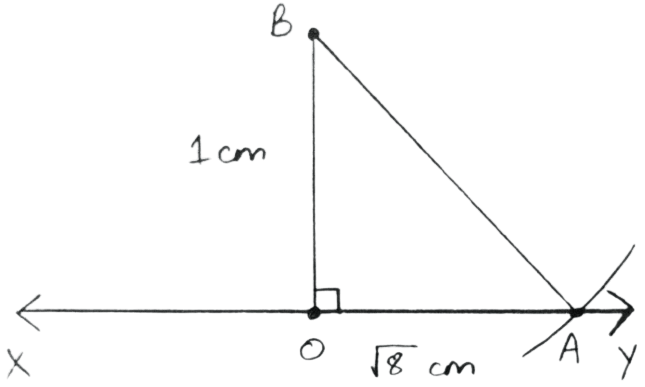
SolvedConstruct a line segment of length \(\sqrt8\) cm.
View step-by-step solution+
- Draw a straight line \(XY\) and mark \(O\).
- At \(O\), draw \(OB\perp XY\) with \(OB=1\) cm.
- With centre \(B\) and radius \(3\) cm, cut the line at \(A\), so \(AB=3\) cm.
- Join \(OA\).
Question 8(i)
SolvedShow that \(x^3+\dfrac1{x^3}=52\), if \(x=2+\sqrt3\).
View step-by-step solution+
Question 8(ii)
SolvedShow that \(x^2+\dfrac1{x^2}=34\), if \(x=3+2\sqrt2\).
View step-by-step solution+
Question 8(iii)
SolvedShow that
View step-by-step solution+
Factor \(\sqrt6\) from the first numerator and denominator:
Question 9
SolvedShow that \(x\) is irrational if (i) \(x^2=6\), (ii) \(x^2=0.009\), and (iii) \(x^2=27\).
View step-by-step solution+
- \(x=\pm\sqrt6\), irrational because \(6\) is not a perfect square.
- \(x=\pm\sqrt{0.009}=\pm\dfrac{3\sqrt{10}}{100}\), irrational.
- \(x=\pm\sqrt{27}=\pm3\sqrt3\), irrational.
Question 10
SolvedShow that \(x\) is rational if (i) \(x^2=16\), (ii) \(x^2=0.0004\), and (iii) \(x^2=1\dfrac79\).
View step-by-step solution+
- \(x=\pm4\), integers and hence rational.
- \(x=\pm0.02\), terminating decimals and hence rational.
- \(1\dfrac79=\dfrac{16}{9}\), so \(x=\pm\dfrac43\), rational.
Question 11
SolvedFind
View step-by-step solution+
For a general term,
Therefore, the series telescopes:
Case-Study Based Questions
Application-oriented questions on rationality and rationalizing factors.
Case-Study Question 1
SolvedReal numbers include rational and irrational numbers. A rational number can be written as \(p/q\), where \(p,q\) are integers and \(q\ne0\); an irrational number cannot.
- Is the difference between a rational number and an irrational number always rational?
- Is \(0.5555\ldots\) rational?
- Is \(0.5050050005\ldots\) rational?
- Is the product of \(3-\sqrt7\) and its rationalizing factor rational?
View step-by-step solution+
- No. Rational minus irrational is irrational; for example, \(2-\sqrt3\).
- Yes. \(0.5555\ldots=0.\overline5=5/9\).
- No. The decimal is non-terminating and non-recurring, so it is irrational.
- Yes. The rationalizing factor is \(3+\sqrt7\), and \((3-\sqrt7)(3+\sqrt7)=9-7=2\), which is rational.
Case-Study Question 2
SolvedUnder the Taruner Swapna Scheme of the West Bengal Government, eligible backward or economically disadvantaged students may receive financial assistance and digital devices such as smartphones or tablets to support online learning and help bridge the digital divide.
Rohan, who lives in Purulia district, receives a tablet and studies the number system through e-learning. He is particularly interested in the irrational number \(7+4\sqrt3\).
- Find its rationalizing factor.
- Find its reciprocal. Are the reciprocal and rationalizing factor the same?
- If \(x=7+4\sqrt3\), find \(x+1/x\).

View step-by-step solution+
- The rationalizing factor is the conjugate \(7-4\sqrt3\).
- \[\frac1{7+4\sqrt3}=\frac{7-4\sqrt3}{49-48}=7-4\sqrt3\]Yes. They are the same because the product of the conjugates is \(1\).
- \[x+\frac1x=(7+4\sqrt3)+(7-4\sqrt3)=14\]





0 Comments