
Disease and Hygiene
Learn communicable diseases, deficiency disorders, pathogens, vitamins and healthy habits through interactive questions and activities.

Fast learning
Quick Revision Notes
Pathogen
A disease-causing microorganism or agent, such as a bacterium, virus, fungus or protozoan.
Communicable
A disease that can spread through air, food, water, contact, droplets or disease-carrying vectors.
Non-communicable
A disease that does not spread from one person to another, such as diabetes or a deficiency disease.
Deficiency disease
An illness caused by a long-term shortage of an essential nutrient, vitamin or mineral.
Build a hygiene shield
Tick each healthy habit and complete the shield.
Test yourself
Multiple Choice Questions
Select one option for every question, then press Check my score.
Malaria is caused by:
Deficiency of Vitamin C causes:
Hay fever and asthma are:
Which one is a genetic disease?
Which one is commonly classified as a degenerative disease?
Pellagra is caused by deficiency of:
Iodine deficiency can cause:
A diet rich in carrots, yellow fruits, vegetables, butter, milk and fish can help prevent:
Which one is a communicable disease?
COVID-19 is caused by:
Which option is a lung disease that may be caused by bacteria?
Kwashiorkor is mainly caused by deficiency of:
A specific symptom of scurvy is:
Swelling in the front of the neck is a typical symptom of:
Which disease is not spread by a mosquito bite?
Reason carefully
Assertion–Reason Questions
Read both statements before selecting an option.
Recall and connect
Fill in the Blanks, Odd One Out and Matching
Write precisely
Short Answer Questions
Read the clues and complete the crossword puzzle.
Clues down
- Germs or germ-substances introduced into the body to prevent an infectious disease.
- A disease caused by an infected dog that affects the central nervous system.
- A condition in which the eyes, skin and urine may turn yellow.
- Pertussis is popularly known as whooping ______.
Clues across
- Category of pathogen that causes common cold and mumps.
- Vaccine used to help prevent tuberculosis.
- An organ commonly affected by tuberculosis.
- Jumbled spelling of the common insect that contaminates exposed food.
- Cover this body part with a handkerchief while sneezing.
- These may grow in unwashed hair.
- A disease that weakens the body's defence system against infections.

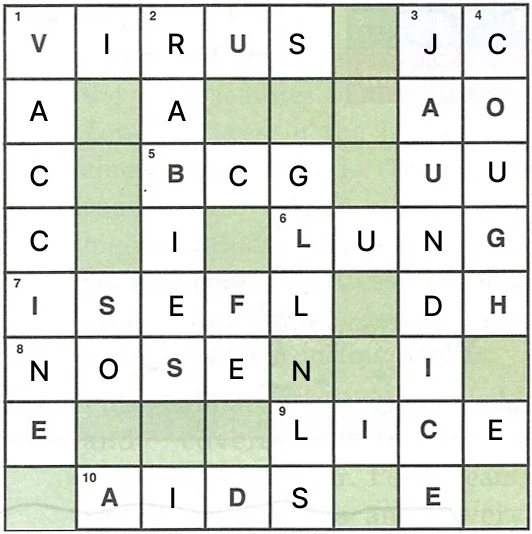
Likely entries: Vaccine, Rabies, Jaundice, Cough, Virus, BCG, Lungs, Housefly, Mouth, Lice and AIDS.
Explain in detail
Long Answer Questions
Apply your knowledge
Case Study Question
Common doubts
Frequently Asked Questions
What are communicable diseases?
Communicable diseases are illnesses that can spread from an infected person or source to another person through pathogens, air, water, food, contact or vectors.
What causes malaria?
Malaria is caused by Plasmodium parasites and is transmitted to humans through the bite of an infected female Anopheles mosquito.
Which vitamin deficiency causes scurvy?
Scurvy is caused by a deficiency of Vitamin C, also called ascorbic acid.
Which deficiency causes rickets in children?
Rickets is mainly caused by Vitamin D deficiency, which affects normal bone mineralisation.
Why does iodine deficiency cause goitre?
Iodine is needed to make thyroid hormones. A long-term deficiency can enlarge the thyroid gland and produce goitre.
What is the difference between a pathogen and an allergen?
A pathogen is a disease-causing organism or agent, while an allergen is a substance that triggers an allergic reaction in a sensitive person.
How can mosquito-borne diseases be prevented?
Prevent water stagnation, keep drains and containers covered, use mosquito nets or repellents, and maintain clean surroundings.
What does hygiene mean?
Hygiene is the science and practice of maintaining health through cleanliness and healthy habits.
Follow Speed Up Science on Instagram
Get quick revision posts, diagrams, quizzes and science learning tips.


0 Comments