
Habitat and Adaptation
Learn how plants and animals survive in deserts, mountains, water, polar regions and the air through clear explanations, interactive questions and answer reveals.
The natural home and immediate surroundings of an organism.
A feature or behaviour that improves survival in a habitat.
Biotic and abiotic factors that interact with living organisms.
Multiple Choice Questions
In a cactus plant, photosynthesis occurs in
Reason: In the cactus, leaves are modified into spines. The green leaf-like structure is a modified stem, which contains chlorophyll. Thus, the modified stem is the centre of photosynthesis in the cactus plants instead of leaves. The leaves are absent.
The animals such as birds have
Reason: Light bones with air cavities keep the bodies of birds light and thus help in flight. Solid heavy bones would make flying difficult. Heavy pointed bones are not a biological feature of birds. Birds are vertebrates and have a skeleton.
The biotic components of the environment includes
Reason: The living organisms such as plants, animals and decomposers are the biotic components of the environment.
The presence of hollow plant stems is a characteristic of
Reason: The stem of aquatic plant is long, hollow, light and grows well up to the water surface. Desert plants have thick stems for water storage, not hollow stems. Mountainous trees are adapted to cold and wind with woody, solid trunks and so do not have hollow stems.
Slow breathing is the characteristic of
Reason: Slow breathing is the characteristic of desert animals because certain amount of moisture is always lost due to evaporation in the respiratory passage during breathing. Aquatic animals breathe using gills or lungs adapted for water and do not need to slow their breathing to save water. Aerial animals (birds) need a rapid supply of oxygen for the energy demands of flight, so their breathing is fast rather than slow. Not all land animals live in water-scarce conditions, so slow breathing is not their general characteristic.
Diversity of organisms is found in different habitats because of different adaptations for
Reason: Organisms adapt to different abiotic factors such as average temperature, soil and annual precipitation in different ways. That is why a diversity of organisms is present in different habitats.
Which of the following is an aquatic plant?
Reason: Vallisneria is an aquatic plant commonly used in setting up an aquarium. It remains submerged in the water. Rice grows in water-logged fields but is not a fully aquatic plant. Mango is a terrestrial fruit tree. Cactus is a desert plant adapted to dry conditions.
Which of the following categories of animals have a streamlined body shape?
Reason: A streamlined body shape is designed to minimize resistance when moving through a fluid like water or air, and both fish and birds have evolved to have this shape for efficient movement. The other pairs are wrong because each includes at least one group that is not streamlined: reptiles, amphibians and most mammals do not have a streamlined body, as they are not adapted for fast, continuous movement through water or air.
Gill cover is technically termed as:
Reason: Gill cover is technically termed as Operculum. An exoskeleton is an outer protective skeleton found in insects and some other animals. Flippers are limb-like structures used for swimming in animals like whales and seals.
The animal which has a thick skin covered with fur is :
Reason: Yak has thick skin covered with fur to protect it from cold. Whale has a thick layer of blubber, not fur. Cat has fur but not thick enough for extreme cold survival like yak. Camel has thick skin but very sparse hair, adapted for deserts.
Assertion–Reason Questions
A is true as adaptation refers to special body features or behaviours that help organisms survive and reproduce successfully in their habitat. R is true as adaptations develop according to climate, habitat, availability of food and water. Therefore, Both A and R are true and R is the correct explanation of A is the correct option.
A is true as biotic factors include living organisms like plants, animals, and humans. Abiotic factors include non-living things like soil, water, air, and sunlight. R is true as Environment has living (biotic) and non-living (abiotic) components. They are interrelated and depend on each other. Therefore, Both A and R are true but R is not the correct explanation of A is the correct option.
A is true as The feathers on a bird’s tail (called tail feathers or rectrices) help in steering, balancing, slowing down while landing. R is true as birds have strong breast muscles that move the wings up and down and help in flying and generating thrust. Therefore, Both A and R are true but R is not the correct explanation of A is the correct option.
A is true as seed dispersal is the process of spreading seeds away from the parent plant. It's important because it helps plants spread to different areas and climates and increases chances of survival and adaptation. R is true as seed dispersal prevents overcrowding and competition for space, water, sunlight, and nutrients. Therefore, Both A and R are true and R is the correct explanation of A is the correct option.
Fill in the Blanks
Fill in the blanks with suitable words.
- In birds, __________ are modified into wings.
- The mountain goat has strong __________ for running up rocky mountain slopes.
- The hump of a camel is full of __________, which serves as reserve food.
- Whales are __________ mammals.
- Flowers pollinated with the help of water are called __________ flowers.
- forelimbs
- hooves
- fat
- marine
- hydrophilous
True or False
Write True or False. Rewrite and correct the false statements.
- Dorsal and ventral fins of a fish are paired fins.
- Fish breathe by means of nostrils.
- A camel urinates very little and its urine is comparatively concentrated.
- The leaves of water lily are reduced to spines to reduce transpiration.
- The claws of a bird help in steering.
Correct statement: Dorsal and ventral fins of a fish are unpaired fins.
Correct statement: Fish breathe by means of gills.
A camel passes very little urine, and its urine is comparatively concentrated.
Correct statement: The leaves of cacti are reduced to spines to reduce transpiration.
Correct statement: The tail feathers of a bird help in steering and changing direction.
Match the Following
Match the terms in Column A with Column B.
| Column A | Column B |
|---|---|
| (i) Penguins | (a) Desert habitat |
| (ii) Pine trees | (b) Very small stem |
| (iii) Camel | (c) Mountain habitat |
| (iv) Cactus | (d) Polar habitat |
| (v) Water lily | (e) Modified fleshy stem |
| Column A | Correct match |
|---|---|
| Penguins | (d) Polar habitat |
| Pine trees | (c) Mountain habitat |
| Camel | (a) Desert habitat |
| Cactus | (e) Modified fleshy stem |
| Water lily | (b) Very small stem |
Short Answer Questions
List any four abiotic factors which affect different living beings.
Four abiotic factors are:
- Soil
- Air
- Water
- Temperature
Define the following: Habitat and Adaptation.
The natural home of an organism and its immediate surroundings is called its habitat. It provides shelter, food, water and suitable conditions for breeding.
The development of a structure, function or behaviour that makes an organism more efficient at surviving in a particular environment or habitat.
Briefly explain the term “Habitat”.
The natural home of an organism and its immediate surroundings is called its habitat. A suitable habitat provides shelter, food, water and conditions for breeding. It includes physical factors such as air, water and temperature, as well as the plants and animals around the organism.
The three major categories are:
- Aquatic habitat
- Terrestrial habitat
- Aerial habitat
Give two adaptations in animals found in the mountain habitat.
- More red blood cells: Mountain air contains less oxygen. More red blood cells help animals absorb and transport enough oxygen even at low air pressure.
- Hibernation: Some animals enter a long winter sleep during extremely cold months. This conserves energy and helps them survive when food is scarce.
How is a whale similar to a fish in adaptation to life in water? Explain any two features.
- Like a fish, a whale has a streamlined, spindle-shaped body that reduces resistance in water.
- Its front limbs are modified into paddles or flippers for swimming, while the hind limbs are absent.
List the environmental factors that influence a habitat.
- Air
- Water
- Climatic conditions
- Temperature
- Plants and animals
Name any three types of terrestrial habitat.
- Desert habitat
- Mountain habitat
- Polar habitat
Name two types of terrestrial habitats with low temperatures.
- Polar habitat
- Mountain habitat
Complete the table. Write two points in each column.
| Habitat | Environmental factors | Plant adaptations | Animal adaptations |
|---|---|---|---|
| Aquatic habitat |
|
|
|
| Mountain habitat |
|
|
|
| Desert habitat |
|
|
|
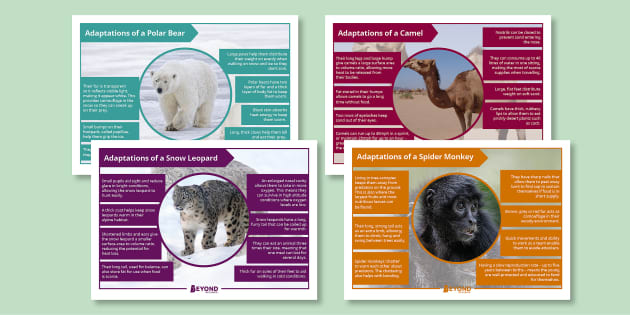
State the “water-saving methods” in a camel.
When deprived of water, a camel passes very little urine, and the urine is concentrated.
Its dung contains very little water.
A camel tolerates high body temperatures, reducing the need to sweat and therefore saving water.
A slower breathing rate reduces water loss as water vapour from the respiratory passages.
Camel body tissues can tolerate considerable dehydration and recover after the animal drinks water.
When stored fat is broken down, it provides energy and also produces some metabolic water.
Name the following.
- Three major categories of habitats
- Four types of terrestrial habitats
- Two components of the environment
- Two categories of dispersing agents
- Three plants found in mountainous regions
- Aquatic habitat, terrestrial habitat and aerial habitat
- Desert habitat, mountain habitat, polar habitat, and forests and grasslands
- Biotic components and abiotic components
- Natural agents and animals
- Pine, fir and cedar
Define the given terms: Habitat, Adaptation, Abiotic factors, Biotic factors and Seed dispersal.
The natural home of an organism and its immediate surroundings.
A structure, function or behaviour that makes an organism more efficient at surviving in a particular environment or habitat.
The non-living physical and chemical components of an ecosystem, such as soil, rocks, air, water and temperature.
The living components of an ecosystem, including plants, animals, fungi, bacteria and other microorganisms.
The transport of seeds away from the parent plant to new locations where they may germinate and grow.
Write one important function of each structure.
- Fins
- Gills
- Swim bladder of a fish
- Hump of a camel
- Streamlined body of a bird
Help a fish swim, balance and change direction.
Act as the breathing organs of fish and absorb dissolved oxygen from water.
Helps a fish maintain buoyancy and move upward or downward by changing the amount of gas inside it.
Stores fat that serves as reserve food and a source of energy.
Reduces air resistance during flight.
Choose the odd one and give a reason.
- Neem, Pine, Fir, Cedar
- Reindeer, Deer, Polar bears, Penguins
- Scales, Fins, Fur, Gills
- Seeds of Cotton, Poppy, Drumstick, Mango
- Water lily, Lotus, Cactus, Vallisneria
Neem is a tree of plains, whereas pine, fir and cedar are common in mountainous regions.
Deer commonly live in forests or plains, whereas reindeer, polar bears and penguins are adapted to polar regions.
Fur is typical of land mammals, whereas scales, fins and gills are aquatic adaptations.
Mango seeds are dispersed mainly by animals, whereas cotton, poppy and drumstick seeds are dispersed by wind.
Cactus is a desert plant, whereas water lily, lotus and Vallisneria are aquatic plants.
Long Answer Questions
Describe any two adaptations seen in desert plants.
- Most cacti have spines instead of leaves. This greatly reduces water loss through transpiration.
- Photosynthesis is carried out by the thick, green, fleshy stem, which also stores water.
Describe the aerial adaptations in birds.
The head points forward, the neck stretches ahead and the tail narrows at the back. This smooth shape reduces air resistance.
The forelimbs are modified into wings and carry long flight feathers.
Tail feathers help birds balance, slow down and change direction.
Large breast muscles move the wings powerfully during flight.
Many bones contain air cavities, reducing body weight without removing essential strength.
Birds excrete uric acid as a semi-solid waste, so less water is needed for excretion.
Differentiate between an aquatic habitat and a terrestrial habitat.
| Aquatic habitat | Terrestrial habitat |
|---|---|
| Includes plants and animals living in rivers, lakes, ponds and seas. | Includes plants and animals living on land. |
| Examples: fish, water lily, lotus and Vallisneria. | Examples: cactus, camel, mountain goat and pine tree. |
Describe how pollination occurs in Vallisneria.
Vallisneria is adapted for cross-pollination and has separate male and female plants. Pollination takes place through water, so its flowers are described as hydrophilous.
Small male flowers detach when mature.
They float on the water surface.
Female flowers reach the surface on long stalks.
Floating male flowers transfer pollen to female flowers at the surface.
Case Study Type Question
Mountain Habitat Case Study
Ankur and his classmates took a virtual field trip to the Great Himalayas. As they travelled upward, they observed animals and plants adapted to a cold, windy and rocky environment. Mountain habitats can remain covered with snow for several months, yet many organisms survive there.
- Name two plants found at high altitudes.
- What is the technical term for changes that help organisms survive in a habitat?
- Give two examples of mountain animals.
- What change in the blood helps mountain animals survive in low-oxygen conditions?
- What is the advantage of hibernation?
- Pine and cedar.
- The term is adaptation.
- Yak and mountain goat.
- Their blood generally contains more red blood cells, helping it carry enough oxygen when air pressure and oxygen availability are low.
- Hibernation conserves energy and allows animals to survive cold winter months when food is scarce.
Frequently Asked Questions
What is a habitat?+
A habitat is the natural home of an organism together with its immediate surroundings. It provides food, water, shelter and suitable conditions for breeding.
What is adaptation in biology?+
Adaptation is a body feature, function or behaviour that helps an organism survive successfully in a particular habitat.
Why does photosynthesis occur in the stem of a cactus?+
Cactus leaves are modified into spines to reduce water loss. Its thick green stem contains chlorophyll, stores water and performs photosynthesis.
How does a camel conserve water?+
A camel passes little concentrated urine, produces dry dung, sweats very little, breathes slowly and tolerates considerable dehydration.
Why do birds have light bones with air cavities?+
Air-filled cavities reduce body weight and make flight easier while the skeleton still supports the body.
How does pollination occur in Vallisneria?+
Male flowers detach and float on the water surface. Female flowers reach the surface on long stalks, where floating male flowers transfer pollen to them.


0 Comments