
Matter: Complete Exercise Solutions
Explore matter, particles, solids, liquids, gases, diffusion, Brownian movement and changes of state through interactive notes, solved exercises and a self-check quiz.

Interactive model
See how particles behave
Choose a state of matter and observe how particle spacing and movement change.
Solved exercise
Exercise I — Objective Type Questions
Question 1(i) Which one is a kind of matter?
Which one is a kind of matter?
Question 1(ii) All kinds of matter:
All kinds of matter:
Question 1(iii) The space occupied by matter is called :
The space occupied by matter is called :
Question 1(iv) The quantity of matter in an object is called as:
The quantity of matter in an object is called as:
Question 1(v) Which of the following is a kind of man-made matter?
Which of the following is a kind of man-made matter?
Question 1(vi) An object which is not made up of wood is:
An object which is not made up of wood is:
Solved exercise
Exercise I — Classify the Following
Question 2 Select natural and man-made matter from the following list:
Select natural and man-made matter from the following list:
Wood, plastic, silk, medicines, detergents, coal, water, ceramic, cotton, glass, nylon, fruits.
Solved exercise
Exercise I — Short Answer Type Questions
Question 1 Define matter.
Define matter.
Anything that has mass and occupies space is called matter.
Question 2 What are the two main types of matter? Give two examples for each type.
What are the two main types of matter? Give two examples for each type.
Two main types of matter :
Living matter — Matter that shows characteristics of life like growth, reproduction, response to stimuli, etc.,
Examples : Humans, trees, etc.
Non-living matter — Matter that does not show characteristics of life. They do not grow, move or reproduce on their own.
Examples: Plastics, cotton, etc.
Question 3 Why are plants and animals considered as matter?
Why are plants and animals considered as matter?
Plants and animals are living matter as they have mass and they occupy space. They show life processes such as growth, movement or response, and reproduction, and they are made up of atoms and molecules. So, they are considered as matter.
Solved exercise
Exercise II — Objective Type Questions
Question 1(i) The state of matter which has no definite shape or volume is called:
The state of matter which has no definite shape or volume is called:
Question 1(ii) The largest intermolecular gaps occur in:
The largest intermolecular gaps occur in:
Question 1(iii) A solid:
A solid:
Question 1(iv) Which of the following diffuses very fast?
Which of the following diffuses very fast?
Question 1(v) Which of the following shows the strongest cohesive force?
Which of the following shows the strongest cohesive force?
Solved exercise
Exercise II — Classify the Following
Question 2 Classify the following into solids, liquids and gases.
Classify the following into solids, liquids and gases.
Oxygen, milk, common salt, wax, stone, L.P.G., carbon dioxide, sugar, mercury, coal, blood, butter, copper, coconut oil, kerosene.
- Solids — Common salt, wax, stone, sugar, coal, butter, copper
- Liquids — Milk, mercury, blood, coconut oil, kerosene
- Gases — Oxygen, L.P.G., carbon dioxide
Question 3 Name the smallest basic particle from which matter is made.
Name the smallest basic particle from which matter is made.
Matter is made up of extremely small particles called atoms.
Solved exercise
Exercise II — Short Answer Type Questions
Question 1 What are molecules ?
What are molecules ?
A molecule is the smallest unit of matter which exhibits all the properties of that kind of matter and is capable of independent existence.
Question 2 Define:
Define:
(a) Intermolecular force of attraction.
(b) Intermolecular space.
(c) Cohesive force
(d) Diffusion
(e) Brownian movement
(a) Particles of matter are held together by a force of attraction that exists between them. This force is known as intermolecular force of attraction.
(b) Particles of matter have space between them which is called inter-particle or intermolecular space or gap.
(c) The force of attraction between like particles or molecules is called cohesive force. It is this force which holds the particles of a substance together.
(d) The phenomenon of intermixing of particles of one kind with another kind is called diffusion.
(e) The zig-zag motion of particles suspended in a medium is called Brownian movement. It is named after the botanist Robert Brown.
Question 3 Give one difference between atoms and molecules.
Give one difference between atoms and molecules.
| Atoms | Molecules |
|---|---|
| An atom is the smallest unit of an element that retains the chemical properties of that element. | Two or more atoms can chemically combine to form a molecule. |
| Many atoms do not ordinarily exist independently. | A molecule can generally exist independently and retains the properties of the substance. |
Question 4 What are fluids? Give two examples.
What are fluids? Give two examples.
All substances that can flow are called fluids. Both gases and liquids are fluids.
Examples: Water and oxygen.
Solved exercise
Exercise II — Long Answer Type Questions
Question 1 Name the three states of matter and define them.
Name the three states of matter and define them.
Question 2(a) Give reason:
Give reason:
Liquids and gases flow but solids do not.
In solids, the molecules are closely packed with negligible intermolecular space between them. There is a strong force of attraction between the molecules. This makes them hard so they cannot flow. However, liquids and gases have more intermolecular space between them compared to solids, so they can flow freely.
Question 2(b) Give reason:
Give reason:
A gas fills up the space available to it.
In case of gases, the molecules are hardly attracted to each other with very large intermolecular space. As a result, gases have neither a fixed shape nor a fixed volume. They completely fill up the space available to them.
Question 2(c) Give reasons:
Give reasons:
The odour of scent spreads in a room.
When you spray scent in a room, its particles mix with air molecules and diffuse and gradually spread throughout the room.
Question 2(d) Give reason:
Give reason:
We can walk through air.
Air is a gas, and its particles are widely spaced, offering very little resistance to movement. So we can easily walk through it.
Question 2(e) Give reason:
Give reason:
Liquids have a definite volume but no definite shape.
In liquids, the molecules are not very closely packed. They are moderately attracted to each other giving it a definite volume. Thus, the intermolecular spaces are larger and the molecules are able to move freely. This allows a liquid to take the shape of its container.
Question 2(f) Give reason:
Give reason:
When a teaspoon of sugar is added to half a glass of water and stirred, the water level in the glass remains unchanged.
This is because sugar particles settle into the spaces between water molecules. This is a result of intermolecular spaces in liquids.
Question 2(g) Give reason:
Give reason:
When an empty gas jar is inverted over a gas jar containing a coloured gas, the gas also spreads into the empty jar.
This is because of diffusion. Gases diffuse rapidly because their particles move randomly and mix with each other, even without stirring.
Question 2(h) Give reason:
Give reason:
A red ink drop added to a small amount of water in a glass turns the water red in some time.
This is because of diffusion. Liquids diffuse more slowly than gases. When a drop of red ink is added to water, the ink particles gradually diffuse throughout the water.
Question 2(i) Give reason:
Give reason:
Solids usually have higher density than liquids and gases.
In solids, particles are tightly packed, making them denser than liquids and gases.
Question 2(j) Give reason:
Give reason:
An egg is kicked out of a bottle when air is blown inside the bottle.
Blowing air increases the air pressure inside the bottle. The high pressure pushes the egg outward.
Solved exercise
Exercise III — Objective Type Questions
Question 1(i) A kind of matter which can sublime is :
A kind of matter which can sublime is :
Question 1(ii) A substance which can change its state is:
A substance which can change its state is:
Question 1(iii) The process by which a solid changes into a liquid is called :
The process by which a solid changes into a liquid is called :
Question 1(iv) The change of state of liquid into vapour below its boiling point is called:
The change of state of liquid into vapour below its boiling point is called:
Question 1(v) When a substance is heated, it can:
When a substance is heated, it can:
Solved exercise
Exercise III — Assertion Reason Type Questions
Question 2(i) Assertion: A chair is made up of wood, which is a kind of matter.
Assertion: A chair is made up of wood, which is a kind of matter.
Reason: Wood has mass and occupies space.
Reason — A is true as wood is a substance, so it is matter.
R is true as anything that has mass and occupies space is called matter.
Therefore, Both A and R are true and R is the correct explanation of A is the correct option.
Question 2(ii) Assertion: Particles of matter are held together by intermolecular forces of attraction.
Assertion: Particles of matter are held together by intermolecular forces of attraction.
Reason: Particles of matter possess kinetic energy.
Reason — A is true as intermolecular forces of attraction keep particles close to each other.
R is true as particles are always in motion due to their kinetic energy.
Therefore, Both A and R are true and R is not the correct explanation of A is the correct option.
Question 2(iii) Assertion: There is no change in the level of water in a glass when a teaspoon of sugar is added to it.
Assertion: There is no change in the level of water in a glass when a teaspoon of sugar is added to it.
Reason: There are intermolecular gaps between water molecules.
Reason — A is true as when sugar dissolves, its particles fit into the spaces between water molecules, so the level does not rise noticeably.
R is true as intermolecular gaps between water molecules allow sugar particles to occupy space without increasing volume.
Therefore, Both A and R are true and R is the correct explanation of A is the correct option.
Question 2(iv) Assertion: A molecule is capable of independent existence.
Assertion: A molecule is capable of independent existence.
Reason: An atom is a bigger particle than a molecule.
Reason — A is true as molecules can exist freely and retain the properties of the substance.
R is false as an atom is actually smaller; molecules are made of two or more atoms.
Therefore, A is true and R is false is the correct option.
Solved exercise
Exercise III — Fill in the blanks
Question 3 (a) Water is matter because it has ............... and occupies ...............
(a) Water is matter because it has ............... and occupies ...............
(b) Any matter which has a definite ............... but no definite shape is called a ................
(c) ............... and ............... can flow.
(d) The molecules are at a greater distance in ............... as compared to liquids.
(e) Water boils at ............... °C.
(f) The physical state of a substance, which has neither fixed volume nor fixed shape is a ...............
(a) Water is matter because it has mass and occupies space.
(b) Any matter which has a definite volume but no definite shape is called a liquid.
(c) Liquids and gases can flow.
(d) The molecules are at a greater distance in gases as compared to liquids.
(e) Water boils at 100°C.
(f) The physical state of a substance, which has neither fixed volume nor fixed shape is a gas.
Solved exercise
Exercise III — State True or False
Question 4 Write whether the following statements are true or false.
Write whether the following statements are true or false.
(a) Only water can exist in three different states. ...............
(b) If the container in which a gas is collected has an opening, the gas will flow out and spread itself indefinitely. ...............
(c) Solids have the largest inter-molecular space. ...............
(d) There is no difference between evaporation and boiling. ...............
(e) All solids, on heating, first change to liquid and then to the gaseous state. ...............
(f) The intermolecular force of attraction is the weakest in gases. ...............
(g) A gas has no free surface. ...............
(a) False
Correct Statement — Many substances like carbon dioxide, iodine, etc., can exist in solid, liquid, and gaseous states under suitable conditions.
(b) True
- (c) False
- Correct Statement — Gases have the largest intermolecular space. Solids have very tightly packed particles.
(d) False
Correct Statement — Evaporation is a slow surface-level process that occurs at any temperature, while boiling is a rapid, bulk process that happens at the boiling point.
(e) False
Correct Statement — Some solids like camphor, iodine, and dry ice undergo sublimation, changing directly from solid to gas without becoming liquid.
(f) True
(g) True
Solved exercise
Exercise III — Match the Following
Question 5 Match the following
Match the following
| Column A | Column B |
|---|---|
| (a) Solids | (i) Can flow in all directions. |
| (b) Sublimation | (ii) The temperature at which a liquid changes into its gaseous state |
| (c) Boiling point | (iii) Can have any number of free surfaces |
| (d) Gases | (iv) Gaps between molecules |
| (e) Intermolecular space | (v) Change of state directly from solid to gas. |
| Column A | Column B |
|---|---|
| (a) Solids | (iii) Can have any number of free surfaces |
| (b) Sublimation | (v) Change of state directly from solid to gas. |
| (c) Boiling point | (ii) The temperature at which a liquid changes into its gaseous state |
| (d) Gases | (i) Can flow in all directions. |
| (e) Intermolecular space | (iv) Gaps between molecules |
Solved exercise
Exercise III — Select the Odd One
Question 6 Select the odd one out from the following:
Select the odd one out from the following:
(a) solid, liquid, gas, volume
(b) water, fruit juice, air, stone, milk
(c) Iron, aluminium, wood, gold
(d) Freezing, condensation, melting point, evaporation
- (a) Volume
- Reason — Solid, liquid and gas are the states of matter, while volume is a property of matter.
- (b) Stone
- Reason — Water, fruit juice, air and milk are fluids and can flow, while stone is a solid and cannot flow.
- (c) Wood
- Reason — Iron, aluminium and gold are metals, whereas wood is a non-metal.
(d) Melting point
Reason — Freezing, condensation and evaporation are processes of state change, while melting point is a temperature, not a process.
Solved exercise
Exercise III — Solid, Liquid, or Gas
Question 7 For each of the following statements, say whether it describes a solid, a liquid or a gas.
For each of the following statements, say whether it describes a solid, a liquid or a gas.
(a) Particles move about very quickly but do not leave the surface.
(b) Particles are quite close together.
(c) Particles are far apart and move in all directions.
(a) Liquid
(b) Solid
(c) Gas
Solved exercise
Exercise III — Short Answer Type Questions
Question 1 Name the phenomenon which causes the following changes:
Name the phenomenon which causes the following changes:
(a) Formation of water vapour from water.
(b) Disappearance of camphor when exposed to air.
(c) Conversion of ice into water.
(d) Conversion of water into steam.
(a) Evaporation
(b) Sublimation
(c) Melting
(d) Boiling or vaporisation
Question 2 Give two examples for each of the following:-
Give two examples for each of the following:-
(a) Substances which sublime.
(b) Substances which do not change their state.
(c) Substances which are rigid and not compressible.
(a) Camphor and dry ice (solid carbon dioxide)
(b) Paper and wood (under ordinary heating they usually undergo chemical change rather than a simple reversible change of state)
(c) Stone and iron
Question 3 Define the following terms:
Define the following terms:
(a) Fusion
(b) Vaporisation
(c) Condensation
(d) Sublimation
(e) Diffusion
(f) Melting point
(g) Boiling point
(h) Liquefaction
(i) Evaporation
(a) The process by which a substance changes from solid state to liquid state is called melting or fusion.
(b) The process by which a liquid changes into vapour is called vaporisation or boiling.
(c) The process by which a substance in gaseous state changes into its liquid state is called condensation or liquefaction.
(d) The conversion of a solid substance directly into vapour without passing through the liquid state is called sublimation.
(e) The phenomenon of intermixing of particles of one kind with another kind is called diffusion.
(f) The fixed temperature at which a solid changes into a liquid at a given pressure is called its melting point.
(g) The fixed temperature at which a liquid boils and changes into the gaseous state is called its boiling point.
(h) The process by which a substance in gaseous state changes into its liquid state is called condensation or liquefaction.
(i) The change of state of a liquid into vapour below its boiling point is called evaporation.
Solved exercise
Exercise III — Long Answer Type Questions
Question 1 (a) Define: interconversion of states of matter.
(a) Define: interconversion of states of matter.
(b) What are the two conditions for the interconversion of states of matter?
(a) The process by which matter changes from one state to another and back to the original state, without any change in its chemical composition is called interconversion of states of matter.
(b) The two conditions for the interconversion of states of matter
- Change in temperature
- Change in pressure
Question 2(a) Differentiate between solidification and condensation.
Differentiate between solidification and condensation.
The difference between solidification and condensation is given below:
| Solidification | Condensation |
|---|---|
| The process by which a substance in liquid state changes into a solid state | The process by which a substance in gaseous state changes into its liquid state |
| Example: Conversion of water to ice | Example: Conversion of steam to water |
Question 2(b) Differentiate between melting and boiling.
Differentiate between melting and boiling.
The difference between melting and boiling is given below:
| Melting | Boiling |
|---|---|
| The process by which a substance changes from solid state to liquid state | The process by which a liquid changes into vapour |
| Example: Ice to water | Example: Water to steam at 100°C |
Question 2(c) Differentiate between gas and vapour.
Differentiate between gas and vapour.
The difference between gas and vapour is given below:
| Gas | Vapour |
|---|---|
| A substance that exists in the gaseous state under ordinary room conditions | The gaseous form of a substance that is usually a liquid or solid at room temperature |
| Examples: Oxygen and nitrogen | Example: Water vapour |
Question 2(d) Differentiate between miscible and immiscible liquids.
Differentiate between miscible and immiscible liquids.
The difference between miscible and immiscible liquids is given below:
| Miscible | Immiscible |
|---|---|
| Liquids which mix with each other | Liquids which do not mix with each other |
| Example: Water and alcohol | Example: Water and oil |
Question 2(e) Differentiate between vaporisation and evaporation.
Differentiate between vaporisation and evaporation.
The difference between vaporisation and evaporation is given below:
| Vaporisation | Evaporation |
|---|---|
| The process by which a liquid changes into vapour | The change of state of a liquid into vapour below boiling point |
| It includes both boiling and evaporation | It is a slow form of vaporisation occurring at the surface level |
| Example: Water to water vapour | Example: Drying of wet clothes |
Question 3 State the three effects of heat on matter.
State the three effects of heat on matter.
Question 4 How is interconversion of states of matter different from a chemical reaction?
How is interconversion of states of matter different from a chemical reaction?
During the interconversion of states of matter, the physical state changes without any change in its chemical composition. Whereas, in a chemical reaction a substance is transformed into a new substance with different properties.
Question 5 How does a liquid change into its gaseous state? Explain in brief.
How does a liquid change into its gaseous state? Explain in brief.
A liquid changes into its gaseous state by the process of boiling or vaporisation.
As a liquid is heated, its particles start gaining energy and move more vigorously which increases the gaps between the particles and decreases the force of attraction. Ultimately, a liquid changes into gaseous state.
Question 6 What happens to a metal ball when it is heated? What does this show?
What happens to a metal ball when it is heated? What does this show?
When we heat a metal ball for about 5–6 minutes, it expands. This shows that a solid substance expands on heating. When we cool a solid substance, it again contracts to its original size.
Question 7 Why does a candle become smaller on burning with time?
Why does a candle become smaller on burning with time?
When a candle is lit, first the candle wax melts and then turns into vapour. The vapours react with air to produce two new substances, carbon dioxide and water.
Therefore, a candle on burning becomes smaller and smaller and the part of wax which has undergone chemical change cannot be recovered.
Question 8 State the two characteristics of a chemical change.
State the two characteristics of a chemical change.
Two characteristics of a chemical change are:
It is a permanent change in which new substances are formed from the original substances.
The properties of the new substances are entirely different from those of the original substances.
Question 9 Look at the diagram given alongside and answer the questions that follow:
Look at the diagram given alongside and answer the questions that follow:
(a) Label A and B.
(b) What is the purpose of this experiment?
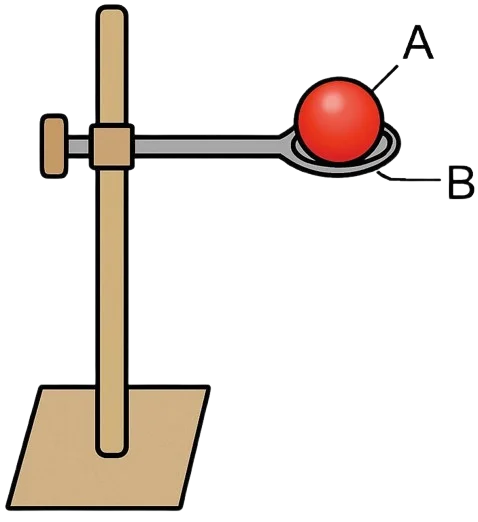
- (a) A — Metal ball
- B — Metal ring
(b) The purpose of this experiment was to show that a solid expands on heating and when it is cooled back down, it contracts back to its original size.
Question 10 Given below is a crossword puzzle based on this lesson. Read the clues across and clues downwards and fill up the blank squares.
Given below is a crossword puzzle based on this lesson. Read the clues across and clues downwards and fill up the blank squares.
Across:
- Quantity of matter
- Solid changes directly into vapour
- Gas changes into liquid
- Down:
- Occupies space and has mass
- Liquid is heated to change into vapour
- Solid changes into liquid.


Across:
- Mass
- Sublimation
- Condensation
- Down:
- Matter
- Boiling
- Melting
Solved exercise
Case Study Type Questions
Question 1 Anshul visited the beach and collected a handful of small pebbles to play with later at home. Once home, he carefully stacked them into a tall tower. Then he decided to pour water over the tower. He observed that water flowed through the gaps between the pebbles and spread everywhere on the floor.
Anshul visited the beach and collected a handful of small pebbles to play with later at home. Once home, he carefully stacked them into a tall tower. Then he decided to pour water over the tower. He observed that water flowed through the gaps between the pebbles and spread everywhere on the floor.
(a) Why was it possible to stack pebbles?
(b) Why did the water spread on the floor?
(c) What happens to the water after it spreads across the floor?
(d) Which other state of matter can flow in all directions?
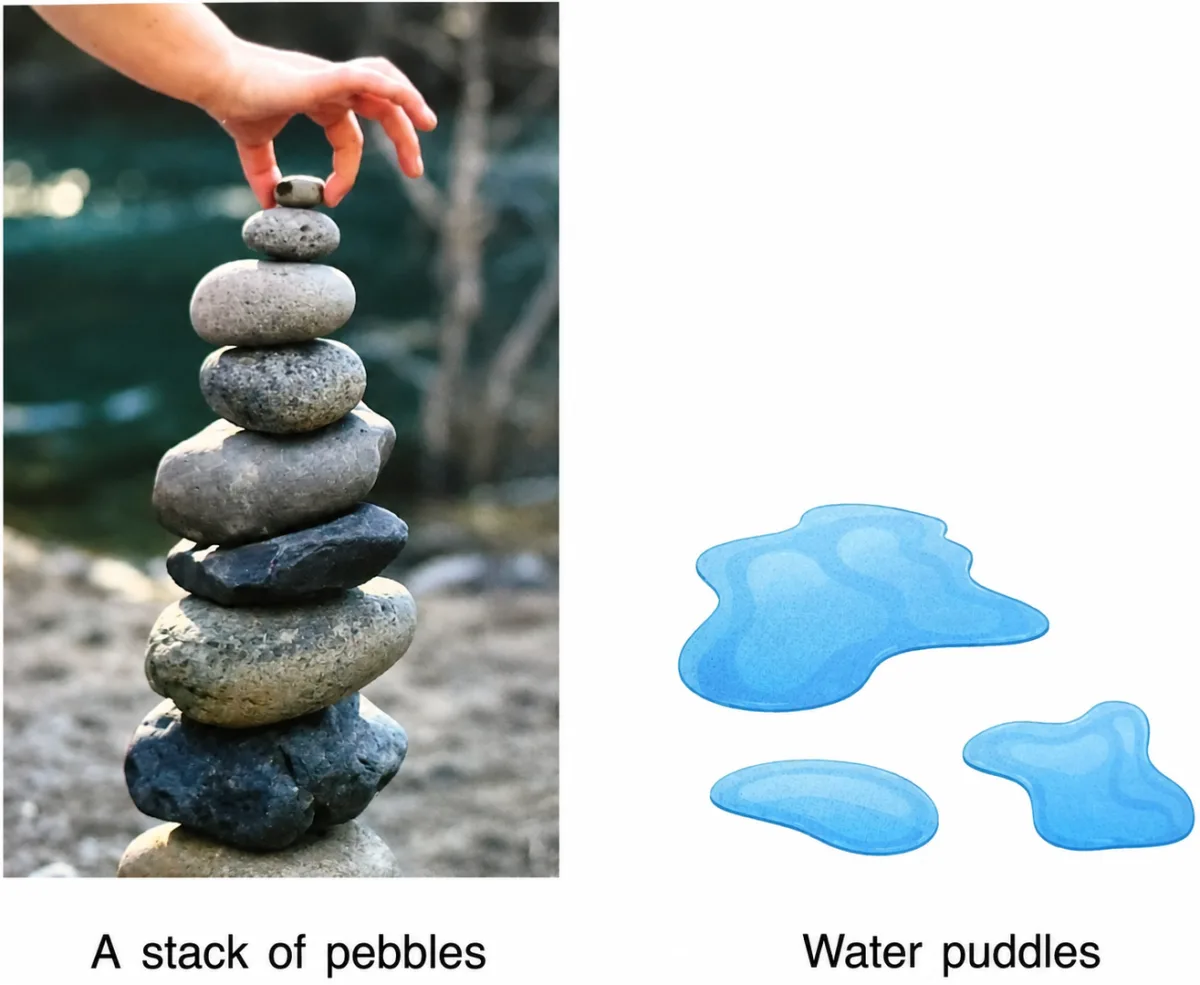
(a) Pebbles are solids, so particles are closely packed. They have strong intermolecular forces and a fixed shape. Therefore, pebbles can be stacked one over another.
(b) Water is a liquid, so particles have weaker intermolecular forces. They can move freely. Therefore, water flows through gaps and spreads on the floor.
(c) Water evaporates slowly into the air after it spreads across the floor.
(d) Gases can flow in all directions.
Knowledge check
Quick Matter Quiz
Answer eight questions and check your understanding instantly.
Frequently asked questions
Matter: FAQs for Class 6
What is matter?
Matter is anything that has mass and occupies space.
What are the three common states of matter?
The three common states are solid, liquid and gas.
Why does a liquid have no fixed shape?
Liquid particles can move past one another, so a liquid takes the shape of its container while keeping a definite volume.
Why can gases fill an entire container?
Gas particles are far apart and move freely in all directions, so they spread through all available space.
What is diffusion?
Diffusion is the intermixing of particles of one substance with particles of another substance.
What is sublimation?
Sublimation is the direct change of a solid into vapour without passing through the liquid state.
What is the difference between evaporation and boiling?
Evaporation is a slow surface process that can occur below the boiling point, while boiling is a rapid process throughout the liquid at its boiling point.
At what temperature does water boil at normal atmospheric pressure?
Pure water boils at 100 degrees Celsius at normal atmospheric pressure.





0 Comments