
Chapter 7
Reflection of Light
Class 9 - Concise Physics Selina Solutions
No matching content found. Try another keyword.
Exercise 7(A) — Multiple Choice Type
9 QuestionsQuestion 1Not selected
Question 1
The angle which the ............... ray makes with the ............... at the point of incidence is called angle of incidence.
Select an option to continue.
Answer
incidence, normal
Reason
The angle which the incidence ray makes with the normal at the point of incidence is called angle of incidence.
Question 2Not selected
Question 2
Regular reflection occurs when a beam of light falls on a ............... .
Select an option to continue.
Answer
Both smooth and polished surfaces
Reason
Regular reflection occurs when a beam of light falls on a smooth and polished surface, such as a plane mirror. The reflected beam is also parallel and it is in a fixed direction. It can be seen only from a particular direction.
Question 3Not selected
Question 3
According to the law of reflection:
Select an option to continue.
Answer
i
=
r
i=r
=
r
i=r
Reason
According to the law of reflection the angle of incidence is equal to the angle of reflection.
Question 4Not selected
Question 4
The image formed due to the actual intersection of the reflected rays is :
Select an option to continue.
Answer
real
Reason
The image which can be obtained on a screen is called a real image. It is inverted. It is formed when light rays after reflection actually intersect.
Question 5Not selected
Question 5
The image formed by a plane mirror is:
Select an option to continue.
Answer
erect and of same size.
Reason
The characteristics of an image formed by a plane mirror are — upright (or erect), virtual and of the same size as the object.
Question 6Not selected
Question 6
The image formed by a plane mirror is:
Select an option to continue.
Answer
virtual with lateral inversion
Reason
The characteristics of an image formed by a plane mirror are — upright (or erect), virtual and laterally inverted.
Question 7Not selected
Question 7
A concave mirror forms ............... image whereas a convex mirror forms ...............
Select an option to continue.
Answer
real, virtual
Reason
For a distant object, the image formed by a concave mirror is real. The image of an object formed by a plane mirror or a convex mirror is virtual.
Question 8Not selected
Question 8
Which of the following combination of letters does not show lateral inversion ?
Select an option to continue.
Answer
M, T, V
Reason
Lateral inversion is the interchange of left and right sides in a plane mirror image. The letters M, T, and V do not exhibit noticeable lateral inversion in their mirror image due to their inherent symmetry about a vertical line passing through their midpoint.
Question 9Not selected
Question 9
If the object is shifted by a distance d towards a plane mirror, the image will shift by distance ............... towards the mirror.
Select an option to continue.
Answer
d
Reason
If the object is shifted by a distance d towards a plane mirror, the image will also shift by a distance d towards the mirror.
Exercise 7(A) — Very Short Answer Type
7 QuestionsQuestion 1Read Mode
Select the luminous object(s) from the following :
Sun, Moon, Earth, Shooting star, Fire
Sun, Moon, Earth, Shooting star, Fire
Answer
Sun, Shooting star, Fire as they emit light by themselves.
Question 2Read Mode
What do you mean by reflection of light ?
Answer
The return of light into the same medium after striking a surface is called reflection of light.
Question 3Read Mode
State which surface of a plane mirror reflects most of the light incident on it : the front smooth surface or the back silvered surface.
Answer
The back silvered surface of the plane mirror reflects most of the light incident on it.
Question 4Read Mode
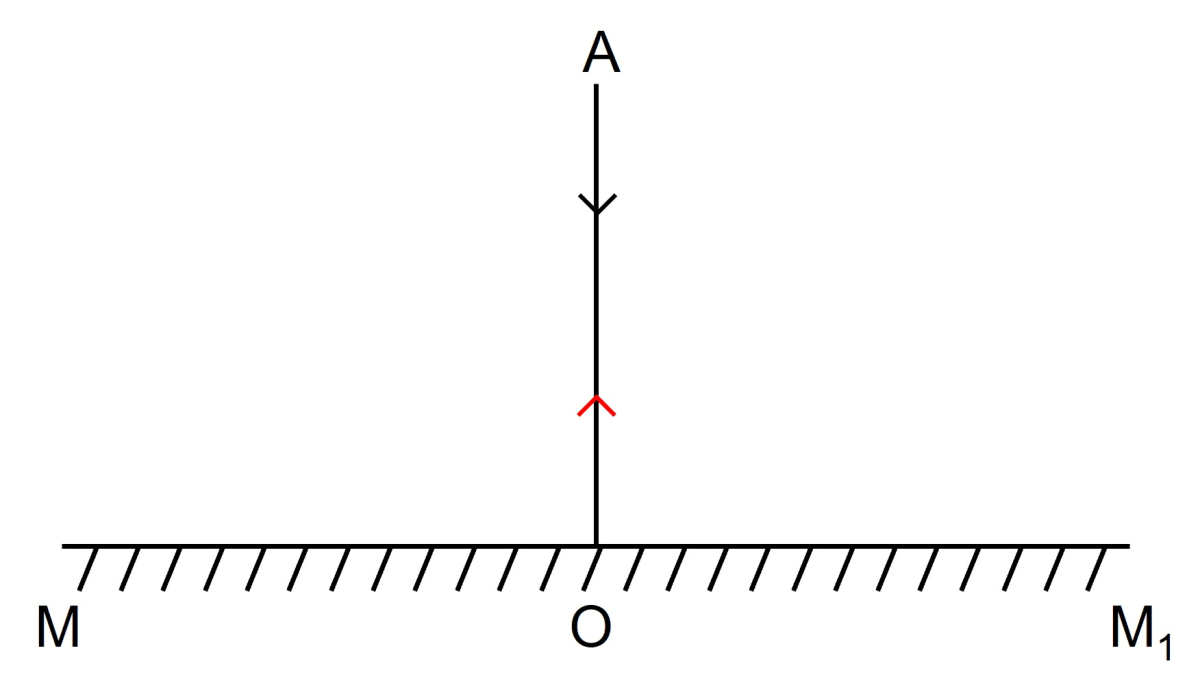
A light ray is incident normally on a plane mirror.
(a) What is its angle of incidence?
(b) What is the direction of reflected ray? Show it on a diagram.
(a) What is its angle of incidence?
(b) What is the direction of reflected ray? Show it on a diagram.
📌 Diagram / Image Space
Answer
(a) When the ray of light is incident normally on a plane mirror then the angle of incidence = 0°.
(b) The direction of reflected ray is same as the incident ray i.e., it retraces the path as shown below.
A light ray is incident normally on a plane mirror. What is its angle of incidence? What is the direction of reflected ray? Show it on a diagram.
(b) The direction of reflected ray is same as the incident ray i.e., it retraces the path as shown below.
A light ray is incident normally on a plane mirror. What is its angle of incidence? What is the direction of reflected ray? Show it on a diagram.
Question 5Read Mode
For a ray reflected on a plane mirror, find the ratio of sin i / sin r = 1
Answer
According to the laws of reflection, angle of incidence = angle of reflection. Hence, sin i = sin r and the ratio becomes 1.
Question 6Read Mode
Light from a torch is reflected by a white sheet of paper and a black polished mica sheet. Which of the two will produce a stronger reflected beam ?
Answer
Black polished mica sheet will produce a stronger reflected beam as highly polished and silvered surfaces reflect almost the entire light falling on them.
Question 7Read Mode
A light ray strikes a mirror and retraces its path. What is the angle of incidence and angle of reflection ?
Answer
For a ray incident normally on a plane mirror, the angle of incidence is i = 0°, therefore the angle of reflection r = 0°. Thus, a ray of light incident normally on a mirror is reflected along the same path.
Exercise 7(A) — Short Answer Type
7 QuestionsQuestion 1Read Mode
Explain the following terms —
(a) plane mirror,
(b) incident ray,
(c) reflected ray,
(d) angle of incidence, and
(e) angle of reflection.
Draw diagram/diagrams to show them.
(a) plane mirror,
(b) incident ray,
(c) reflected ray,
(d) angle of incidence, and
(e) angle of reflection.
Draw diagram/diagrams to show them.
📌 Diagram / Image Space
Answer
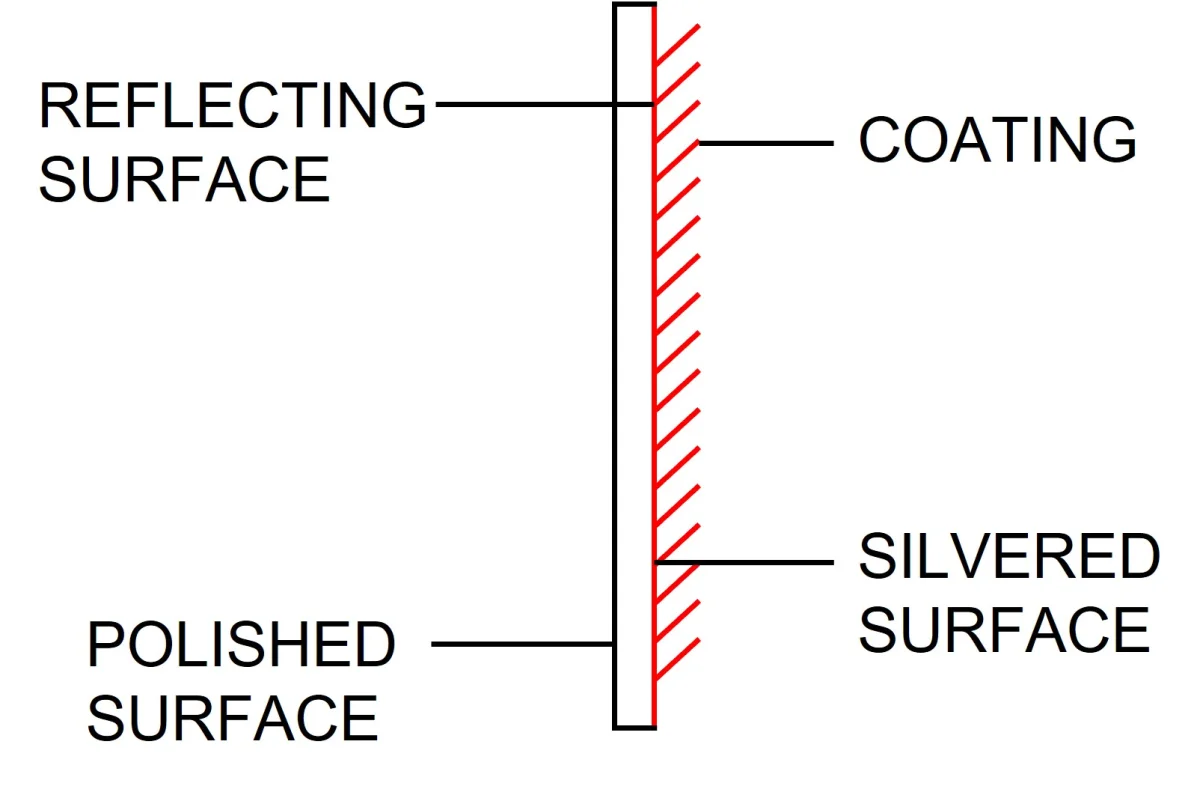
(a) Plane mirror — It is made from few mm thick glass plate. One surface of the glass plate is polished to a high degree of smoothness. This forms the front surface of the mirror and the other surface is silvered (i.e., silver mercury or some suitable material is deposited over it). The silvered surface is further coated with some opaque material so as to protect the silvering on it.
The two surfaces of the plane mirror are shown below —
Explain the following terms - Plane mirror. Draw diagram to show them.
(b) Incident ray — the ray of light striking a reflecting surface is called the incident ray.
(c) Reflected ray — the light ray obtained after reflection from the surface in the same medium in which the incident ray is travelling is called reflected ray.
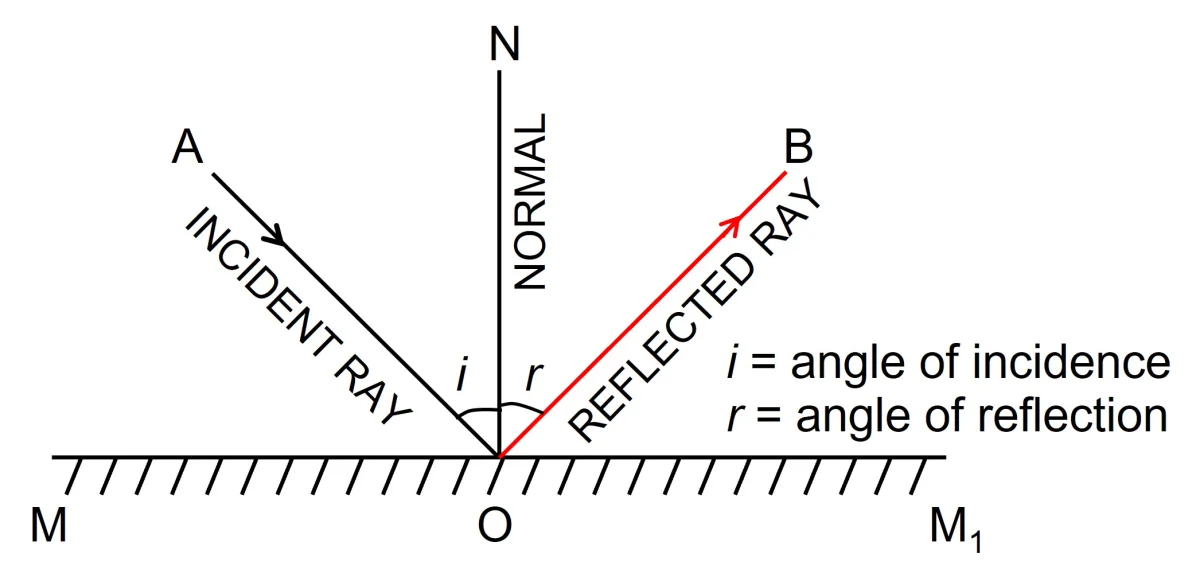
(d) Angle of incidence — The angle which the incident ray makes with the normal at the point of incidence, is called angle of incidence.
It is denoted by the letter i.
(e) Angle of reflection — The angle which the reflected ray makes with the normal at the point of incidence, is called angle of reflection.
It is denoted by the letter r.
Below diagram illustrates the Incident ray, Reflected ray, Angle of incidence and Angle of reflection:
The two surfaces of the plane mirror are shown below —
Explain the following terms - Plane mirror. Draw diagram to show them.
(b) Incident ray — the ray of light striking a reflecting surface is called the incident ray.
(c) Reflected ray — the light ray obtained after reflection from the surface in the same medium in which the incident ray is travelling is called reflected ray.
(d) Angle of incidence — The angle which the incident ray makes with the normal at the point of incidence, is called angle of incidence.
It is denoted by the letter i.
(e) Angle of reflection — The angle which the reflected ray makes with the normal at the point of incidence, is called angle of reflection.
It is denoted by the letter r.
Below diagram illustrates the Incident ray, Reflected ray, Angle of incidence and Angle of reflection:
📌 Diagram / Image Space
Question 2Read Mode
Differentiate between reflection of light from a plane mirror and that from a plane wall.
Answer
Reflection of light from a plane mirror Reflection of light from a plane wall
When a ray of light is incident on a smooth and polished surface such as a plane mirror then regular reflection occurs. When a ray of light is incident on a plane wall then irregular reflection occurs.
When a parallel beam of light is incident on a plane mirror, the reflected beam is also parallel and it is in a fixed direction . When rays fall at different points on a plane wall then due to uneven surface at different points, light rays gets reflected in different directions. As a result, The reflected light spreads over a wide area and it does not follow a particular direction.
When a ray of light is incident on a smooth and polished surface such as a plane mirror then regular reflection occurs. When a ray of light is incident on a plane wall then irregular reflection occurs.
When a parallel beam of light is incident on a plane mirror, the reflected beam is also parallel and it is in a fixed direction . When rays fall at different points on a plane wall then due to uneven surface at different points, light rays gets reflected in different directions. As a result, The reflected light spreads over a wide area and it does not follow a particular direction.
Question 3Read Mode
State the two laws of reflection of light.
Answer
The two laws of reflection are —
State the two laws of reflection of light.
The angle of incidence i is equal to the angle of reflection r (i.e., ∠i = ∠r)
∠AON = ∠BON
The incident ray, the reflected ray and the normal at the point of incidence, lie in the same plane.
AO, ON and OB are in one plane.
State the two laws of reflection of light.
The angle of incidence i is equal to the angle of reflection r (i.e., ∠i = ∠r)
∠AON = ∠BON
The incident ray, the reflected ray and the normal at the point of incidence, lie in the same plane.
AO, ON and OB are in one plane.
Question 4Read Mode
Draw a diagram to show the reflection of a ray of light by a plane mirror. In the diagram, label the incident ray, the reflected ray, the normal, the angle of incidence and the angle of reflection.
(a) Write three characteristics of the image formed by a plane mirror?
(b) How is the position of image related to the position of the object?
(a) Write three characteristics of the image formed by a plane mirror?
(b) How is the position of image related to the position of the object?
Answer
Below is the labelled diagram showing the reflection of a ray of light by a plane mirror:
Draw a diagram to show the reflection of a ray of light by a plane mirror. In the diagram, label the incident ray, the reflected ray, the normal, the angle of incidence and the angle of reflection.
.
(a) The characteristics of an image formed by a plane mirror are —
Image is upright (or erect).
Image is virtual.
Image is of the same size as the object.
(b) The position of the image is situated at the same perpendicular distance behind the mirror as the object is in front of it.
Draw a diagram to show the reflection of a ray of light by a plane mirror. In the diagram, label the incident ray, the reflected ray, the normal, the angle of incidence and the angle of reflection.
.
(a) The characteristics of an image formed by a plane mirror are —
Image is upright (or erect).
Image is virtual.
Image is of the same size as the object.
(b) The position of the image is situated at the same perpendicular distance behind the mirror as the object is in front of it.
Question 5Read Mode
Differentiate between a real and a virtual image.
Answer
The difference between a real and a virtual image are as follows —
Real image Virtual image
A real image is formed due to actual intersection of the reflected rays. A virtual image is formed when the reflected rays appear to meet when produced backwards.
A real image can be obtained on a screen. A virtual image cannot be obtained on a screen.
A real image is inverted with respect to the object A virtual image is erect with respect to the object.
Example — The image of a distant object formed by a concave mirror. Example — The image of an object formed by a plane mirror or by a convex mirror.
Real image Virtual image
A real image is formed due to actual intersection of the reflected rays. A virtual image is formed when the reflected rays appear to meet when produced backwards.
A real image can be obtained on a screen. A virtual image cannot be obtained on a screen.
A real image is inverted with respect to the object A virtual image is erect with respect to the object.
Example — The image of a distant object formed by a concave mirror. Example — The image of an object formed by a plane mirror or by a convex mirror.
Question 6Read Mode
What is meant by lateral inversion of an image in a plane mirror? Explain it with the help of a ray diagram.
Answer
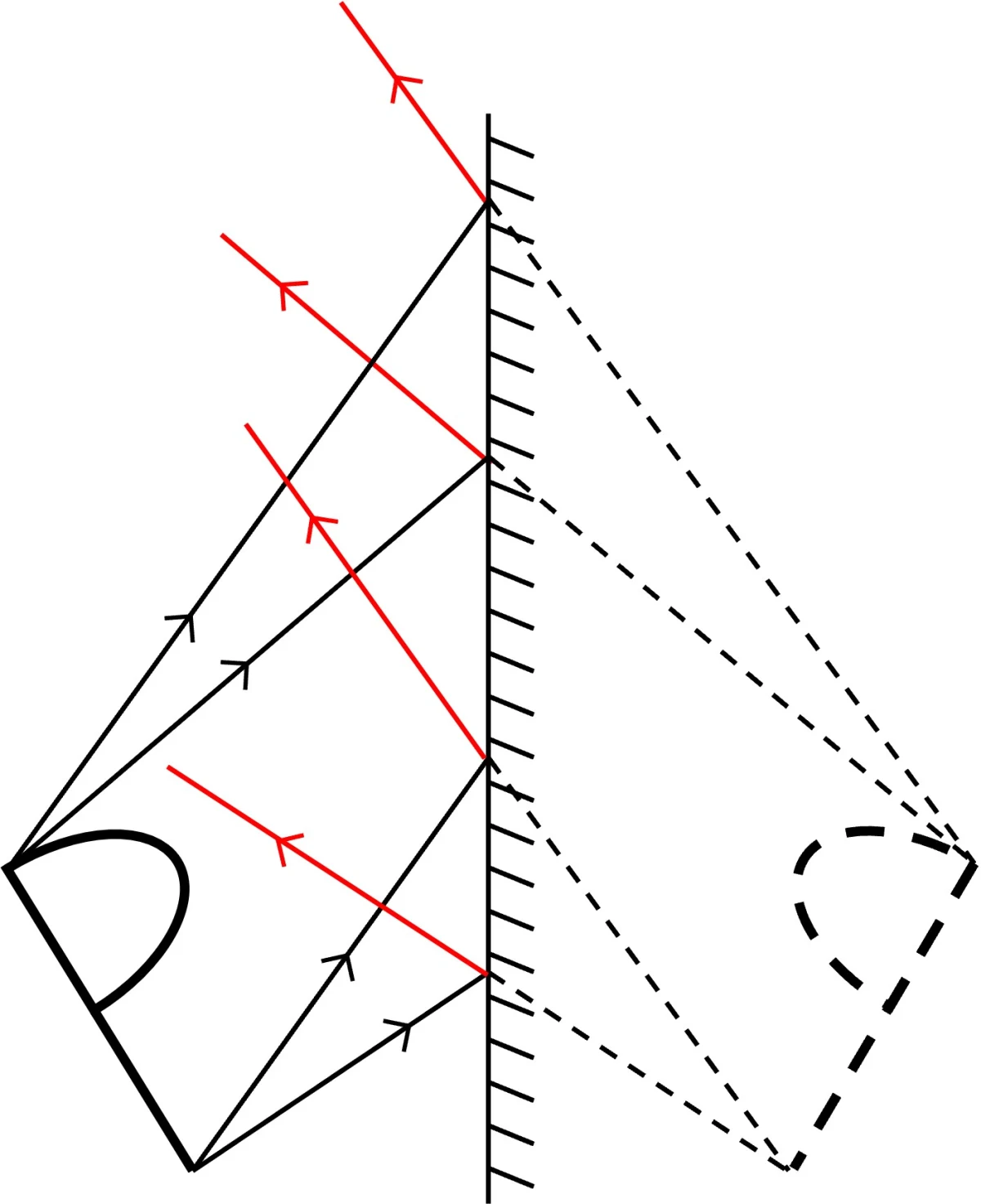
The interchange of the left and right sides in the image of an object in a plane mirror is called lateral inversion.
Below diagram illustrates lateral inversion of an image:
What is meant by lateral inversion of an image in a plane mirror? Explain it with the help of a ray diagram.
Below diagram illustrates lateral inversion of an image:
What is meant by lateral inversion of an image in a plane mirror? Explain it with the help of a ray diagram.
📌 Diagram / Image Space
Question 7Read Mode
The letters on the front of an ambulance are written laterally inverted like ƎƆИA⅃UꓭMA. Give reason.
Answer
The letters on the front of an ambulance are written laterally inverted like ƎƆИA⅃UꓭMA so that the driver of the vehicle moving ahead of the ambulance reads the word laterally inverted as AMBULANCE, in his rear view mirror, and gives way to the ambulance first.
Exercise 7(A) — Long Answer Type
5 QuestionsQuestion 1Read Mode
With the help of diagrams, explain the difference between regular and irregular reflection.
📌 Diagram / Image Space
Answer
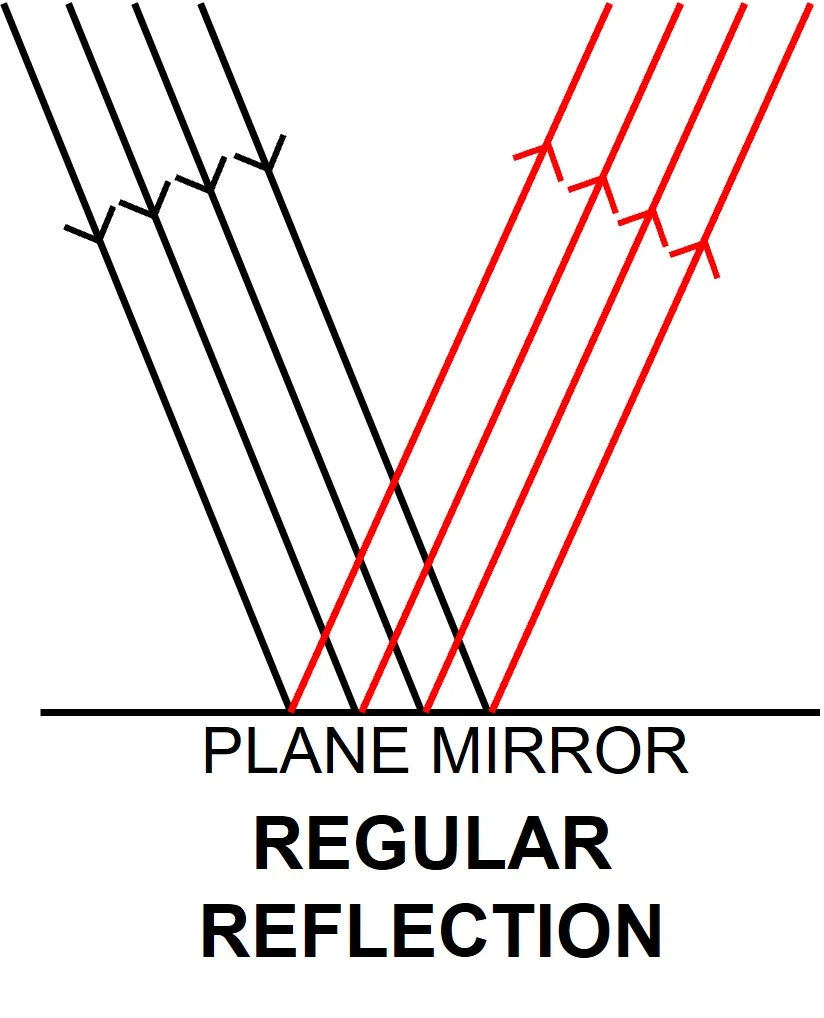
Regular reflection — It occurs when a beam of light falls on a smooth and polished surface, such as a plane mirror. In the figure shown below, a parallel beam of light is incident on a plane mirror. The reflected beam is also parallel and it is in a fixed direction. It can be seen only from a particular direction.
With the help of diagrams, explain the difference between regular and irregular reflection.
Irregular reflection — It occurs when a beam of light falls on a rough or ordinary surface such as the walls of a room or the page of a book which appear smooth but have many small projections over it.
In the figure given below, light rays fall at different points on a rough surface and each ray gets reflected from it obeying the laws of reflection of light. Due to uneven surface at different points, light rays gets reflected in different directions and give rise to diffused or irregular reflection.
With the help of diagrams, explain the difference between regular and irregular reflection.
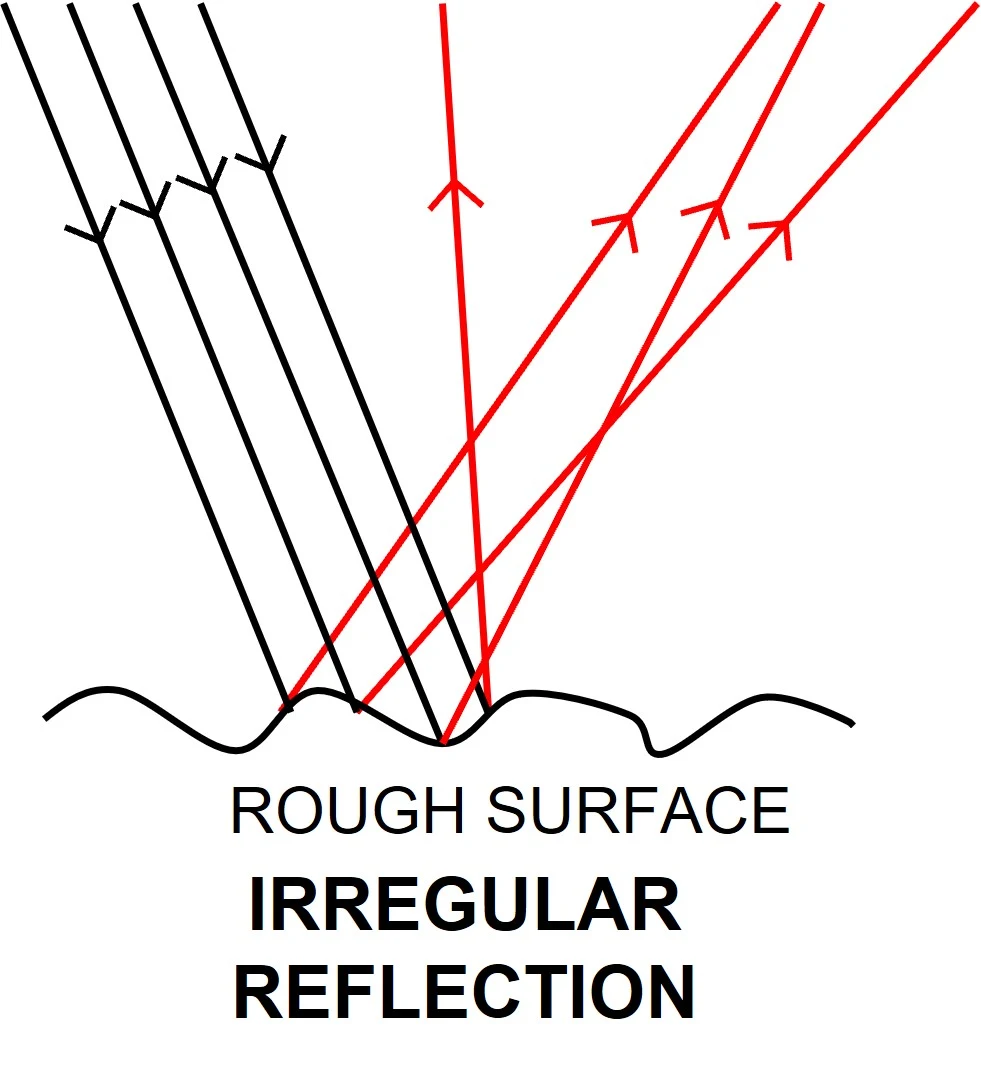
As a result, reflected light spreads over a wide area and it does not follow a particular direction. Hence, reflected light can be seen from anywhere.
With the help of diagrams, explain the difference between regular and irregular reflection.
Irregular reflection — It occurs when a beam of light falls on a rough or ordinary surface such as the walls of a room or the page of a book which appear smooth but have many small projections over it.
In the figure given below, light rays fall at different points on a rough surface and each ray gets reflected from it obeying the laws of reflection of light. Due to uneven surface at different points, light rays gets reflected in different directions and give rise to diffused or irregular reflection.
With the help of diagrams, explain the difference between regular and irregular reflection.
📌 Diagram / Image Space
As a result, reflected light spreads over a wide area and it does not follow a particular direction. Hence, reflected light can be seen from anywhere.
Question 2Read Mode
State the laws of reflection and describe an experiment to verify them.
Answer
The two laws of reflection are —
State the laws of reflection and describe an experiment to verify them.
The angle of incidence i is equal to the angle of reflection r (i.e., ∠i = ∠r)
∠AON = ∠BON
The incident ray, the reflected ray and the normal at the point of incidence, lie in the same plane.
AO, ON and OB are in one plane.
Experimental verification —
Fix a sheet of white paper on a drawing board and draw a line MM1 as shown below. On this line, take a point O nearly at the middle of it and draw a line OA such that ∠MOA is less than 90° (say, ∠MOA = 60°). Then draw a normal ON on line MM1 at point O, and place a small plane mirror vertically by means of a stand with it's silvered surface on the line MM1.
Now fix two pins P and Q vertically at some distance (say 5 cm) apart on line OA, on the board. Keeping eye on the other side of the normal (but on the same side of mirror), see clearly the images P'and Q' of the pins P and Q.
Now fix a pin R such that it is in line with the images P' and Q' as observed in the mirror. Now fix one more pin S such that the pin S is also in line with the pin R as well as the images P' and Q' of pins P and Q.
Draw small circles on paper around the positions of pins as in figure. Remove the pins and draw a line OB joining the point O to the pin points S and R.
As we can observe, AO is the incident ray, OB is the reflected ray, ∠AON = i is the angle of incidence and ∠BON = r is the angle of reflection. The angles AON and BON are measured and recorded in the observation table.
The experiment is repeated for the ∠MOA equal to 50°, 40° and 30°.
Observation table —
S. No. Angle of incidence,
i = ∠AON
(in degrees) Angle of reflection
r = ∠BON
(in degrees)
1 30 30
2 40 40
3 50 50
4 60 60
From the above observation table, we find that in each case, angle of incidence is equal to the angle of reflection. This verifies the first law of reflection.
The experiment is being performed on a flat drawing board, with mirror normal to the plane on which white sheet of paper is being fixed. Since the lower tips of all the four pins lie on the same plane (i.e., the plane of paper), therefore, the incident ray, the reflected ray and the normal at the point of incidence, all lie in one plane. This verifies the second law of reflection.
State the laws of reflection and describe an experiment to verify them.
📌 Diagram / Image Space
The angle of incidence i is equal to the angle of reflection r (i.e., ∠i = ∠r)
∠AON = ∠BON
The incident ray, the reflected ray and the normal at the point of incidence, lie in the same plane.
AO, ON and OB are in one plane.
Experimental verification —
Fix a sheet of white paper on a drawing board and draw a line MM1 as shown below. On this line, take a point O nearly at the middle of it and draw a line OA such that ∠MOA is less than 90° (say, ∠MOA = 60°). Then draw a normal ON on line MM1 at point O, and place a small plane mirror vertically by means of a stand with it's silvered surface on the line MM1.
Now fix two pins P and Q vertically at some distance (say 5 cm) apart on line OA, on the board. Keeping eye on the other side of the normal (but on the same side of mirror), see clearly the images P'and Q' of the pins P and Q.
Now fix a pin R such that it is in line with the images P' and Q' as observed in the mirror. Now fix one more pin S such that the pin S is also in line with the pin R as well as the images P' and Q' of pins P and Q.
Draw small circles on paper around the positions of pins as in figure. Remove the pins and draw a line OB joining the point O to the pin points S and R.
As we can observe, AO is the incident ray, OB is the reflected ray, ∠AON = i is the angle of incidence and ∠BON = r is the angle of reflection. The angles AON and BON are measured and recorded in the observation table.
The experiment is repeated for the ∠MOA equal to 50°, 40° and 30°.
Observation table —
S. No. Angle of incidence,
i = ∠AON
(in degrees) Angle of reflection
r = ∠BON
(in degrees)
1 30 30
2 40 40
3 50 50
4 60 60
From the above observation table, we find that in each case, angle of incidence is equal to the angle of reflection. This verifies the first law of reflection.
The experiment is being performed on a flat drawing board, with mirror normal to the plane on which white sheet of paper is being fixed. Since the lower tips of all the four pins lie on the same plane (i.e., the plane of paper), therefore, the incident ray, the reflected ray and the normal at the point of incidence, all lie in one plane. This verifies the second law of reflection.
Question 3Read Mode
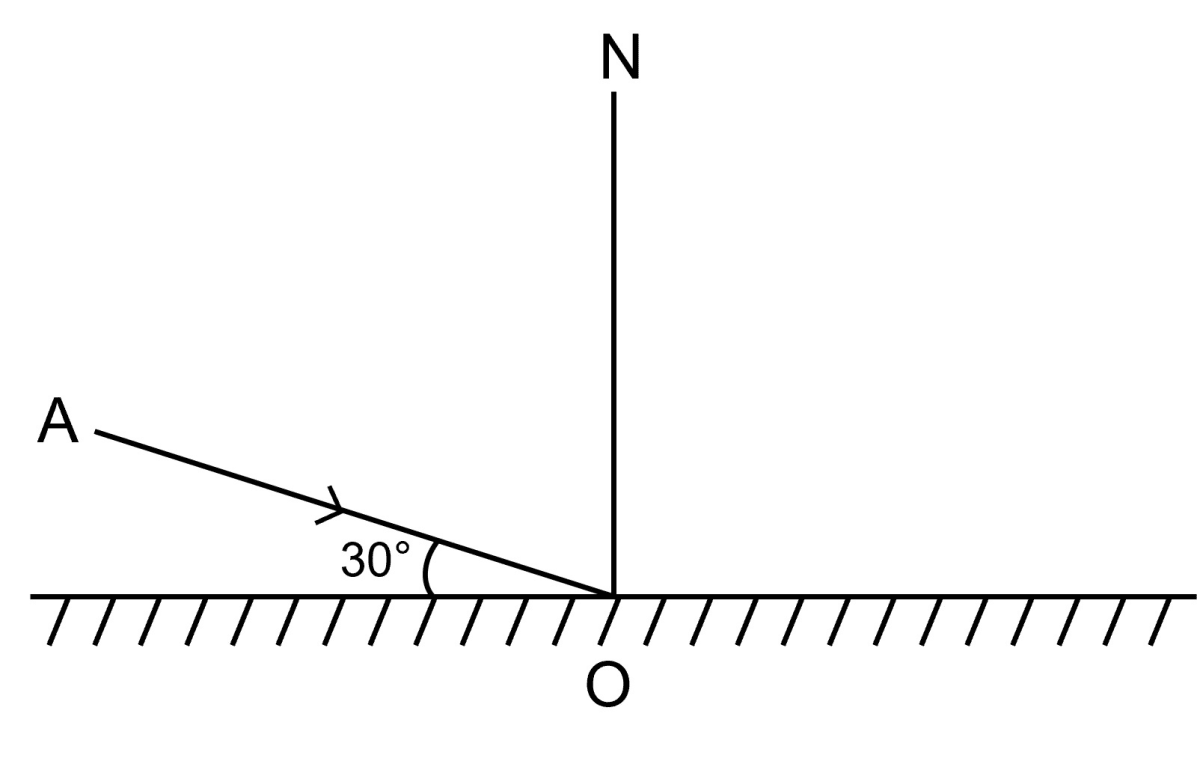
The below figure shows an incident ray AO and the normal ON on a plane mirror. The angle which the incident ray AO makes with the mirror is 30°.
The figure given below shows an incident ray AO and the normal ON on a plane mirror. The angle which the incident ray AO makes with the mirror is 30°. Find the angle of incidence. Draw the reflected ray and then find the angle between the incident and reflected rays.
(a) Find the angle of incidence.
(b) Draw the reflected ray and then find the angle between the incident and reflected rays.
The figure given below shows an incident ray AO and the normal ON on a plane mirror. The angle which the incident ray AO makes with the mirror is 30°. Find the angle of incidence. Draw the reflected ray and then find the angle between the incident and reflected rays.
(a) Find the angle of incidence.
(b) Draw the reflected ray and then find the angle between the incident and reflected rays.
📌 Diagram / Image Space
Answer
(a) The angle of incidence = 90° - 30° = 60°
(b) Diagram showing the reflected ray is given below:
The figure given below shows an incident ray AO and the normal ON on a plane mirror. The angle which the incident ray AO makes with the mirror is 30°. Find the angle of incidence. Draw the reflected ray and then find the angle between the incident and reflected rays.
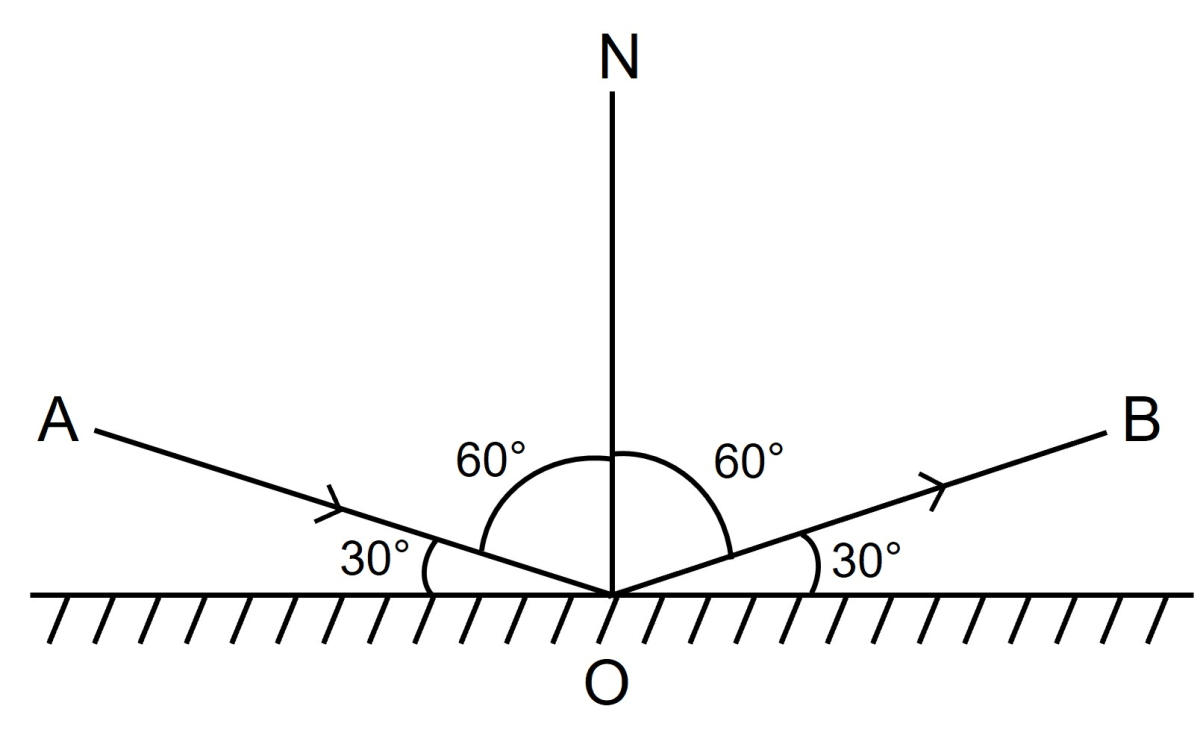
The angle between the incident ray and the reflected ray = angle of incidence + angle of reflection
As we know,
Angle of incidence = Angle of reflection = 60°
Therefore, we get,
60° + 60° = 120°
Hence, the angle between the incident ray and reflected ray = 120°
(b) Diagram showing the reflected ray is given below:
The figure given below shows an incident ray AO and the normal ON on a plane mirror. The angle which the incident ray AO makes with the mirror is 30°. Find the angle of incidence. Draw the reflected ray and then find the angle between the incident and reflected rays.
📌 Diagram / Image Space
The angle between the incident ray and the reflected ray = angle of incidence + angle of reflection
As we know,
Angle of incidence = Angle of reflection = 60°
Therefore, we get,
60° + 60° = 120°
Hence, the angle between the incident ray and reflected ray = 120°
Question 4Read Mode
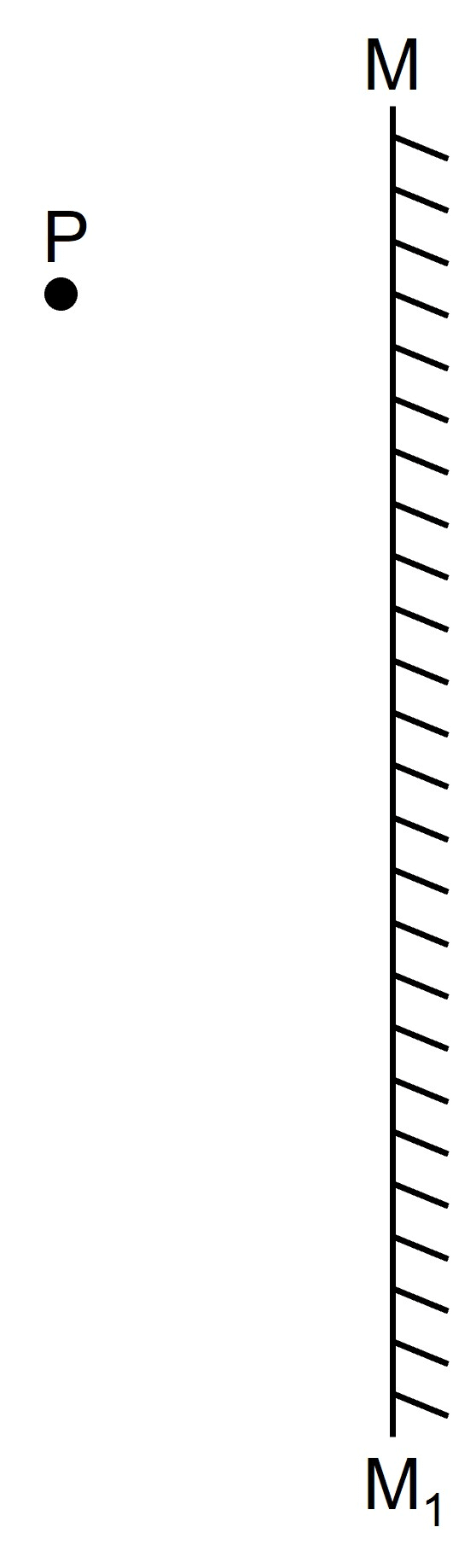
The diagram in below figure shows a point object P in front of a plane mirror MM1.
(a) Complete the diagram by taking two rays from the point P to show the formation of its image.
(b) In the diagram, mark the position of eye to see the image.
(c) Is the image formed real or virtual? Explain why.
The diagram below shows a point object P in front of a plane mirror MM<sub>1<sub>. Complete the diagram by taking two rays from the point P to show the formation of its image. In the diagram, mark the position of eye to see the image. Is the image formed real or virtual? Explain why.
(a) Complete the diagram by taking two rays from the point P to show the formation of its image.
(b) In the diagram, mark the position of eye to see the image.
(c) Is the image formed real or virtual? Explain why.
The diagram below shows a point object P in front of a plane mirror MM<sub>1<sub>. Complete the diagram by taking two rays from the point P to show the formation of its image. In the diagram, mark the position of eye to see the image. Is the image formed real or virtual? Explain why.
📌 Diagram / Image Space
Answer
Diagram showing the image with the position of the eye marked is given below:
The diagram below shows a point object P in front of a plane mirror MM<sub>1<sub>. Complete the diagram by taking two rays from the point P to show the formation of its image. In the diagram, mark the position of eye to see the image. Is the image formed real or virtual? Explain why.
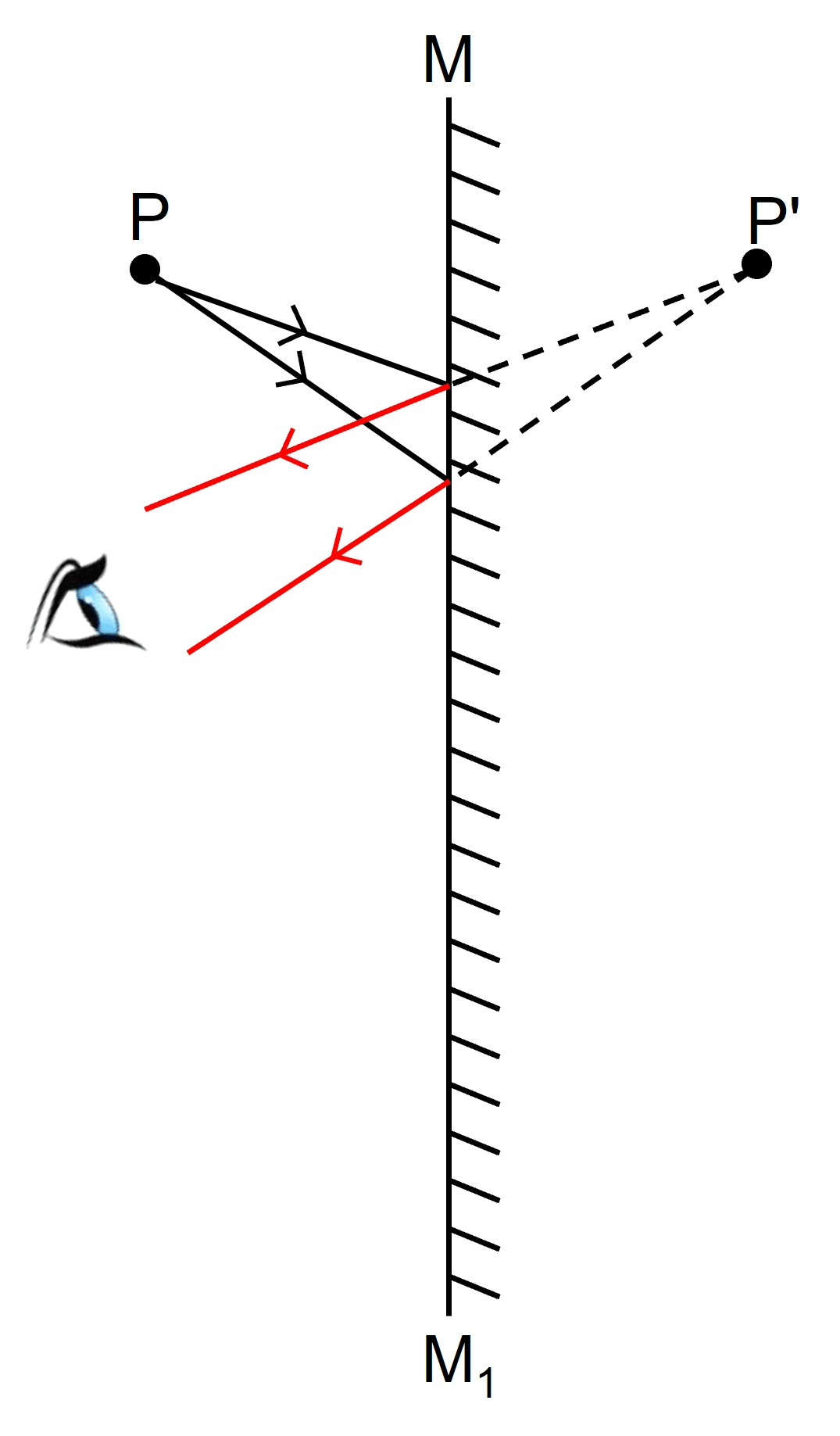
(c) The image formed is virtual because the reflected rays appear to meet only when they are produced backwards.
The diagram below shows a point object P in front of a plane mirror MM<sub>1<sub>. Complete the diagram by taking two rays from the point P to show the formation of its image. In the diagram, mark the position of eye to see the image. Is the image formed real or virtual? Explain why.
📌 Diagram / Image Space
(c) The image formed is virtual because the reflected rays appear to meet only when they are produced backwards.
Question 5Read Mode
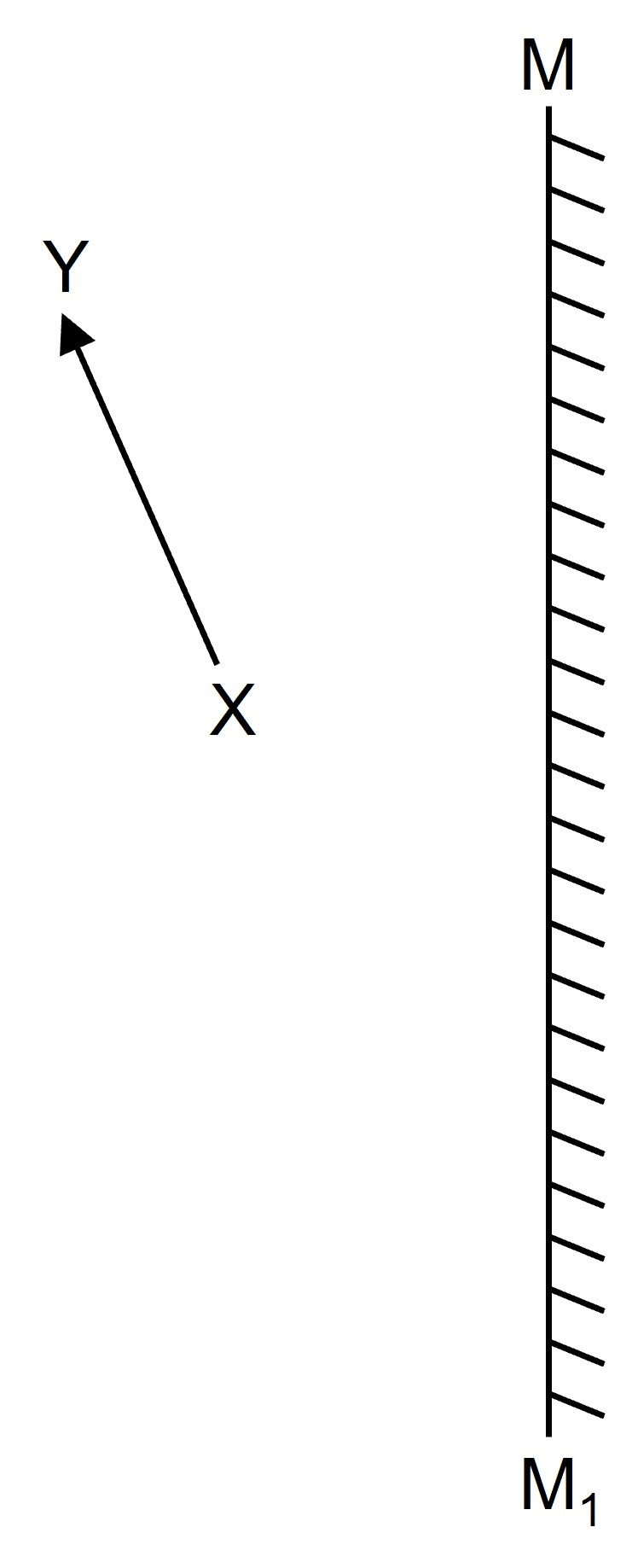
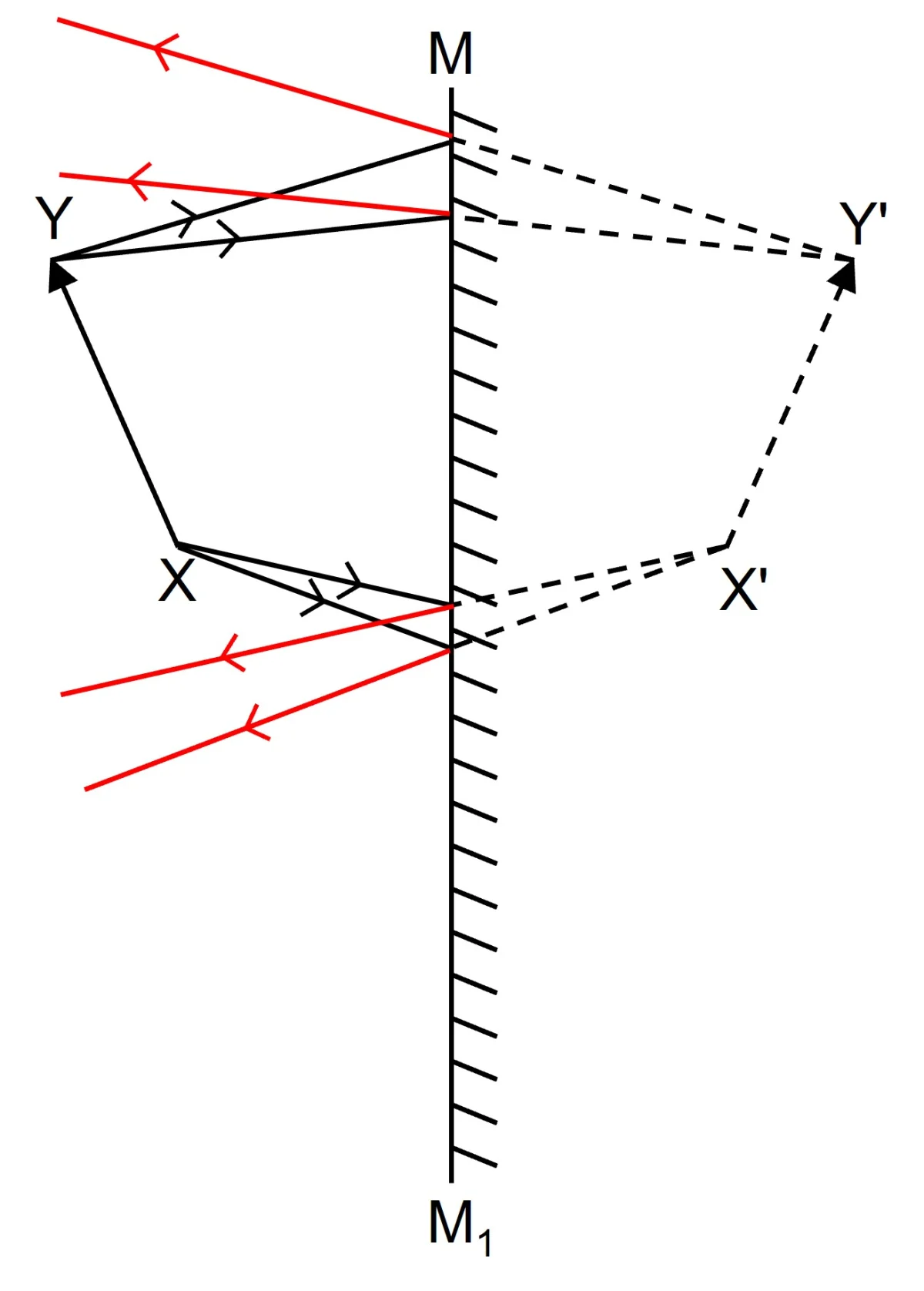
The diagram below in figure shows an object XY in front of a plane mirror MM1. Draw on the diagram, path of two rays from each point X and Y of the object to show the formation of its image.
The diagram shown below shows an object XY in front of a plane mirror MM<sub>1</sub>. Draw on the diagram, path of two rays from each point X and Y of the object to show the formation of it's image.
The diagram shown below shows an object XY in front of a plane mirror MM<sub>1</sub>. Draw on the diagram, path of two rays from each point X and Y of the object to show the formation of it's image.
📌 Diagram / Image Space
Answer
Complete diagram showing the formation of the image is given below:
The diagram shown below shows an object XY in front of a plane mirror MM<sub>1</sub>. Draw on the diagram, path of two rays from each point X and Y of the object to show the formation of it's image.
The diagram shown below shows an object XY in front of a plane mirror MM<sub>1</sub>. Draw on the diagram, path of two rays from each point X and Y of the object to show the formation of it's image.
📌 Diagram / Image Space
Exercise 7(A) — Numericals
5 QuestionsQuestion 1Read Mode
A ray is incident on a plane mirror. Its reflected ray is perpendicular to the incident ray. Find the angle of incidence.
Answer
According to the law of reflection,
Angle of incidence = Angle of reflection
i.e., i = r
Given,
Reflected ray is perpendicular to incident ray
Hence,
i + r = 90°
Using above law, we get,
i + i = 90°
2i = 90°
Hence,
i = r = 45°
Therefore, angle of incidence = 45°
Angle of incidence = Angle of reflection
i.e., i = r
Given,
Reflected ray is perpendicular to incident ray
Hence,
i + r = 90°
Using above law, we get,
i + i = 90°
2i = 90°
Hence,
i = r = 45°
Therefore, angle of incidence = 45°
Question 2Read Mode
A man standing in front of a plane mirror finds his image at a distance 6 metre from himself. What is the distance of man from the mirror?
Answer
Given,
Distance between the man and his image = 6 m
But for a plane mirror,
Object distance = Image distance
Therefore,
Distance between the man and mirror = Distance between mirror and image
Hence,
The distance of the man and the mirror =
6
2
2
6
= 3 m
Distance between the man and his image = 6 m
But for a plane mirror,
Object distance = Image distance
Therefore,
Distance between the man and mirror = Distance between mirror and image
Hence,
The distance of the man and the mirror =
6
2
2
6
= 3 m
Question 3Read Mode
An insect is sitting in front of a plane mirror at a distance 1 m from it.
(a) Where is the image of the insect formed?
(b) What is the distance between the insect and its image?
(a) Where is the image of the insect formed?
(b) What is the distance between the insect and its image?
Answer
(a) For a plane mirror, the image is as far behind the mirror as the object is in front of it i.e., the perpendicular distance of image from the mirror is equal to the perpendicular distance of object from the mirror.
Hence, the image of the insect is formed 1 m behind the mirror.
(b) The distance between the insect and it's image = the perpendicular distance of image from the mirror + the perpendicular distance of object from the mirror
= 1 + 1
= 2 m
Hence, the distance between the insect and its image is 2 m.
Hence, the image of the insect is formed 1 m behind the mirror.
(b) The distance between the insect and it's image = the perpendicular distance of image from the mirror + the perpendicular distance of object from the mirror
= 1 + 1
= 2 m
Hence, the distance between the insect and its image is 2 m.
Question 4Read Mode
An object is kept at 60 cm in front of a plane mirror. If the mirror is now moved 25 cm away from the object, how does the image shift from its previous position ?
Answer
Given,
Initially, the distance of the object A in front of plane mirror M is AM = 60 cm.
Therefore the image B is at a distance MB = 60 cm from the mirror M behind it.
Distance between the object A and its image B = 60 + 60 = 120 cm
On shifting the mirror by 25 cm away from the object, the new distance of object A from the mirror M' become AM' = 60 + 25 = 85 cm .
The new image B' is now at a distance M'B' = 85 cm behind the mirror M'.
So, the current distance of the image from the object = 85 cm + 85 cm = 170 cm
Let the reference point be the position of the object,
Thus,
New distance of the image from the object - Distance of the image from the object initially = Distance between the two positions of the image
⟹
170
cm–
120
cm
=
50
cm
⟹170 cm–120 cm=50 cm
Hence, the image shifts 50 cm from its previous position.
Initially, the distance of the object A in front of plane mirror M is AM = 60 cm.
Therefore the image B is at a distance MB = 60 cm from the mirror M behind it.
Distance between the object A and its image B = 60 + 60 = 120 cm
On shifting the mirror by 25 cm away from the object, the new distance of object A from the mirror M' become AM' = 60 + 25 = 85 cm .
The new image B' is now at a distance M'B' = 85 cm behind the mirror M'.
So, the current distance of the image from the object = 85 cm + 85 cm = 170 cm
Let the reference point be the position of the object,
Thus,
New distance of the image from the object - Distance of the image from the object initially = Distance between the two positions of the image
⟹
170
cm–
120
cm
=
50
cm
⟹170 cm–120 cm=50 cm
Hence, the image shifts 50 cm from its previous position.
Question 5Read Mode
An optician while testing the eyes of a patient keeps a chart of letters 3 m behind the patient and asks him to see the letters on the image of chart formed in a plane mirror kept at distance 2 m in front of him. At what distance is the chart seen by the patient?
Answer
Given,
Distance between the man and the mirror = 2 m
Distance between the man and the chart = 3 m
Therefore,
Distance between the chart and the mirror = Distance between the man and the mirror + Distance between the man and the chart
= 3 m + 2 m
= 5 m
As the new image is formed on the mirror which is 2 m apart from the man,
So,
Distance at which the chart can be seen by the patient = 5 m + 2 m = 7 m
Hence, the chart seen by the patient is 7 m away from him.
Distance between the man and the mirror = 2 m
Distance between the man and the chart = 3 m
Therefore,
Distance between the chart and the mirror = Distance between the man and the mirror + Distance between the man and the chart
= 3 m + 2 m
= 5 m
As the new image is formed on the mirror which is 2 m apart from the man,
So,
Distance at which the chart can be seen by the patient = 5 m + 2 m = 7 m
Hence, the chart seen by the patient is 7 m away from him.





0 Comments