
Motion in One Dimension
Concise Physics Selina Solutions covering Exercises 2(A), 2(B) and 2(C), with multiple-choice questions, short answers, numericals, assertion–reason questions and a case study.
Core Formula Reference
Video Explanation
Exercise 2(A) — Multiple Choice Type
Question 1 — Which of the following is a scalar quantity? Force Time Acceleration Displacement
Force Time Acceleration Displacement
AnswerTime
Time has only magnitude, whereas force, acceleration and displacement all have magnitude as well as direction.
Question 2 — A vector quantity possesses : Direction Magnitude Both (a) and (b) None of these
A vector quantity possesses :
Direction Magnitude Both (a) and (b) None of these
AnswerBoth (a) and (b)
Vector quantities have both magnitude and direction.
Question 3 — A vector quantity is — work pressure distance velocity
A vector quantity is —
work pressure distance velocity
Answervelocity
A vector quantity has both magnitude and direction. Velocity has both magnitude and direction, so it is a vector quantity.
Question 4 — The motion of a train on a straight track is an example of ............... motion. Two-dimensional Three-dimensional One-dimensional All of these
Two-dimensional Three-dimensional One-dimensional All of these
AnswerOne-dimensional
As the train is moving on a straight track and there is no lateral movement (sideways), hence it is a one dimensional motion.
Question 5 — If a body starts its motion from point A to B and comes back to the same point after a certain time interval, the displacement is : 10 20 0 15

10 20 0 15
Answer0
If a body starts its motion from point A to B and comes back to the same point after a certain time interval, the displacement is 0. For example: In a circular motion, the body comes back to the starting point after completing the circle, then displacement is zero but distance covered is not zero.
Question 6 — Motion of a car in a crowded street is an example of : Uniform speed Uniform velocity Variable acceleration Uniform acceleration
Uniform speed Uniform velocity Variable acceleration Uniform acceleration
AnswerVariable acceleration
As the change in velocity of the car in not same in same interval of time, the acceleration is said to be variable.
Question 7 — The distance travelled by a body in 10 s when it travels with a uniform speed of 10 m s−1 is : 100 m 1 m 20 m 50 m
100 m 1 m 20 m 50 m
Answer100 m
As the body is moving with uniform speed, equal distance is covered in equal intervals of time.
Question 8 — For a particle in motion, which of the following quantity can be zero at any given instant? Displacement Distance Speed None of these
Displacement Distance Speed None of these
AnswerDisplacement
If a body starts its motion from point A to B and comes back to the same after a certain time interval, the displacement is 0. Whereas, distance covered and speed will not be zero.
Question 9 — 18 km h−1 is equal to — 10 m s−1 5 m s−1 18 m s−1 1.8 m s−1
18 km h−1 is equal to —
10 m s−1 5 m s−1 18 m s−1 1.8 m s−1
Answer5 m s−1
As,
Hence, 18 km h−1 is equal to 5 m s−1.
Question 10 — The value of g does not depend on the : Height of the body Mass of the body Shape of the body All of these
The value of g does not depend on the :
Height of the body Mass of the body Shape of the body All of these
AnswerAll of these
The value of g does not depend on height, mass or shape of the body. On the earth's surface, g is maximum at the poles and minium at the equator. The value of g decreases with altitude and also with depth from the earth's surface.
Question 11 — Free fall of a body near earth's surface is an example of : Uniform acceleration Uniform velocity Variable acceleration None of these
Uniform acceleration Uniform velocity Variable acceleration None of these
AnswerUniform acceleration
When a body is falling freely, the acceleration is said to be uniform as equal changes in velocity takes place in equal intervals of time.
Question 12 — The value of g is maximum at : Tropic of capricorn Equator Tropic of cancer Poles
The value of g is maximum at :
Tropic of capricorn Equator Tropic of cancer Poles
AnswerPoles
On the earth's surface, g is maximum at the poles and minium at the equator. The value of g decreases with altitude and also with depth from the earth's surface.
Question 13 — A body when projected up with an initial velocity u goes to a maximum height h in time t and then comes back at the point of projection. The correct statement is — the average velocity is 2h/t. the acceleration is zero. the final velocity on reaching the point of projection is 2u. the displacement is zero.
the average velocity is 2h/t. the acceleration is zero. the final velocity on reaching the point of projection is 2u. the displacement is zero.
Answerthe displacement is zero.
The displacement is zero because the initial and the final position of the body is same.
Question 14 — Identify the correct statement from the following : (a) The average speed of a body can be zero even if it's average velocity is not zero. (b) Speed and velocity both are scalar quantities. (c) The magnitude of velocity of a body in motion is its speed. (d) Speed and velocity can be positive or negative depending upon the direction of motion.
Identify the correct statement from the following :
(b) Speed and velocity both are scalar quantities.
(d) Speed and velocity can be positive or negative depending upon the direction of motion.
Answer(1) Incorrect — Average speed is the total distance travelled divided by time, and is never zero unless the body doesn’t move at all. On the other hand, average velocity can be zero if the displacement is zero (like in a round trip).
(3) Correct — The magnitude of velocity is the same as the speed of the body.
Question 15 — A car travels the first 2/5th part of its total distance with a speed v1 and the remaining 3/5th of the distance with speed v2. Its average speed is : (1/2)v1v2 (v1 + v2)/2 2v1v2/(v1 + v2) 5v1v2/(3v1 + 2v2)
(1/2)v1v2 (v1 + v2)/2 2v1v2/(v1 + v2) 5v1v2/(3v1 + 2v2)
Answer5v1v2/(3v1 + 2v2)
Let, total distance covered be S of which S1 is covered with v1 in time t1 and S2 with v2 in time t2.
Then,
and
As
Speed (v) = Distance (S)/Time (t)
Then,
Similarly
Now,
Average Speed (v) = Total distance travelled (S)/Total time taken (t)
Exercise 2(A) — Very Short Answer Type
Question 1 — State whether the following quantity is a scalar or vector? (a) pressure (b) force (c) momentum (d) energy (e) weight (f) speed.
(a) pressure
(b) force
(c) momentum
(d) energy
(e) weight
(f) speed.
Answer(a) Pressure — Scalar quantity
(b) Force — Vector quantity
(c) Momentum — Vector quantity
(d) Energy — Scalar quantity
(e) Weight — Vector quantity
(f) Speed — Scalar quantity
Question 2 — Write the parameters required to express a scalar quantity.
Unit in which the quantity is being expressed. Numerical value of the measured quantity.
Question 3 — Name the parameters required to express a vector quantity.
Unit in which the quantity is being expressed. Numerical value of the measured quantity. Direction.
Question 4 — What does the negative sign with a vector quantity indicates?
Question 5 — When is a body said to be at rest ?
A body is said to be at rest if it does not change its position with respect to its immediate surrounding.
Question 6 — When is a body said to be in motion ?
A body is said to be in motion if it changes its position with respect to its immediate surroundings.
Question 7 — What do you mean by motion in one direction ?
What do you mean by motion in one direction ?
AnswerQuestion 8 — Define displacement. State its unit.
Define displacement. State its unit.
AnswerThe shortest distance from the initial to the final position of the body, is the magnitude of displacement and its direction is from initial position to the final position. It is a vector quantity.
Unit — The S.I. unit of displacement is metre (m) and C.G.S. unit is centimetre (cm)
Question 9 — When is the magnitude of displacement equal to the distance?
When is the magnitude of displacement equal to the distance?
AnswerQuestion 10 — Define velocity. State its S.I. unit.
Define velocity. State its S.I. unit.
AnswerS.I. unit of velocity = metre/second = m/s C.G.S. unit of velocity = centimetre/second = cm/s.
Question 11 — Define speed. What is its S.I. unit ?
Define speed. What is its S.I. unit ?
AnswerSpeed (v) = Distance (S)/Time (t) = S/t
S.I. unit of speed = metre/second = m/s C.G.S. unit of speed = centimetre/second = cm/s.
Question 12 — Which quantity, speed or velocity gives the direction of motion of a body.
Question 13 — When is the instantaneous speed same as the average speed?
When is the instantaneous speed same as the average speed?
AnswerIn case of a body moving with uniform speed, the instantaneous speed and the average speed are equal (same as the uniform speed) because, in case of uniform speed, neither the speed nor the direction change.
Question 14 — Define acceleration. State its S.I. unit.
Define acceleration. State its S.I. unit.
AnswerAcceleration is the rate of change of velocity with time.
Numerically, acceleration is equal to the change in velocity in 1 s.
i.e.,
Acceleration = Change in velocity/Time interval S.I. unit of acceleration = meter/second² = m/s² C.G.S. unit of acceleration = centimeter/second² = cm/s²
Question 15 — What is meant by the term retardation? Name its S.I. unit.
What is meant by the term retardation? Name its S.I. unit.
AnswerIt's unit is same as that of acceleration.
S.I. unit of retardation = meter/second² = m/s² C.G.S. unit of retardation = centimeter/second² = cm/s²
Question 16 — Which of the quantity, velocity or acceleration determines the direction of motion ?
Which of the quantity, velocity or acceleration determines the direction of motion ?
AnswerPositive or negative sign of velocity indicates the direction of motion.
Acceleration is the rate of change of velocity with time. It does not say anything about direction of motion.
Positive or negative sign of acceleration tell us whether the velocity is increasing or decreasing.
Question 17 — Define the term acceleration due to gravity. State its average value.
Define the term acceleration due to gravity. State its average value.
AnswerThe average value of 'g' is 9.8 m s−2 (or nearly 10 m s−2).
Exercise 2(A) — Short Answer Type
Question 1 — Differentiate between scalar and vector quantities and give two examples of each.
Differentiate between scalar and vector quantities and give two examples of each.
AnswerDifferences between scalar and vector quantities are as follows —
| Scalar Quantity | Vector Quantity |
| These are physical quantities which are expressed only by their magnitude. | These physical quantities require magnitude as well as the direction to express them, then only their meaning is complete. |
| We need two parameters to express a scalar quantity. | We require three parameters to express a vector quantity. |
The parameters are: (i) unit in which the quantity is being measured
| (ii) numerical value of the measured quantity. | The parameters are: |
(i) unit (ii) direction (iii) numerical value of quantity.
| Scalar quantities can be added, subtracted, multiplied and divided by simple arithmetic methods. | Vector quantities follow different algebra for their addition, subtraction, multiplication and division. |
Example :
| (ii) mass, length, time, etc. | Example : |
(ii) velocity, acceleration, force, etc.
Question 2 — Both scalar and vector quantities can be added, subtracted, multiplied and divided by simple arithmetic methods. Is this statement correct? Give a reason for your answer.
No, the statement is not correct. Scalar quantities can be added, subtracted, multiplied and divided by simple arithmetic methods however vector quantities follow different algebra for their addition, subtraction and multiplication as they have magnitude as well as direction.
Question 3 — Differentiate between the following : (a) distance and displacement. (b) speed and velocity. (c) uniform velocity and variable velocity. (d) average speed and average velocity. (e) acceleration and retardation. (f) uniform acceleration and variable acceleration.
Differentiate between the following :
(a) distance and displacement.
(b) speed and velocity.
(c) uniform velocity and variable velocity.
(d) average speed and average velocity.
(e) acceleration and retardation.
(f) uniform acceleration and variable acceleration.
Answer(a) The difference between distance and displacement is as follows :
| Distance | Displacement |
| It is the length of the path traversed by the object in a certain time. | It is the distance travelled by the object in a specified direction in a certain time (i.e. it is the shortest distance between the final and the initial positions). |
| It is a scalar quantity i.e., it has only the magnitude. | It is a vector quantity i.e., it has both magnitude and direction. |
| It depends on the path followed by the object. | It does not depend on the path followed by the object. |
| It is always positive. | It can be positive or negative depending on its direction. |
| It can be more than or equal to the magnitude of displacement. | Its magnitude can be less than or equal to the distance, but can never be greater than the distance. |
| It may not be zero even if displacement is zero, but it can not be zero if displacement is not zero. | It is zero if distance is zero, but it can be zero if distance is not zero. |
(b) The difference between speed and velocity is as follows :
| Speed | Velocity |
| The distance travelled per second by a moving object is called its speed. | The distance travelled per second by a moving object in a particular direction is called its velocity. |
| It is a scalar quantity. The speed does not tell us the direction of motion. | It is a vector quantity. The velocity tells us the speed as well as the direction of motion. |
| The speed is always positive since direction is not taken into consideration. | The velocity can be positive or negative depending upon the direction of motion. |
| After one round in a circular path, the average speed is not zero. | After completing each round in a circular path, the average velocity is zero. |
(c) The difference between uniform velocity and variable velocity is as follows :
| Uniform Velocity | Variable Velocity (or non-uniform) |
| If a body travels equal distances in a particular direction, in equal intervals of time, the body is said to be moving with a uniform velocity. | If a body moves unequal distances in a particular direction in equal intervals of time or it moves equal distances in equal intervals of time, but its direction of motion does not remain the same, then the velocity of the body is said to be variable (non-uniform). |
| Example — A body, once started on a frictionless surface, moves with uniform velocity. | Example — The motion of a body in circular path, even with uniform speed is with variable velocity as the direction of motion of body continuously changes with time. |
(d) The difference between average speed and average velocity is as follows :
| Average Speed | Average Velocity |
| The ratio of the total distance travelled by the body to the total time of journey is called its average speed. | If the velocity of a body moving in a particular direction changes with time, the ratio of displacement to the time taken in the entire journey is called its average velocity. |
| Avg Speed = Total Distance/Total time | Avg Velocity = Displacement/Total time |
| Average speed can never be zero. | It can be zero, even if average speed is a non-zero value. |
(e) The differences between acceleration and retardation are as follows :
| Acceleration | Retardation |
| If the velocity of a body increases with time, it is called acceleration. | If the velocity of a body decreases with time, it is called retardation. |
| As it is increase in velocity per second so it is positive acceleration. | As it is decrease in velocity per second so retardation is negative acceleration. |
(f) The differences between uniform acceleration and variable acceleration are as follows :
| Uniform Acceleration | Variable acceleration |
| The acceleration is said to be uniform (or constant) when equal changes in velocity take place in equal intervals of time. | If changes in velocity are not same in the same intervals of time, the acceleration is said to be variable. |
| Example — The motion of a body under gravity (e.g., free fall of a body) | Example — The motion of a vehicle on a crowded (or hilly) road. |
Question 4 — Can displacement be zero even if distance is not zero? Give one example to explain your answer.
Can displacement be zero even if distance is not zero? Give one example to explain your answer.
AnswerYes, the displacement can be zero, even if the distance is not zero.
Example — When a body is thrown vertically upwards from a point A on the ground, after some time it comes back to the same point A, then the displacement of the body is zero but the distance travelled by the body is not zero.
Question 5 — Give an example of motion of a body moving with a constant speed, but with a variable velocity. Draw a diagram to represent such a motion.
At any instant, the velocity is along the tangent to the circular path at that point.
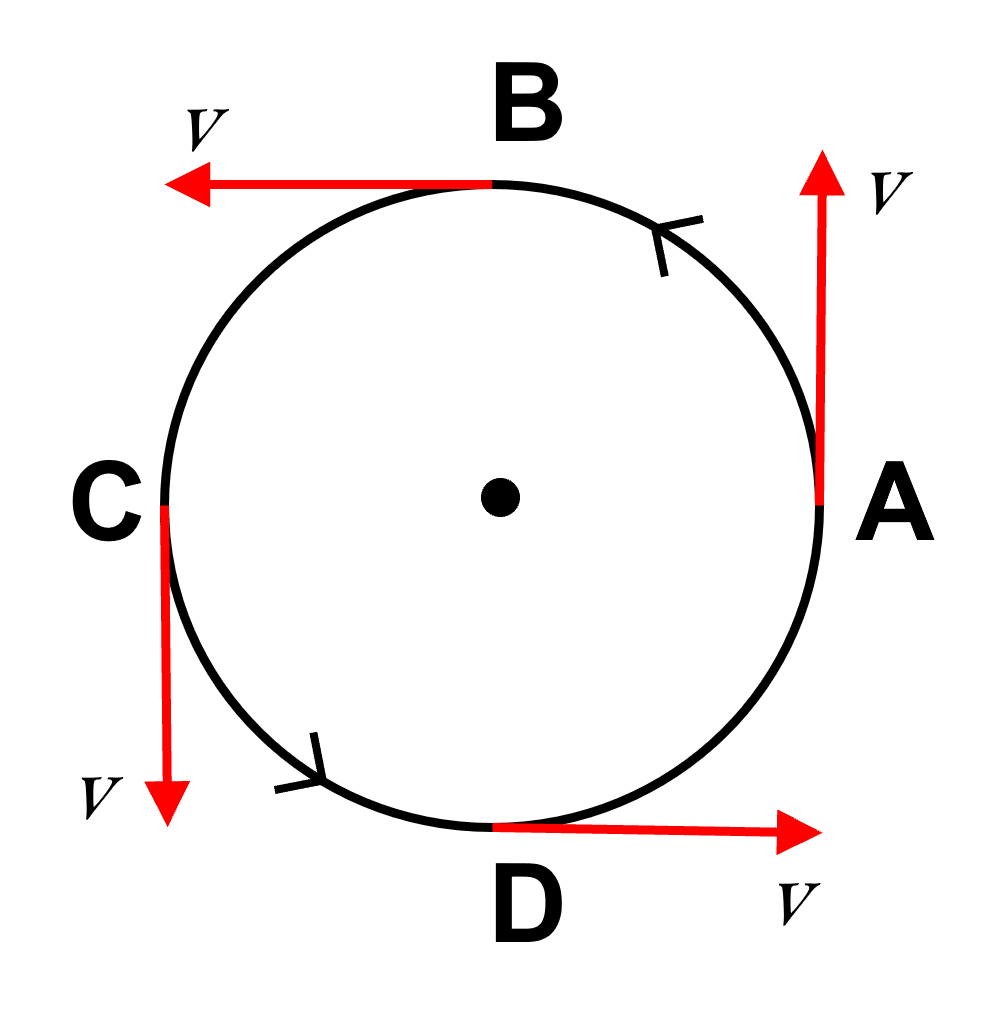
Question 6 — Give an example of motion in which average speed is not zero, but average velocity is zero.
Give an example of motion in which average speed is not zero, but average velocity is zero.
AnswerIf a body starts its motion and comes back to the same point after a certain time, (e.g., in a circular motion,) the displacement is zero, so the average velocity is also zero, but the total distance travelled is not zero and therefore, the average speed is not zero.
Question 7 — Give one example of each of the following : (a) uniform velocity (b) variable velocity (c) variable acceleration (d) uniform retardation.
Give one example of each of the following :
(a) uniform velocity
(b) variable velocity
(c) variable acceleration
(d) uniform retardation.
Answer(a) Uniform velocity — The rain drops reach on earth’s surface falling with uniform velocity.
(b) Variable velocity — The motion of a freely falling body is with variable velocity because although the direction of motion of the body does not change, but the speed continuously increases.
Question 8 — The diagram below shows the pattern of the oil on the road, dripping at a constant rate from a moving car. What information do you get from it about the motion of the car?

With the help of the given diagram, we observe that the red dots (dripping oil) are initially at regular intervals and later the gap between the dots decreases, which implies that initially the car was covering equal distances in equal intervals of time but later the distance is decreasing.
Question 9 — What is the direction of velocity of an object moving in a circular path?
Question 10 — 'The value of g remains same at all places on the earth surface'. Is this statement true? Give reason for your answer.
'The value of g remains same at all places on the earth surface'. Is this statement true? Give reason for your answer.
AnswerNo, the value of 'g' is not same at all places on the earth's surface. The value of g varies from place to place so an average value is considered. The average value of 'g' is 9.8 m s−2 or nearly 10 m s−2. The value of g decreases with altitude and also with depth from the earth's surface.
The value of 'g' is maximum at the poles and minimum at the equator on the earth surface.
Question 11 — If a stone and a pencil are dropped simultaneously in vacuum from the top of a tower, which of the two will reach the ground first ? Give reason.
Both will reach the ground simultaneously as value of g does not depend on the mass of the body. Acceleration due to gravity is same ( = g ) on both and there is no effect of friction and buoyancy due to air.
Exercise 2(A) — Numericals
Question 1 — The speed of a car is 72 km h−1. Express it in m s−1.
As,
Hence, 72 km h−1 is equal to 20 m s−1.
Question 2 — Express 15 m s−1 in km h−1.
Express 15 m s−1 in km h−1.
AnswerAs,
Hence, 15 m s−1 is equal to 54 km h−1.
Question 3 — Express each of the following in m s−1 — (a) 10 km h−1 (b) 18 km min-1
Express each of the following in m s−1 —
(a) 10 km h−1
(b) 18 km min-1
Answer(a) As,
Hence, 10 km h−1 is equal to 2.78 m s−1.
(b) As,
Hence, 18 km h−1 is equal to 300 m s−1.
Question 4 — Arrange the following speeds in increasing order — 10 m s−1, 1 km min-1, 18 km h−1.
Arrange the following speeds in increasing order — 10 m s−1, 1 km min-1, 18 km h−1.
AnswerIn order to arrange in increasing order of speeds, the units of the given speeds must be same.
Hence, we convert all the three in m s−1.
(already in m s−1)
(b) 1 km min-1,
(c) 18 km h−1,
As,
From 1, 2 and 3, we get the increasing order as follows —
18 km h−1, 10 m s−1, 1 km min-1.
Question 5 — A train takes 3 h to travel from Agra to Delhi with a uniform speed of 65 km h−1. Find the distance between the two cities.
As we know,
Distance = Speed x Time
Given,
Substituting the values in the formula above, we get,
Hence, the distance between the two cities is 195 km.
Question 6 — A car travels first 30 km with a uniform speed of 60 km h−1 and then next 30 km with a uniform speed of 40 km h -1. Calculate — (i) the total time of journey, (ii) the average speed of the car.
Calculate —
(i) the total time of journey,
(ii) the average speed of the car.
AnswerGiven,
(i) As we know,
Time (t) = Distance (S)/Speed (v)
Substituting the values in the formula above, we get,
Converting 0.5 h to min we get,
and
Converting 0.75 h to min we get,
Hence, total time of journey is 75 min.
(ii) As we know,
Hence, total distance travelled is 60 km.
As we know,
Hence, average speed of the car is 48 km h−1.
Question 7 — A train takes 2 h to reach station B from station A, and then 3 h to return from station B to station A. The distance between the two stations is 200 km. Find — (i) the average speed, (ii) The average velocity of the train.
A train takes 2 h to reach station B from station A, and then 3 h to return from station B to station A. The distance between the two stations is 200 km.
Find —
(i) the average speed,
(ii) The average velocity of the train.
AnswerGiven,
(i) As we know,
Average speed = Total distance/Total time taken
Substituting the values of total distance travelled and total time taken in the formula of Average Speed above, we get,
Hence, average speed of the car is 80 km h−1.
Question 8 — A car moving on a straight path covers a distance of 1 km due east in 100 s. What is (i) the speed and (ii) the velocity, of car ?
What is
(i) the speed and
(ii) the velocity, of car ?
AnswerAs we know,
Speed (v) = distance (S)/time (t)
Given,
Substituting the values in the formula above, we get,
Hence, the speed of the car is 10 m s−1.
(ii) The magnitude of velocity of the car is same as that of speed of car i.e., 10 m s−1
However, when we talk about velocity, we mention direction also.
Hence, velocity of car is 10 m s−1 due east.
Question 9 — A body starts from rest and acquires a velocity 10 m s−1 in 2 s. Find the acceleration.
Given,
As we know,
Substituting the values in the formula above, we get,
Hence, acceleration of the body is 5 m s−2.
Question 10 — A car starting from rest acquires a velocity of 180 m s−1 in 0.05 h. Find the acceleration.
As we know,
Given,
Converting 0.05 h to s we get,
Substituting the values in the formula above, we get,
Hence, acceleration of the body is 1 m s−2.
Question 11 — A body is moving vertically upwards. Its velocity changes at a constant rate from 50 m s−1 to 20 m s−1 in 3 s. What is its acceleration ?
As we know,
Given,
Substituting the values in the formula above, we get,
Hence, acceleration of the body is -10 m s−2. Negative sign shows that the velocity decreases with time, so retardation is 10 m s−2.
Question 12 — A toy car initially moving with a uniform velocity of 18 km h−1 comes to a stop in 2 s. Find the retardation of the car in S.I. units.
As we know,
Given,
Hence, 18 km h−1 is equal to 5 m s−1.
Substituting the values in the formula above, we get,
Hence, acceleration of the body is -2.5 m s−2. Negative sign shows that the velocity decreases with time, so retardation is 2.5 m s−2.
Question 13 — A car accelerates at a rate of 5 m s−2. Find the increase in its velocity in 2 s.
As we know,
Hence,
Velocity Increase = Acceleration (a) × time(t)
Given,
Substituting the values in the formula above, we get,
Hence, increase in velocity is 10 m s−1.
Question 14 — A car is moving with a velocity 20 m s−1. The brakes are applied to retard it at a rate of 2 m s−2. What will be the velocity after 5 s of applying the brakes ?
As we know,
and retardation is negative acceleration.
Hence,
final vel. (v) − initial vel. (u) = Retardation(a) × time(t)
Given,
Substituting the values in the formula above, we get,
Hence, final velocity is 10 m s−1.
Question 15 — A bicycle initially moving with a velocity 5.0 m s−1 accelerates for 5 s at a rate of 2 m s−2 . What will be its final velocity?
As we know,
Hence,
final vel. (v) − initial vel. (u) = Acceleration (a) × time (t)
Given,
Substituting the values in the formula above, we get,
Hence, final velocity is 15 m s−1.
Question 16 — A car is moving in a straight line with speed 18 km h−1. It is stopped in 5 s by applying the brakes. Find — (i) the speed of car in m s−1, (ii) the retardation and (iii) the speed of car after 2 s of applying the brakes.
Find —
(i) the speed of car in m s−1,
(ii) the retardation and
(iii) the speed of car after 2 s of applying the brakes.
AnswerGiven,
(i) To convert speed to m s−1
Hence, 18 km h−1 is equal to 5 m s−1.
As we know,
Given,
Substituting the values in the formula above, we get,
Hence, acceleration of the car is -1 m s−2. Negative sign shows that the velocity decreases with time, so retardation is 1 m s−2.
(iii) Given,
Substituting the values in the formula for acceleration, we get,
Hence, the speed of car after 2 s of applying the brakes is 3 m s−1.
Exercise 2(B) — Multiple Choice Type
Question 1 — The slope of displacement-time graph gives : Velocity Acceleration Speed Displacement
The slope of displacement-time graph gives :
Velocity Acceleration Speed Displacement
AnswerVelocity
As, velocity is the ratio of displacement and time, therefore, the slope of displacement-time graph gives the velocity.
Question 2 — From the given displacement-time graph, answer the following questions : (i) The kind of motion depicted in this graph is : uniform non-uniform retardation all of the above (ii) The velocity between point A and C is: 20 m s−1 5 m s−1 10 m s−1 15 m s−1 (iii) The displacement at t = 3 s is: 15 m/s2 12.5 m/s2 40 m 30 m
From the given displacement-time graph, answer the following questions :
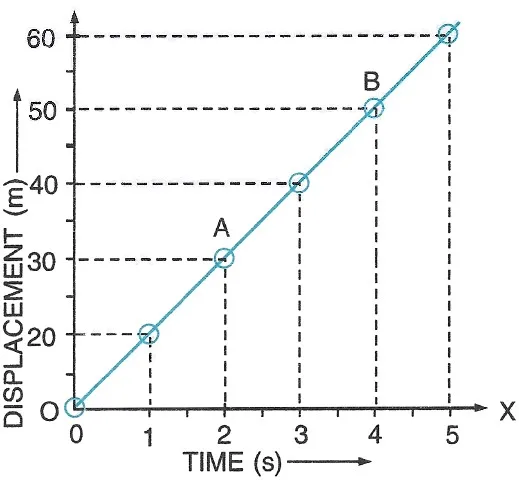
(i) The kind of motion depicted in this graph is :
uniform non-uniform retardation all of the above (ii) The velocity between point A and C is:
20 m s−1 5 m s−1 10 m s−1 15 m s−1
15 m/s2 12.5 m/s2 40 m 30 m
Answer(i) uniform
As the graph shows the linear relationship between displacement and time i.e., the car travels equal distance in equal intervals of time in a certain direction. Thus, it is moving with uniform motion.
(ii) 10 m s−1
As, velocity is the ratio of displacement and time, therefore,
(iii) 40 m
When we observe the graph, we notice that at t = 3 s, the displacement axis shows 40 m, hence, displacement at t = 3 s is 40 m
Question 3 — Out of the following, the correct displacement-time graph for uniform motion is:
Out of the following, the correct displacement-time graph for uniform motion is:

The correct displacement-time graph for uniform motion is :

When the displacement-time graph is a straight line inclined to the time axis, then the body covers equal distances in equal intervals of time and shows uniform motion.
Question 4 — From the velocity-time graph, we can determine : The displacement of the body in a certain time interval. The acceleration of the body at any instance. Both (1) and (2) None of these
From the velocity-time graph, we can determine :
The acceleration of the body at any instance. Both (1) and (2) None of these
AnswerBoth (1) and (2)
(1) Since, velocity x time = displacement, the area enclosed between the velocity-time sketch and X-axis (i.e., the time axis) gives the displacement of the body.
(2) Since, acceleration is equal to the ratio of change in velocity and time taken, therefore the slope (or gradient) of the velocity-time sketch gives the acceleration.
Question 5 — The velocity-time graph of a body in motion is a straight line inclined to the time axis. The correct statement is — velocity is uniform acceleration is uniform both velocity and acceleration are uniform neither velocity nor acceleration is uniform.
velocity is uniform acceleration is uniform both velocity and acceleration are uniform neither velocity nor acceleration is uniform.
Answeracceleration is uniform
When the velocity-time graph of a body in motion is a straight line inclined to the time axis then there are equal changes in velocity in equal intervals of time and hence, the movement is with uniform acceleration.
Question 6 — For a uniformly retarded motion, the velocity-time graph is : a curve. a straight line parallel to the time axis. a straight line perpendicular to the time axis. a straight line inclined to the time axis.
If the motion is uniformly retarded (i.e., its velocity decreases by an equal amount in each second), the velocity-time graph will be a straight line inclined to the time axis with a negative slope.
Question 7 — Study the velocity-time graph shown below and answer the questions that follow : (i) The distance travelled in 5 s : 10 m 50 m 125 m 250 m (ii) The retardation of the body as calculated from the graph is : 12 m s−2 15 m s−2 10 m s−2 20 m s−2
Study the velocity-time graph shown below and answer the questions that follow :

(i) The distance travelled in 5 s :
10 m 50 m 125 m 250 m (ii) The retardation of the body as calculated from the graph is :
12 m s−2 15 m s−2 10 m s−2 20 m s−2
Answer(i) 125 m
Area under the velocity-time graph will give the distance travelled in 5 secs :
Hence, the distance travelled in 5 s is 125 m.
(ii) 10 m s−2
Question 8 — The graph representing the state of rest of an object is :
The graph representing the state of rest of an object is :

The graph representing the state of rest of an object is :

As distance is not changing in distance-time graph hence, the state of rest of an object is shown.
Question 9 — Which of the following graphs shown below represents the uniform motion of an object?
Which of the following graphs shown below represents the uniform motion of an object?

The graph representing the uniform motion of an object is :

As in velocity-time graph, velocity of the body is not changing, therefore, the body is covering equal distance in equal intervals of time and is in uniform motion.
Question 10 — The velocity-time graph given below shows : Uniform acceleration Average speed Uniform velocity All of these
The velocity-time graph given below shows :

Uniform acceleration Average speed Uniform velocity All of these
AnswerUniform velocity
As in velocity-time graph, velocity of the body is not changing, therefore, the body is covering equal distance in equal intervals of time and is in uniform motion.
Question 11 — In the velocity-time graph shown below, the ratio of the distance travelled by the object in the last 2 s and the distance travelled in 7 s is : 1/2 1/4 1/3 2/3
In the velocity-time graph shown below, the ratio of the distance travelled by the object in the last 2 s and the distance travelled in 7 s is :

1/2 1/4 1/3 2/3
Answer1/4
Distance covered in last 2 s = area of triangle = 1/2 x 2 x 10 = 10 m
Question 12 — The velocity-time graph given below shows an object moving in a straight line. The displacement and the distance travelled by the object in 6 s will respectively be : 8 m, 16 m 16 m, 8 m 16 m, 16 m 8 m, 8 m

8 m, 16 m 16 m, 8 m 16 m, 16 m 8 m, 8 m
Answer8 m, 16 m
Displacement = area of 1st rectangle - area of 2nd rectangle + area of third rectangle
Question 13 — A rubber ball falls freely from a height h onto a smooth floor. After striking the floor, the ball again rises to the same height. Assume that the duration of contact of the ball with the floor is negligible. Identify the correct graph for velocity with time and height with time.
A rubber ball falls freely from a height h onto a smooth floor. After striking the floor, the ball again rises to the same height. Assume that the duration of contact of the ball with the floor is negligible. Identify the correct graph for velocity with time and height with time.
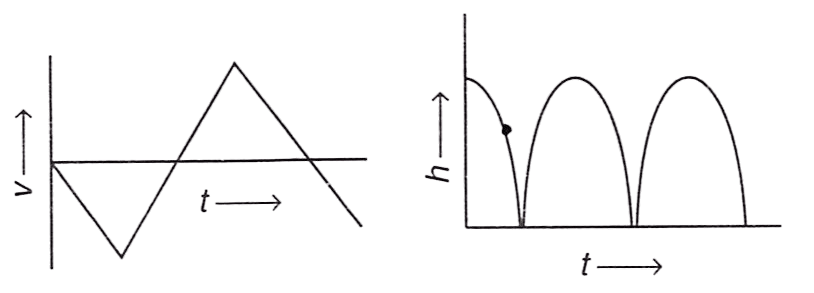
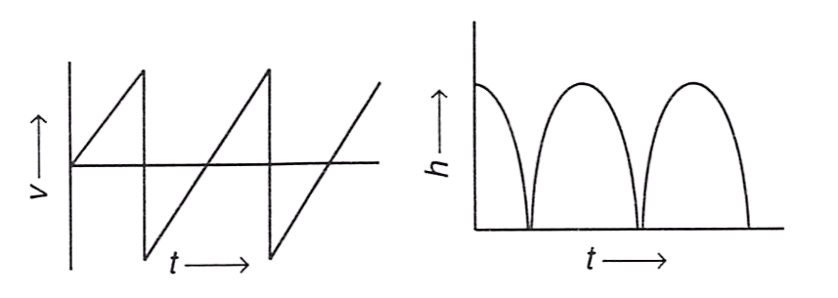
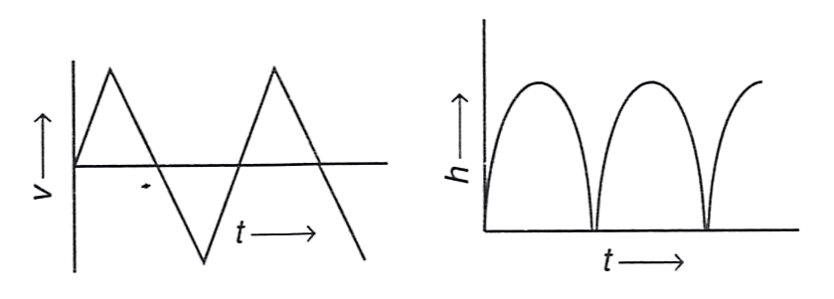
Option (1) :
Velocity graph is incorrect as it always shows positive velocity and height graph is also incorrect because it shows that height of ball was zero for some amount of time whereas in the question it is mentioned that ball was in contact with floor for negligible time.
Option (2) :
Velocity graph is incorrect because it's linear sections with sign reversal is not following height-time graph but height graph is correct as it is smooth parabolic curves representing motion to and from height h.
Option (3) :
Velocity graph is correct because it's linear sections with sign reversal is following height-time graph and height-time graph is also correct as it is smooth parabolic curves representing motion to and from height h.
Option (4) :
Velocity graph is incorrect because the process of sign reversal of velocity should be instantaneous and have no time gap during sign reversal. Height graph is also incorrect as it shows the ball has started it's motion from ground (h = 0) which is not the case as the ball is released from a particular height.
Exercise 2(B) — Very Short Answer Type
Question 1 — For the motion with uniform velocity, how is the distance travelled related to the time?
For the motion with uniform velocity, how is the distance travelled related to the time?
AnswerFor the motion with uniform velocity, distance is directly proportional to time.
Question 2 — What does the slope of a displacement-time graph represent?
As, velocity is the ratio of displacement and time, therefore, the slope gives the velocity.
When slope is positive, it implies body is moving away from the starting (reference) point.
When slope is negative, it implies body is returning towards the starting (reference) point.
Question 3 — When can the distance-time and displacement-time graph be the same?
When can the distance-time and displacement-time graph be the same?
AnswerQuestion 4 — What information do we get by a greater slope of displacement-time graph?
A greater slope of displacement-time graph shows higher velocity.
Question 5 — What information is conveyed about motion by the negative slope of a displacement-time graph?
Question 6 — What does the slope of velocity-time graph represent?
What does the slope of velocity-time graph represent?
AnswerAs the ratio of change in velocity and time taken is equal to the acceleration. Therefore, the slope of the velocity-time graph represents the acceleration.
Question 7 — What information do we get by a higher slope of velocity-time graph?
On the velocity-time graph, larger the slope, higher is the acceleration or retardation.
Question 8 — What information do we get about motion by the negative slope of a velocity-time graph?
Exercise 2(B) — Short Answer Type
Question 1 — What informations about the motion of a body are obtained from the displacement-time graph ?
In a displacement time graph, the time is on the X axis and the displacement of the body is on the Y axis. As, velocity is the ratio of displacement and time, therefore, the slope gives the velocity.
When slope is positive, it implies body is moving away from the starting (reference) point.
When slope is negative, it implies body is returning towards the starting (reference) point.
Question 2 — Can displacement-time sketch be parallel to the displacement axis? Give reason to your answer.
Can displacement-time sketch be parallel to the displacement axis? Give reason to your answer.
AnswerNo, the displacement-time sketch can never be a straight line, parallel to the displacement axis because such a line would mean that the distance covered by the body in a certain direction increases without any increase in time (i.e., the velocity of the body is infinite) which is impossible.
Question 3 — Draw a displacement-time graph for a boy going to school with a uniform velocity.
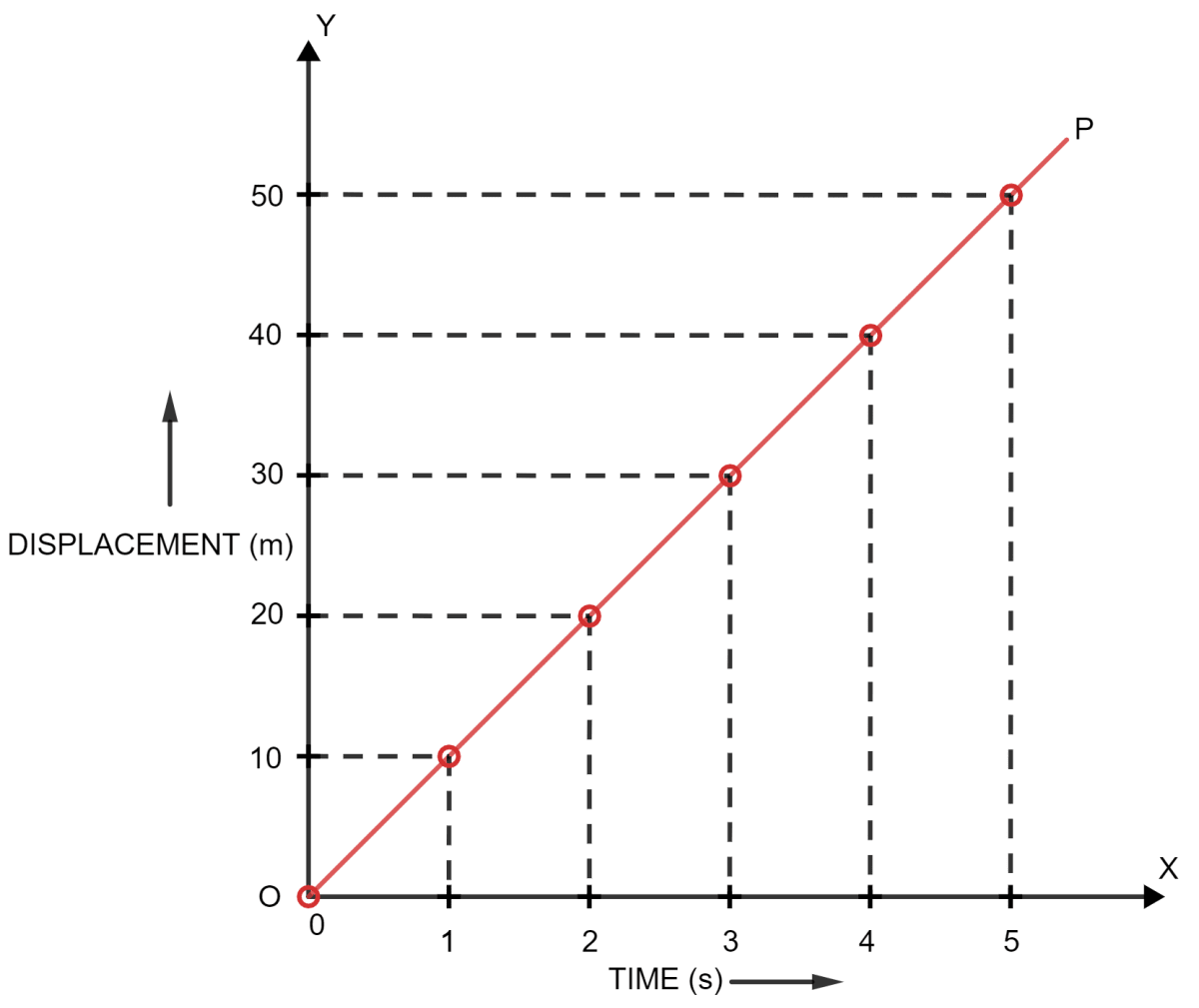
Question 4 — State how the velocity-time graph can be used to find — (i) the acceleration of a body, (ii) the distance travelled by the body in a given time, and (iii) the displacement of the body in a given time.
State how the velocity-time graph can be used to find —
(i) Acceleration of a body — As acceleration is equal to the ratio of change in velocity and time taken, therefore, the slope ( or gradient ) of the velocity-time graph gives the acceleration.
(ii) Distance travelled by the body in a given time — The total distance travelled by the body is obtained by the arithmetic sum of the positive displacement and negative displacement (without sign).
(iii) Displacement of the body — As the product of velocity and time gives the displacement, therefore, the area enclosed between the velocity-time sketch and X - axis (i.e., the time axis) gives the displacement of the body.
The total displacement is obtained by adding positive displacement and negative displacement numerically with proper sign.
Question 5 — What can you say about the nature of motion of a body if its displacement-time graph is — (a) a straight line parallel to time axis? (b) a straight line inclined to the time axis with an acute angle? (c) a straight line inclined to the time axis with an obtuse angle? (d) a curve.
(a) A straight line parallel to time axis — shows that the body is stationary (or no motion).
(b) A straight line inclined to the time axis with an acute angle — shows the linear relationship between the displacement and time (i.e., the body travels equal distance in equal intervals of time in a certain direction). Hence, we can say the motion is away from the starting point with uniform velocity.
Question 6 — The figure given below shows displacement-time graph of two vehicles A and B moving along a straight road. Which vehicle is moving faster? Give reason.
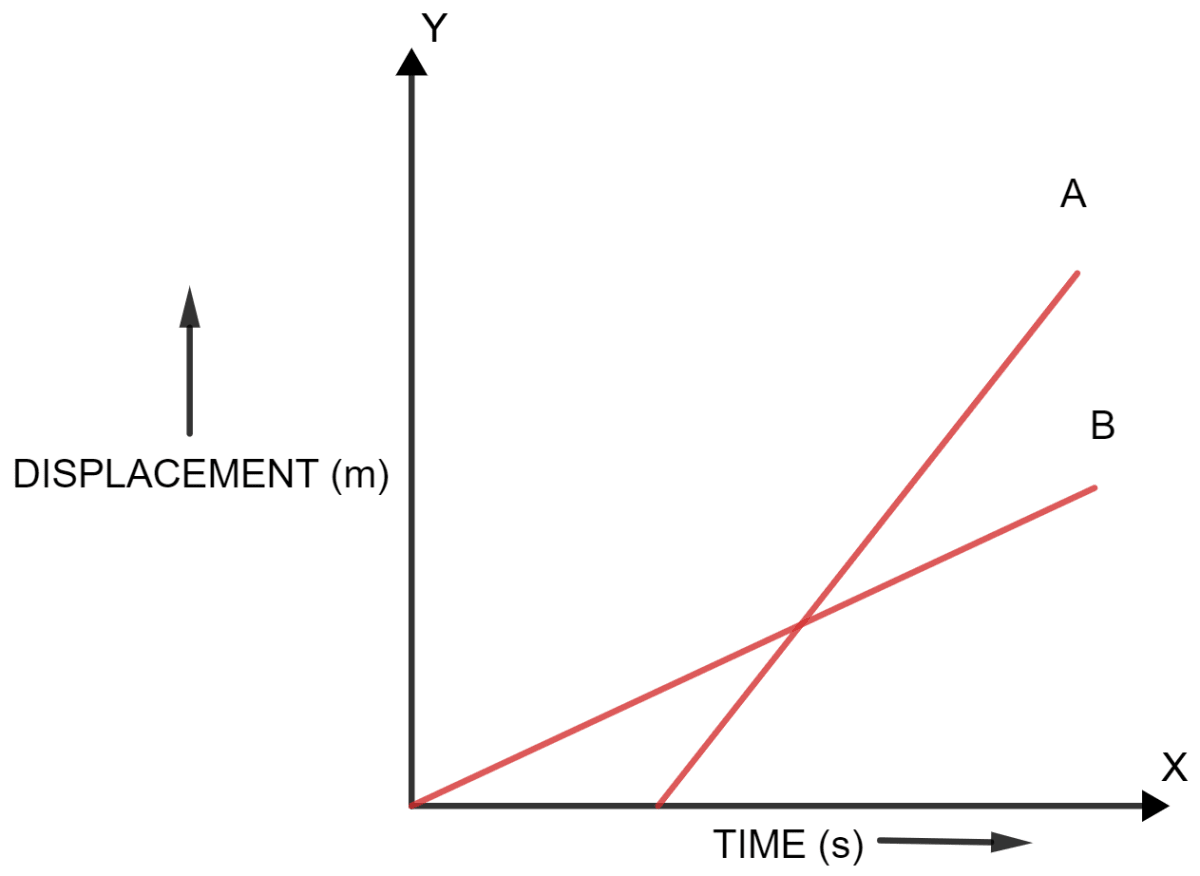
We infer from the graph, that vehicle A is moving faster than vehicle B. It is so because, the slope of line A is more than that of line B.
Question 7 — How is the velocity obtained from the displacement-time graph for a body moving with a varying speed in a fixed direction?
If a body moves with varying speed in a fixed direction i.e., with variable velocity, the displacement-time graph is not a straight line, but it is a curve. The velocity at any instant can then be obtained by finding the slope of the tangent drawn on the curve at that instant of time.
Question 8 — Draw a velocity-time graph for a body moving with an initial velocity u and uniform acceleration a. Use this graph to find the distance travelled by the body in time t.
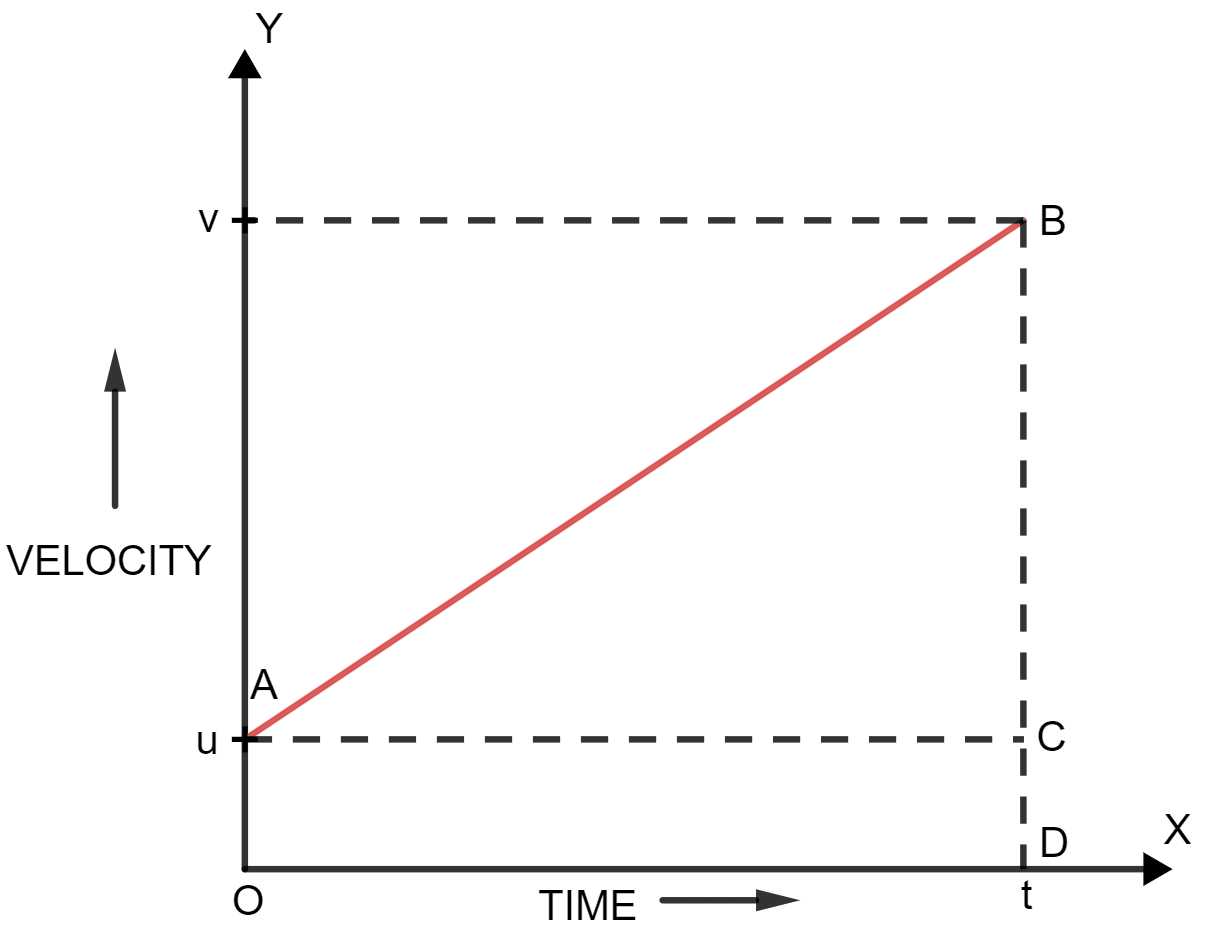
Hence,
Distance travelled = area of trapezium OABD
Question 9 — State the type of motion represented by the following sketches in (a) and (b). Give example of each type of motion. (a) (b)
State the type of motion represented by the following sketches in (a) and (b).
Give example of each type of motion.
(a)
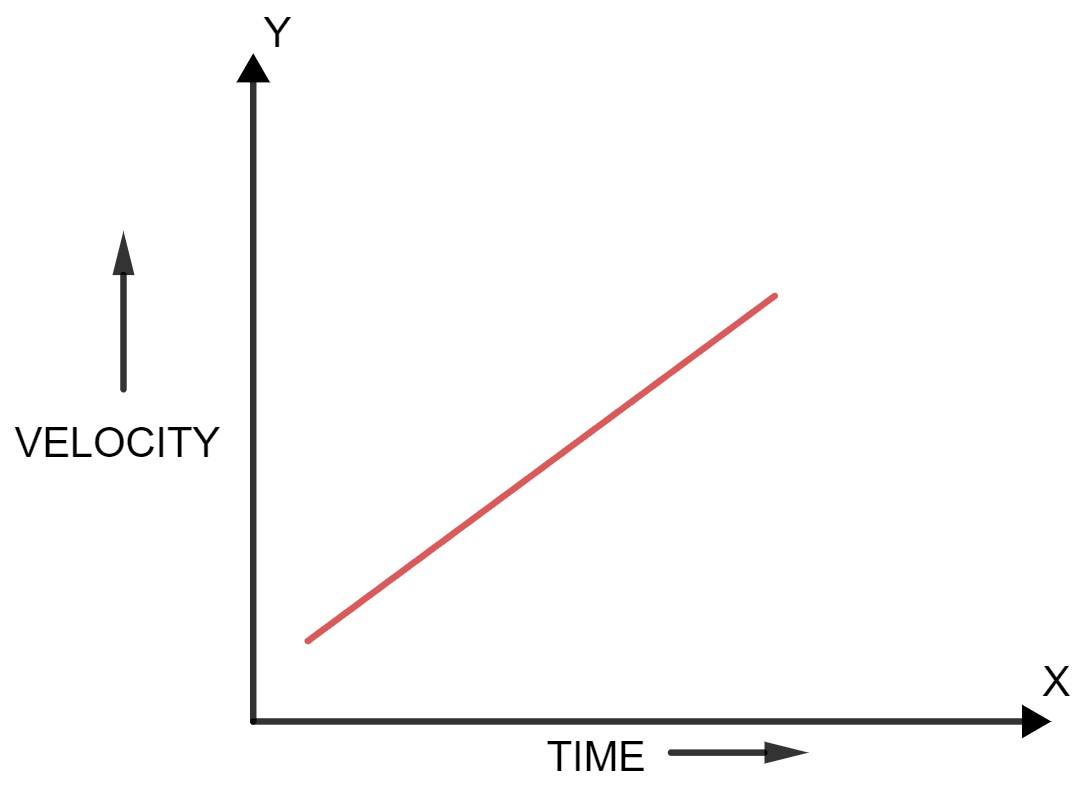
(b)
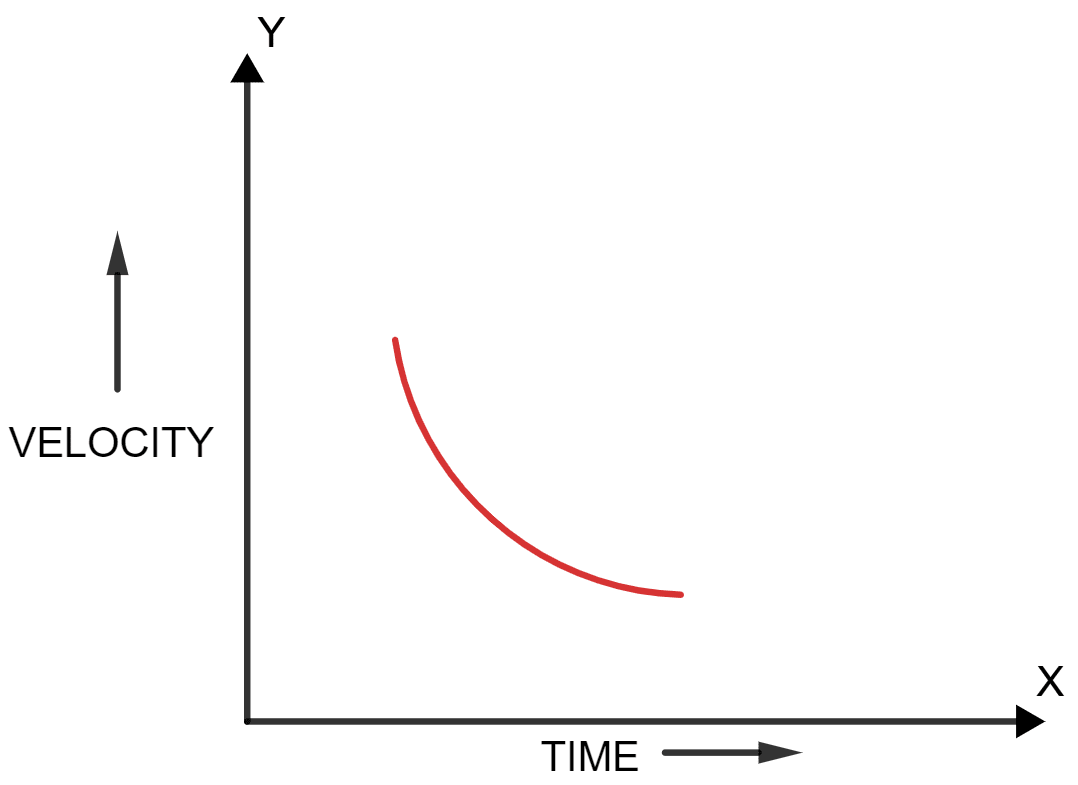
(a) The graph shows uniformly accelerated motion.
Question 10 — The figure given below shows the velocity-time graph for two cars A and B moving in same direction. Which car has the greater acceleration? Give reason to your answer.
The figure given below shows the velocity-time graph for two cars A and B moving in same direction. Which car has the greater acceleration? Give reason to your answer.
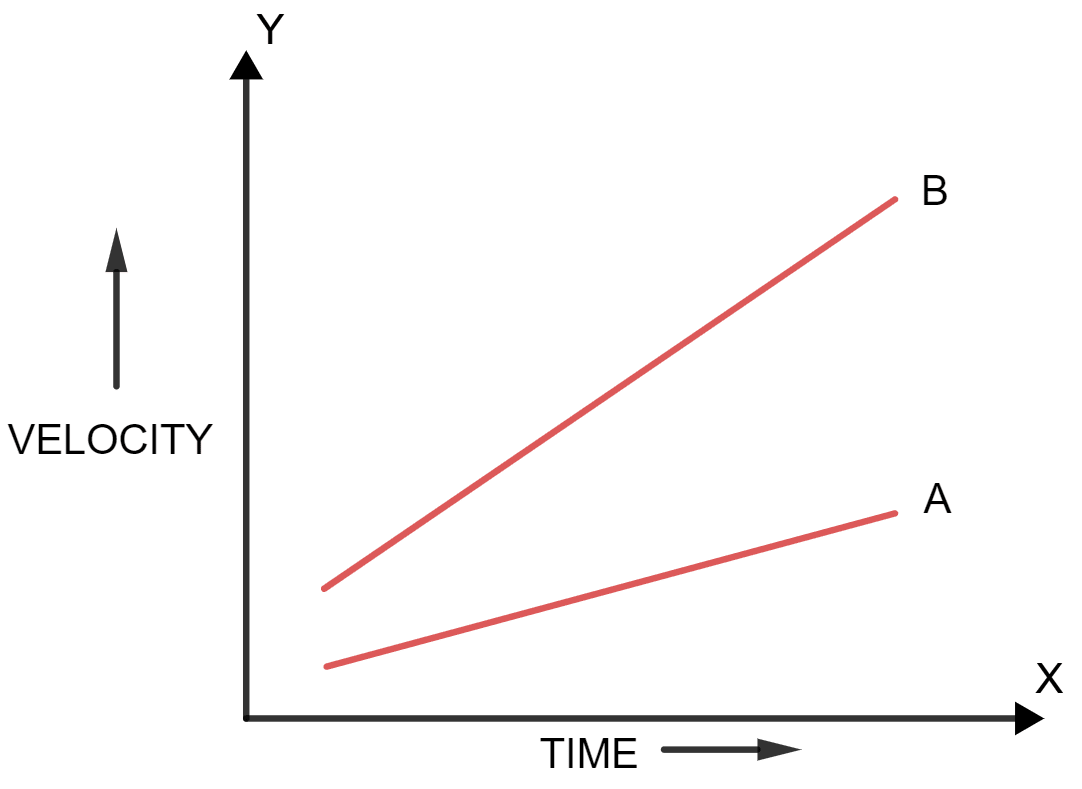
We can infer from the graph, that the car B has greater acceleration than car A as the slope of straight line for car B is more than that of car A.
Question 11 — Draw a velocity-time graph for a body moving with — (a) uniform velocity, (b) uniform acceleration.
(a) uniform velocity,
(b) uniform acceleration.
Answer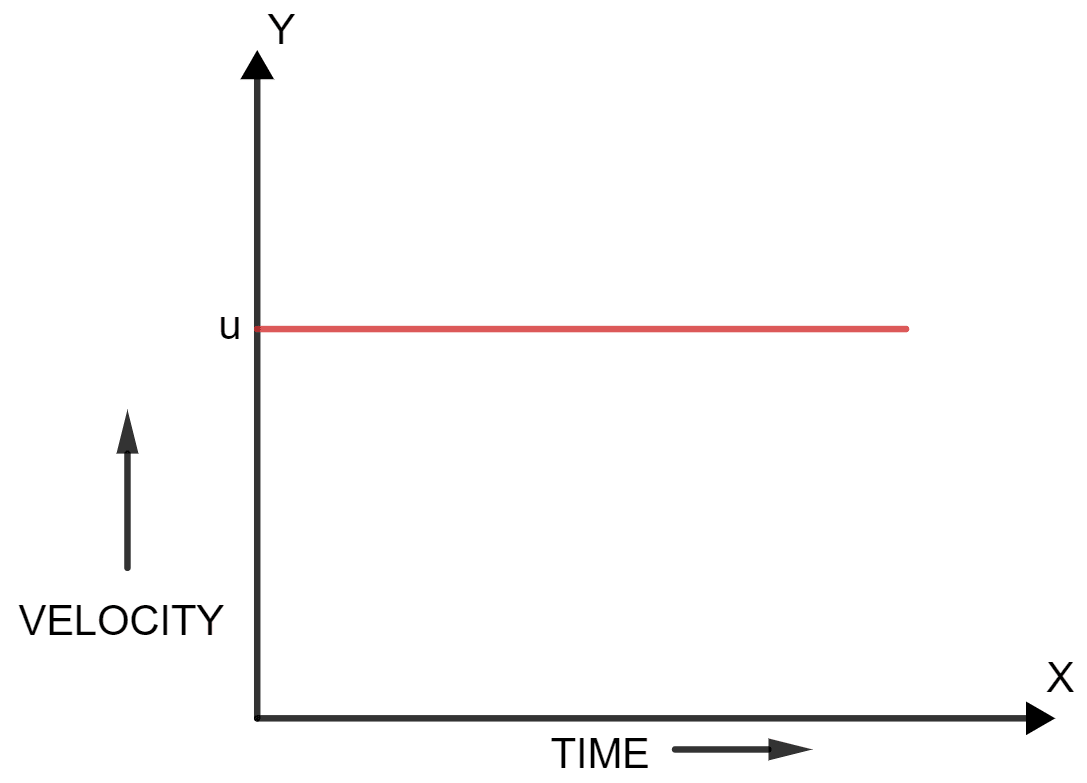
Question 12 — The velocity-time graph for a uniformly retarded body is a straight line inclined to the time axis with an obtuse angle. How is retardation calculated from the velocity-time graph?
Retardation is calculated from the velocity-time graph, by finding the negative slope.
Question 13 — The figure given below shows the displacement-time graph for four bodies A, B, C and D. In each case state what information do you get about the acceleration (zero, positive or negative).
The figure given below shows the displacement-time graph for four bodies A, B, C and D. In each case state what information do you get about the acceleration (zero, positive or negative).
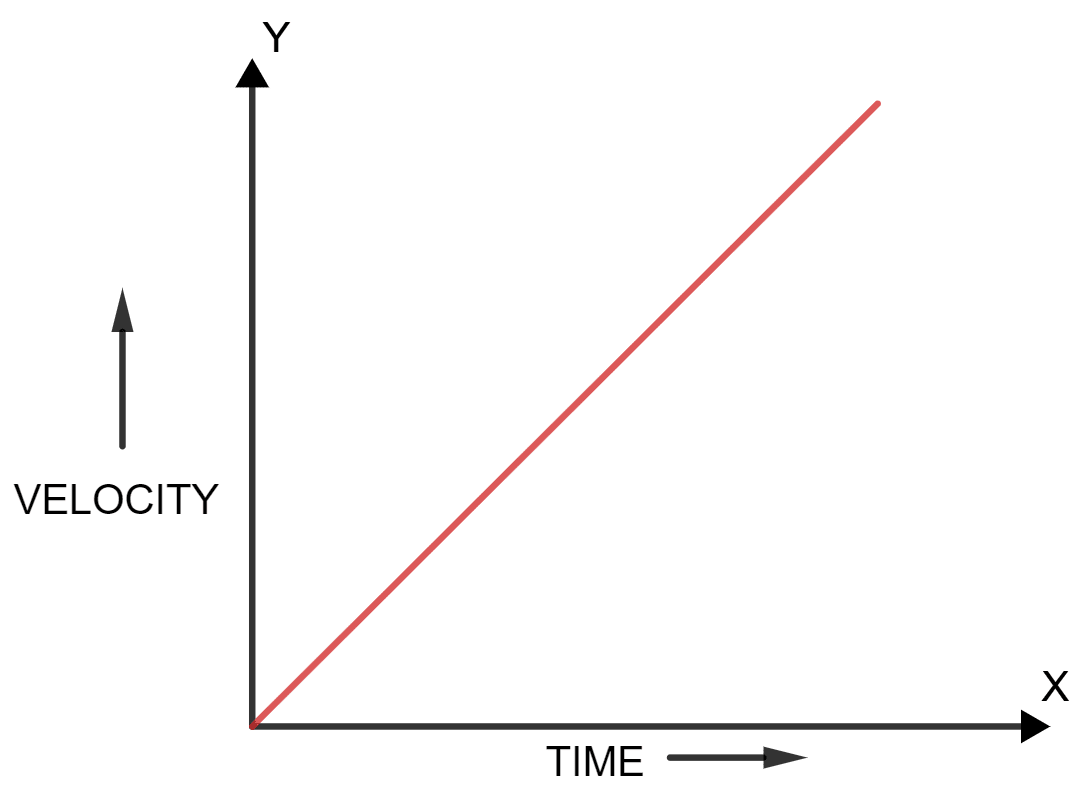
The following information is obtained from the given figures —
A → Zero acceleration since slope (i.e., velocity) is constant. B → Zero acceleration since slope (i.e., velocity) is constant. C → Negative acceleration (or retardation) since slope is decreasing with time. D → positive acceleration since slope is increasing with time.
Question 14 — Draw a graph for acceleration against time for a uniformly accelerated motion. How can it be used to find the change in speed in a certain interval of time?
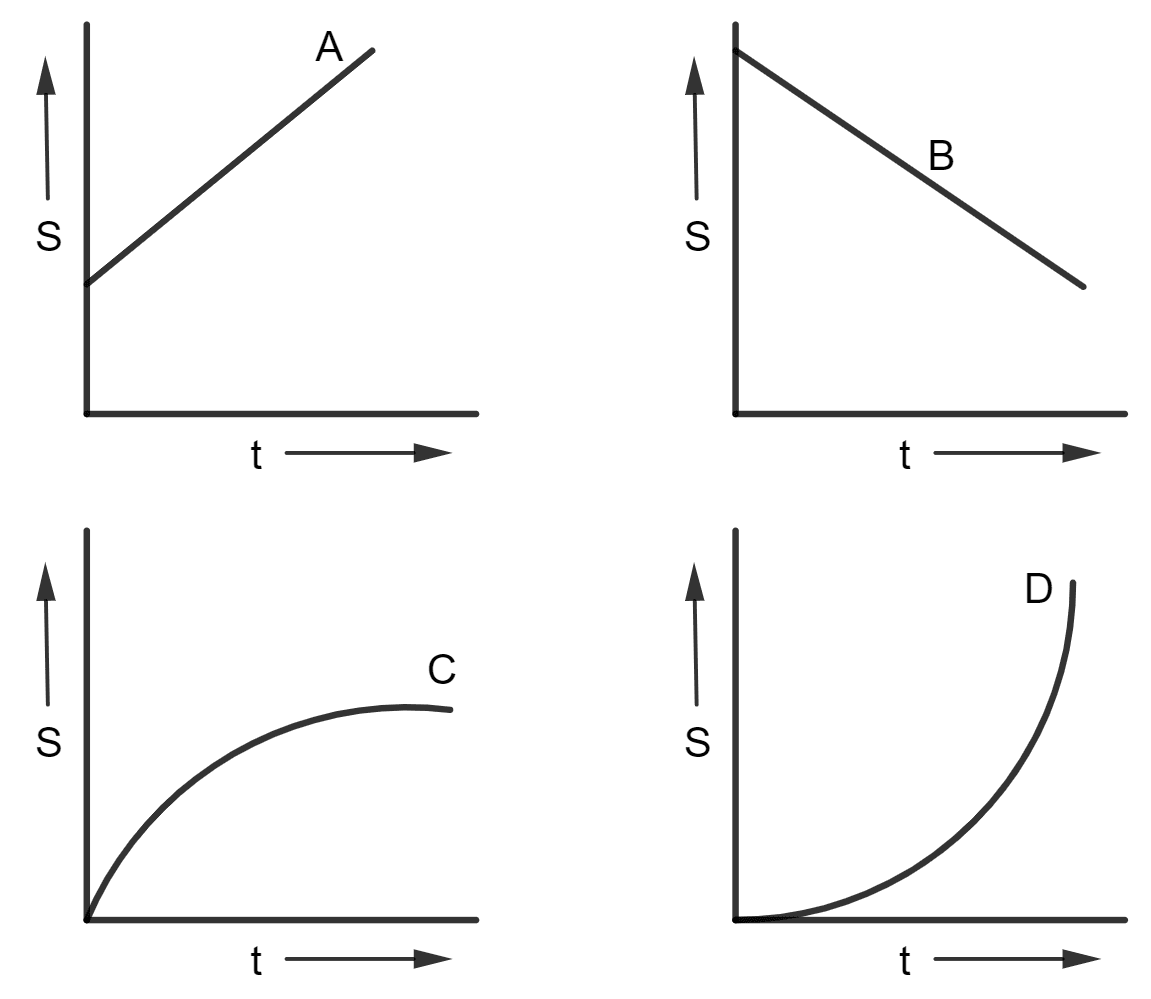
For linear motion,
Acceleration x time = change in speed
Therefore, we can find the change in speed from the area enclosed between the acceleration-time sketch and the time axis.
Question 15 — Draw a velocity-time graph for the free fall of a body under gravity, starting from rest. Take g = 10 m s−2.
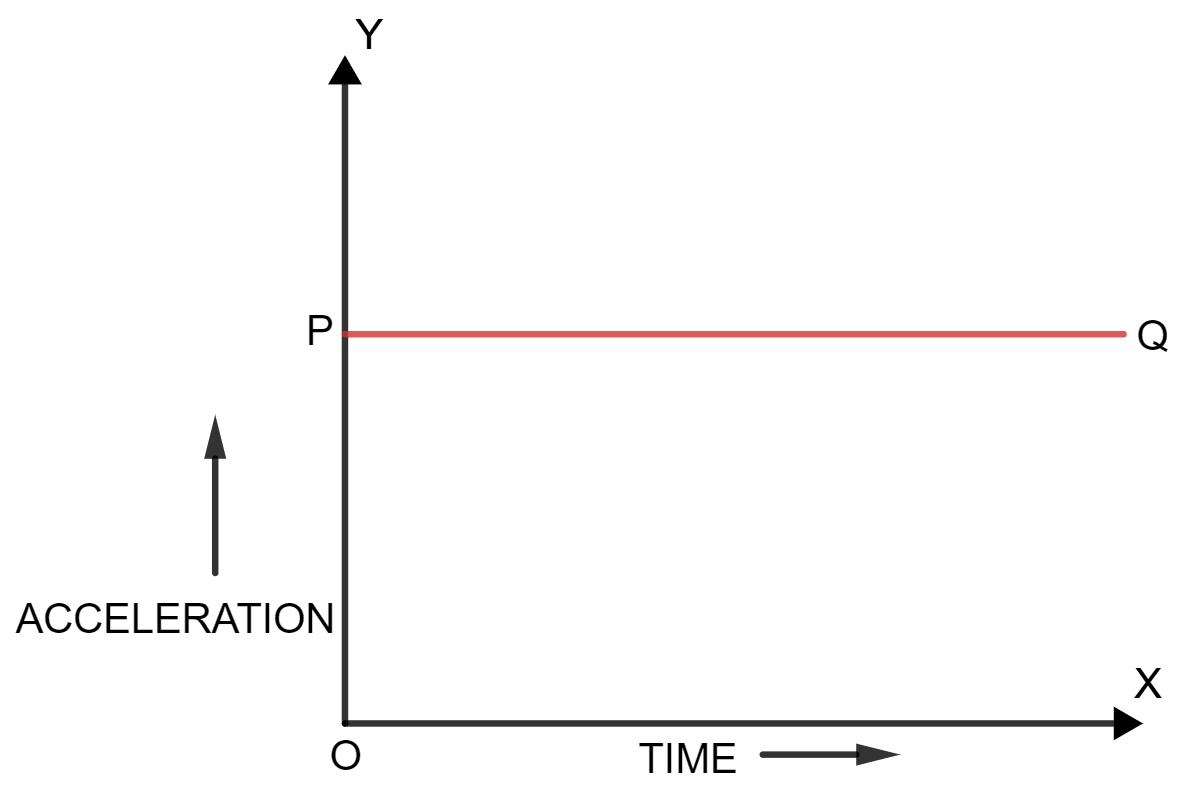
Question 16 — How is the distance related with time for the motion under uniform acceleration such as the motion of a freely falling body ?
i.e.,
Question 17 — A body falls freely from a certain height. Show graphically the relation between the distance fallen and square of time. How will you determine g from this graph?
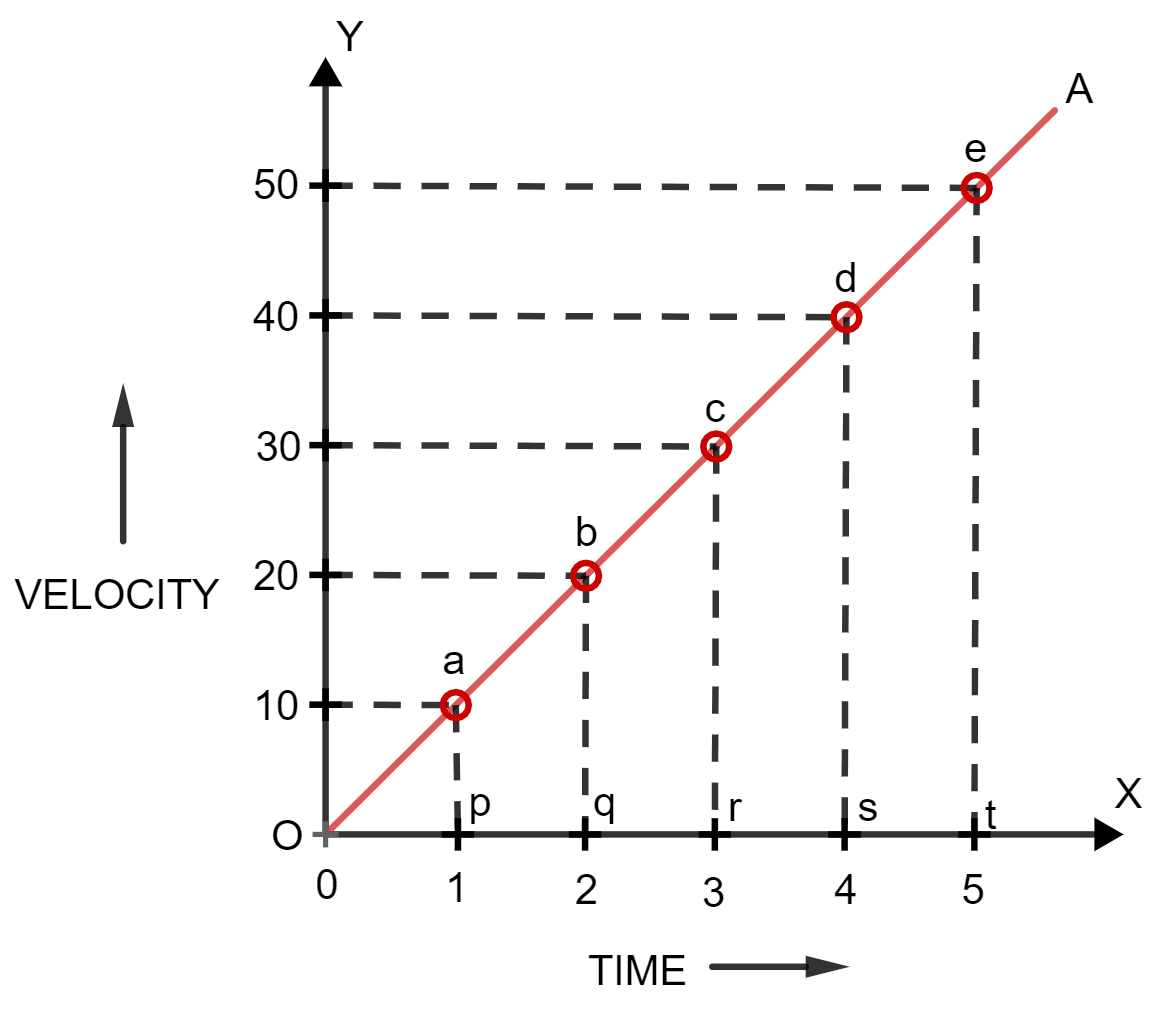
The slope is half the acceleration due to gravity.
Exercise 2(B) — Long Answer Type
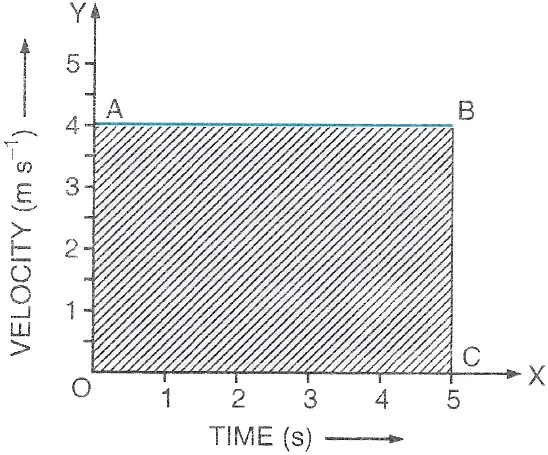
Question 1 — Draw the velocity-time graphs for a body moving with — (a) uniform velocity (b) uniform acceleration and give one example of each and also calculate the displacement and acceleration.
(a) uniform velocity
(b) uniform acceleration
and give one example of each and also calculate the displacement and acceleration.
Answer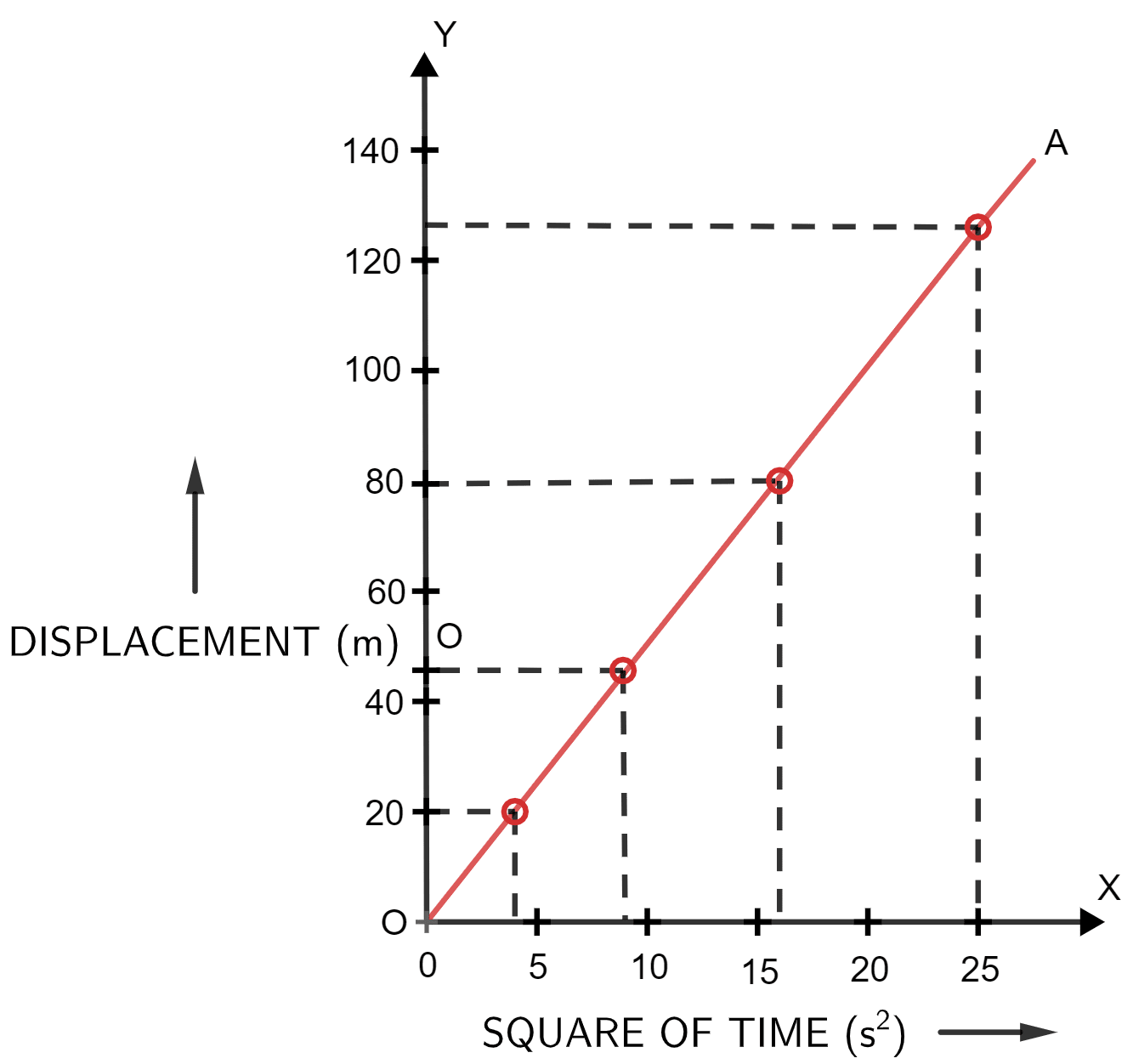
The slope of the straight line AB is zero, therefore, its acceleration is zero.
| Time (s) | 0 | 1 | 2 | 3 | 4 | 5 | 6 | 7 | 8 |
| Displacement (m) | 0 | 10 | 20 | 30 | 40 | 50 | 60 | 70 | 80 |

= area of triangle OPQ
Acceleration of body
= slope of line OP
= PQ/QO
Hence, distance covered is 320 m and acceleration is 10 m s−2.
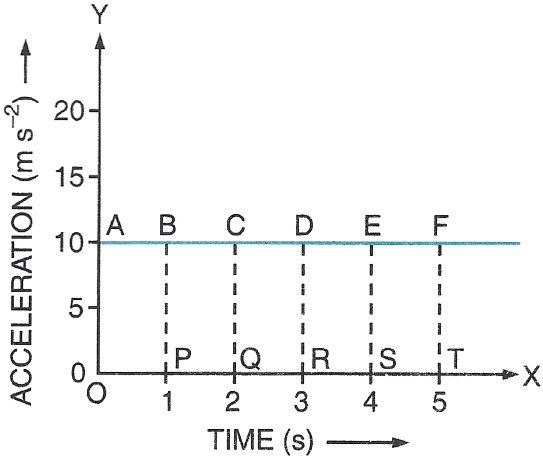
Question 2 — Draw the acceleration-time graph for a body moving with : (a) Uniform velocity (b) Free falling body and give an example of each.
(a) Uniform velocity
(b) Free falling body
and give an example of each.
Answer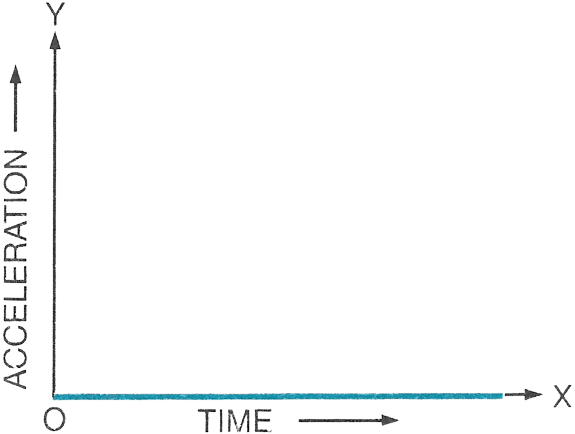
Exercise 2(B) — Numericals
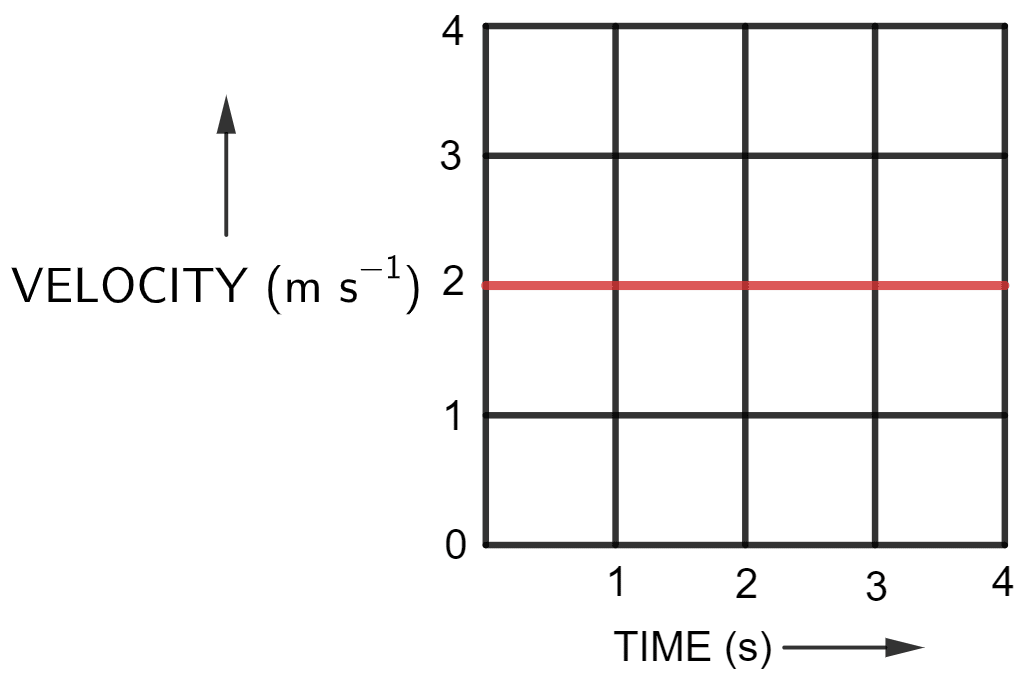
Question 1 — The figure (a) given below shows the displacement-time graph for the motion of a body. Use it to calculate the velocity of body at t = 1 s, 2 s and 3 s, then draw the velocity-time graph for it in Figure (b).
The figure (a) given below shows the displacement-time graph for the motion of a body. Use it to calculate the velocity of body at t = 1 s, 2 s and 3 s, then draw the velocity-time graph for it in Figure (b).
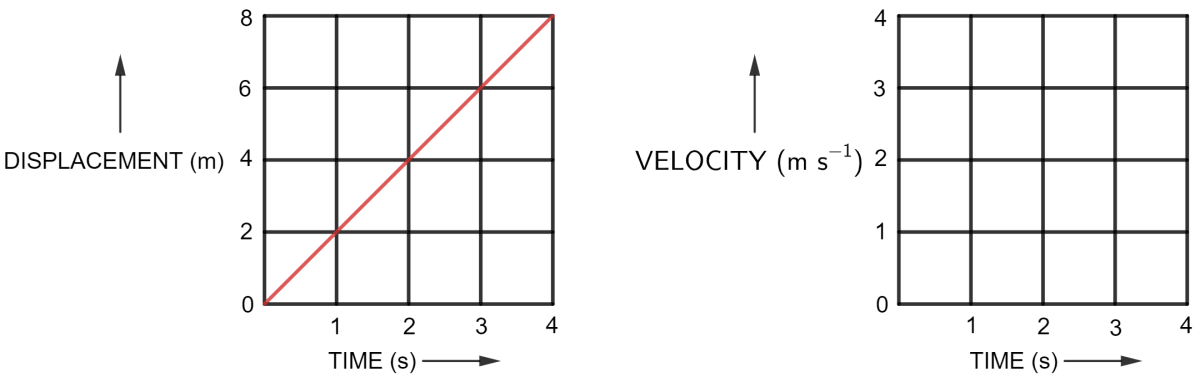
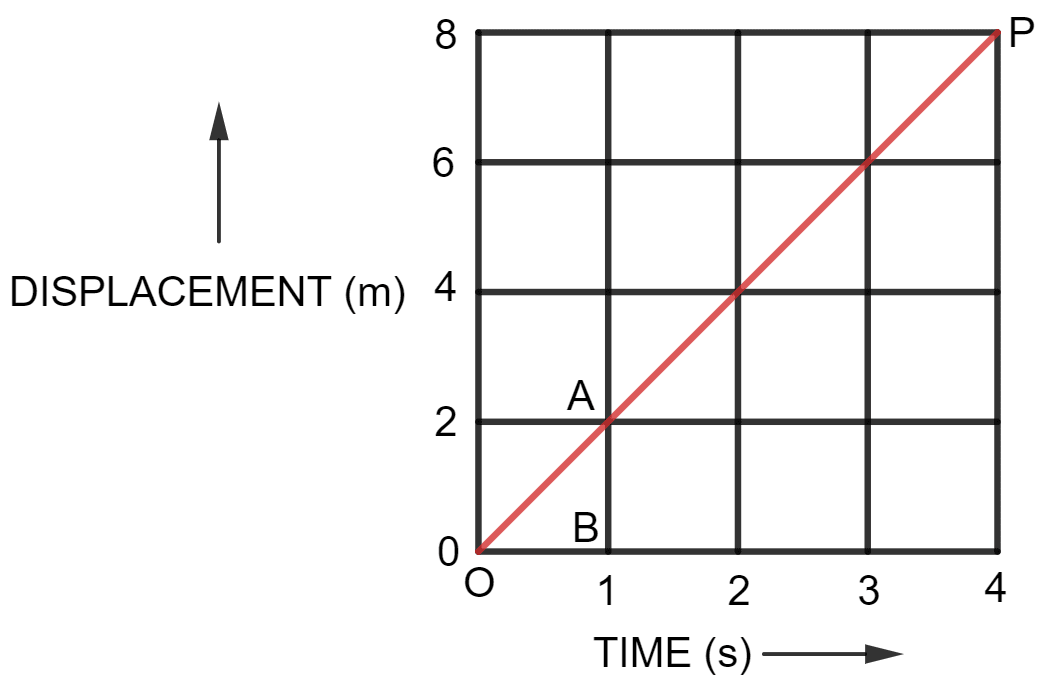
We observe from the given displacement-time graph above, that the slope is a straight line inclined with time axis, so the body is moving with uniform velocity. Hence, the velocity will be same at t = 1 s, 2 s and 3 s.
Question 2 — Following table gives the displacement of a car at different instants of time. Time (s) 0 1 2 3 4 Displacement (m) 0 5 10 15 20 (a) Draw the displacement-time sketch and find the average velocity of car. (b) What will be the displacement of car at (i) 2.5 s and (ii) 4.5 s ?
| Time (s) | 0 | 1 | 2 | 3 | 4 |
| Displacement (m) | 0 | 5 | 10 | 15 | 20 |
(a) Draw the displacement-time sketch and find the average velocity of car.
(b) What will be the displacement of car at (i) 2.5 s and (ii) 4.5 s ?
Answer(a) The displacement-time sketch for the car is shown below :
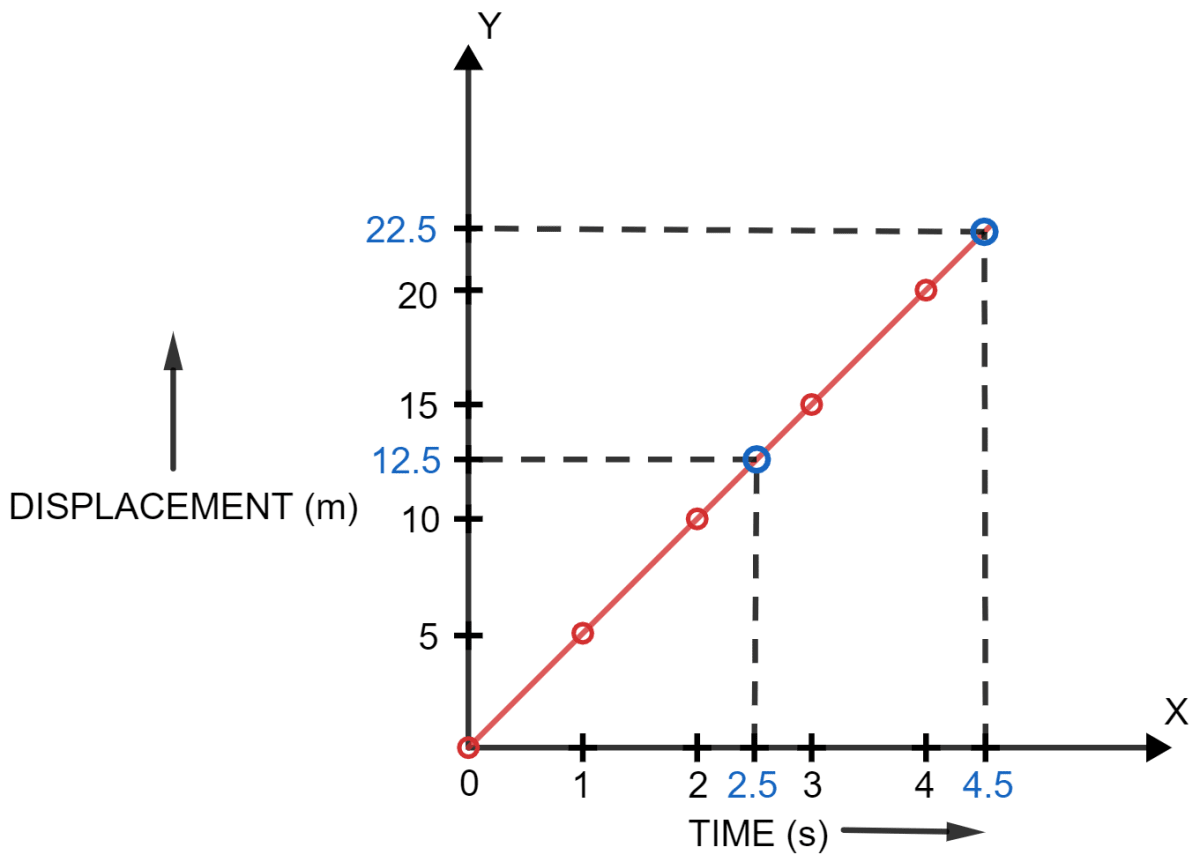
As we know,
Hence, average velocity of the car is 5 m s−1.
(b) When we observe the graph, we can find the displacement of the car at various points,
Question 3 — A body is moving in a straight line and its displacement at various instants of time is given in the following table — Time (s) 0 1 2 3 4 5 6 7 Displacement (m) 2 6 12 12 12 18 22 24 Plot displacement-time graph and calculate — (i) total distance travelled in interval 1 s to 5 s, (ii) average velocity in time interval 1 s to 5 s.
| Time (s) | 0 | 1 | 2 | 3 | 4 | 5 | 6 | 7 |
| Displacement (m) | 2 | 6 | 12 | 12 | 12 | 18 | 22 | 24 |
Plot displacement-time graph and calculate —
(i) total distance travelled in interval 1 s to 5 s,
(ii) average velocity in time interval 1 s to 5 s.
AnswerThe displacement-time graph is given below :
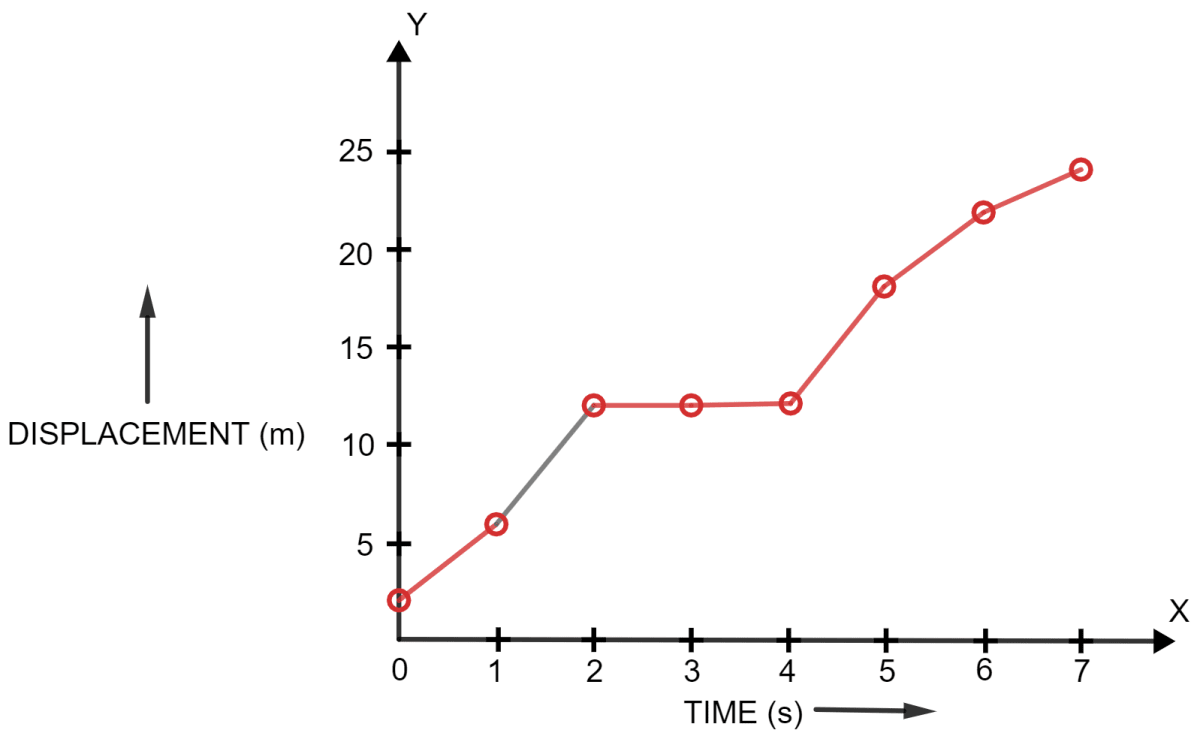
(i) When we observe the graph, we find —
(ii) As we know,
Hence, average velocity of the car in interval 1 s to 5 s is 3 m s−1.
Question 4 — The figure given below shows the displacement of a body at different times. (a) Calculate the velocity of the body as it moves for time interval (i) 0 to 5 s, (ii) 5 s to 7 s and (iii) 7 s to 9 s. (b) Calculate the average velocity during the time interval 5 s to 9 s. [ Hint : From 5 s to 9 s, displacement = 7 m - 3 m = 4 m ]
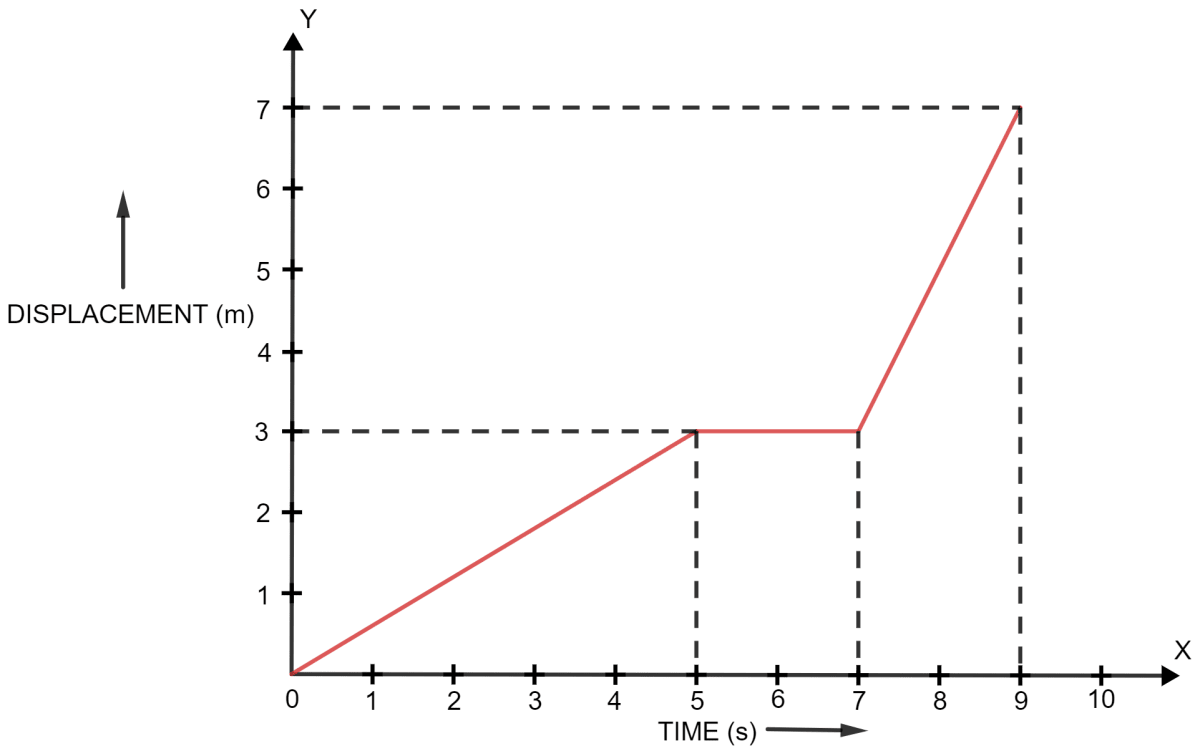
(a) Calculate the velocity of the body as it moves for time interval
(i) 0 to 5 s,
(ii) 5 s to 7 s and
(iii) 7 s to 9 s.
(b) Calculate the average velocity during the time interval 5 s to 9 s.
Below is the displacement-time graph of the body with the different points marked :
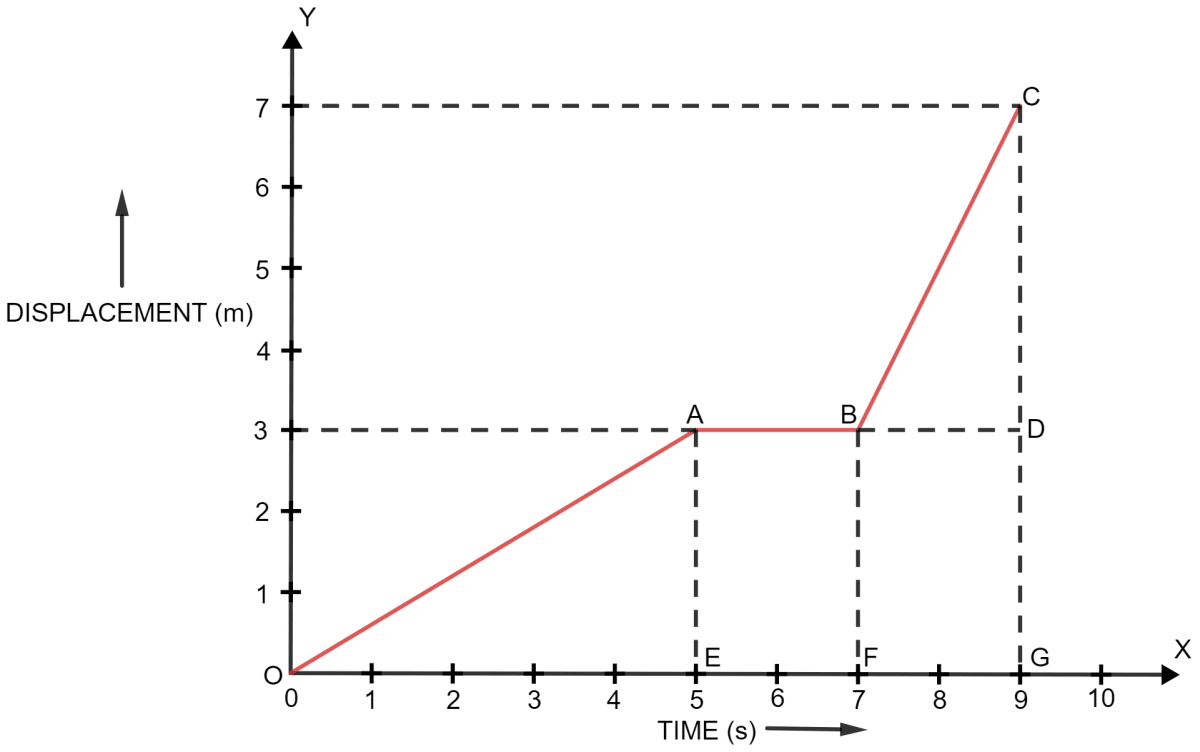
(a) As we know,
Velocity = Slope of straight line OA
In this part we observe that there is no change in Y axis, (i.e. displacement is zero so the body is stationary).
Velocity = Slope of straight line BC
(b) As we know,
Avg. velocity = Total distance/Total time
Substituting the values from the graph we get,
Hence, average velocity of the car is 1 m s−1.
Question 5 — From the displacement-time graph of a cyclist, given in below figure, find — (i) the average velocity in the first 4 s, (ii) the displacement from the initial position at the end of 10 s, (iii) the time after which he reaches the starting point.
(i) the average velocity in the first 4 s,
(ii) the displacement from the initial position at the end of 10 s,
(iii) the time after which he reaches the starting point.
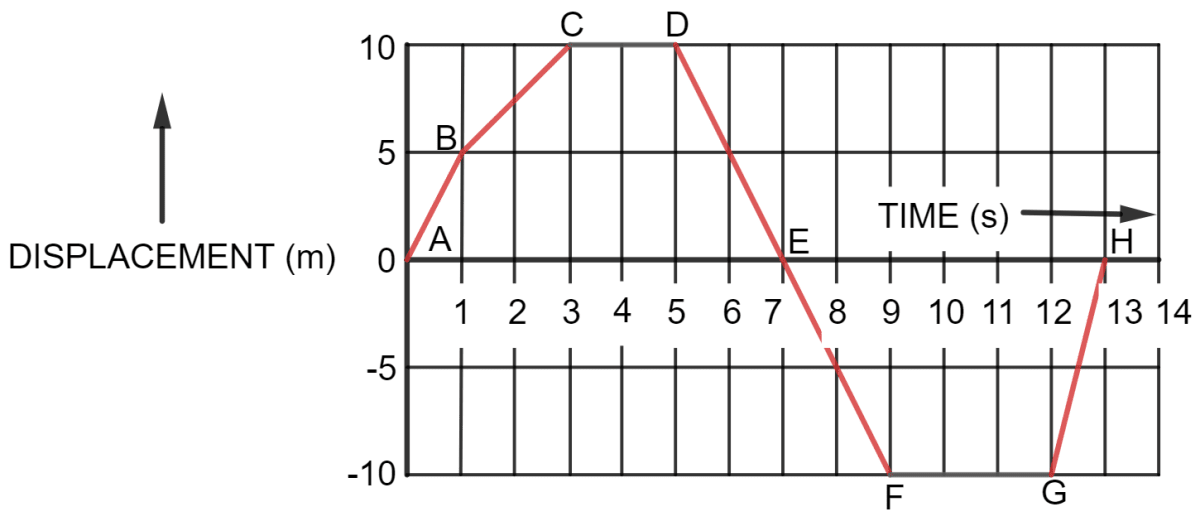
(i) As we know,
Avg. velocity = Total distance/Total time
Substituting the values from the graph, for the first 4 s, we get,
Hence, average velocity of the car is 2.5 m s−1.
(ii) From the graph, we get,
Displacement = final position - initial position
Substituting the values from the graph, for the first 10 s, we get,
(iii) The cyclist would reach the start point two times, one at the 7 s and the other at 13 s.
Question 6 — The figure given below represents the displacement-time sketch of motion of two cars A and B. Find — (i) the distance by which the car B was initially ahead of car A. (ii) the velocities of car A and car B (iii) the time in which car A catches car B (iv) the distance from start when the car A will catch the car B
The figure given below represents the displacement-time sketch of motion of two cars A and B.
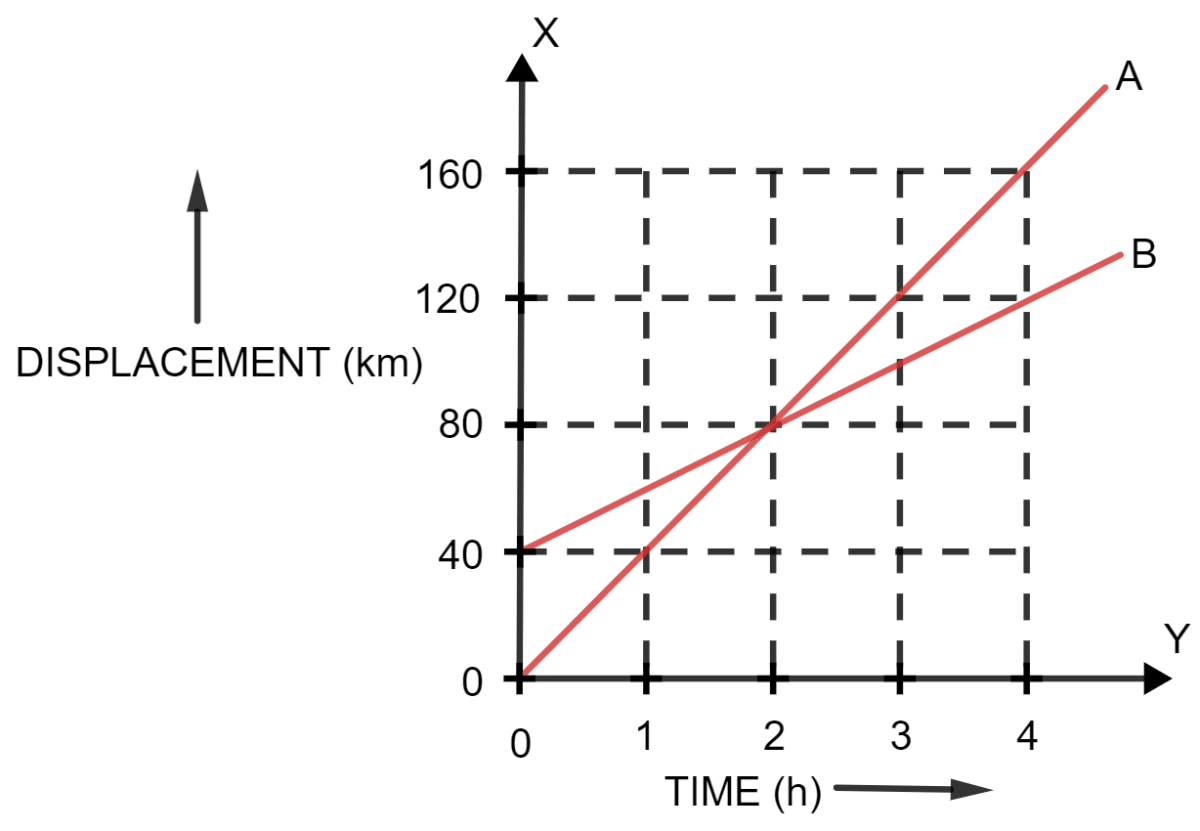
Find —
(i) the distance by which the car B was initially ahead of car A.
(ii) the velocities of car A and car B
(iii) the time in which car A catches car B
(iv) the distance from start when the car A will catch the car B
Answer(i) When we observe the graph, we find that the car B was ahead of car A by 40 km.
(ii) As we know,
Velocity = displacement/time
Cars A and B have uniform velocities as displacement-time graph for both are straight lines.
Car A
Hence, velocity of car A is 40 km h−1
Car B
Hence, velocity of car B is 20 km h−1
Hence,
Question 7 — A body at rest is made to fall from the top of a tower. Its displacement at different instants is given in the following table — Time (in s) 0.1 0.2 0.3 0.4 0.5 0.6 Displacement (in m) 0.05 0.20 0.45 0.80 1.25 1.80 Draw a displacement-time graph and state whether the motion is uniform or non-uniform?
| Time (in s) | 0.1 | 0.2 | 0.3 | 0.4 | 0.5 | 0.6 |
| Displacement (in m) | 0.05 | 0.20 | 0.45 | 0.80 | 1.25 | 1.80 |
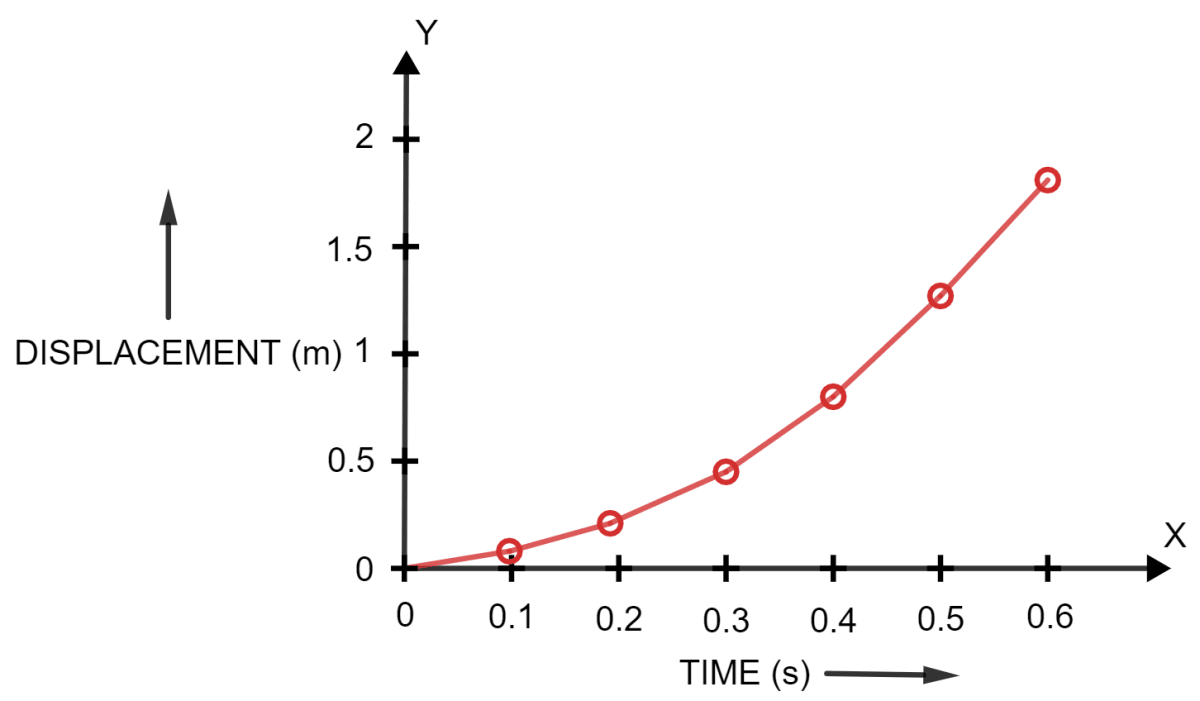
Hence, we can say that the motion is non-uniform.
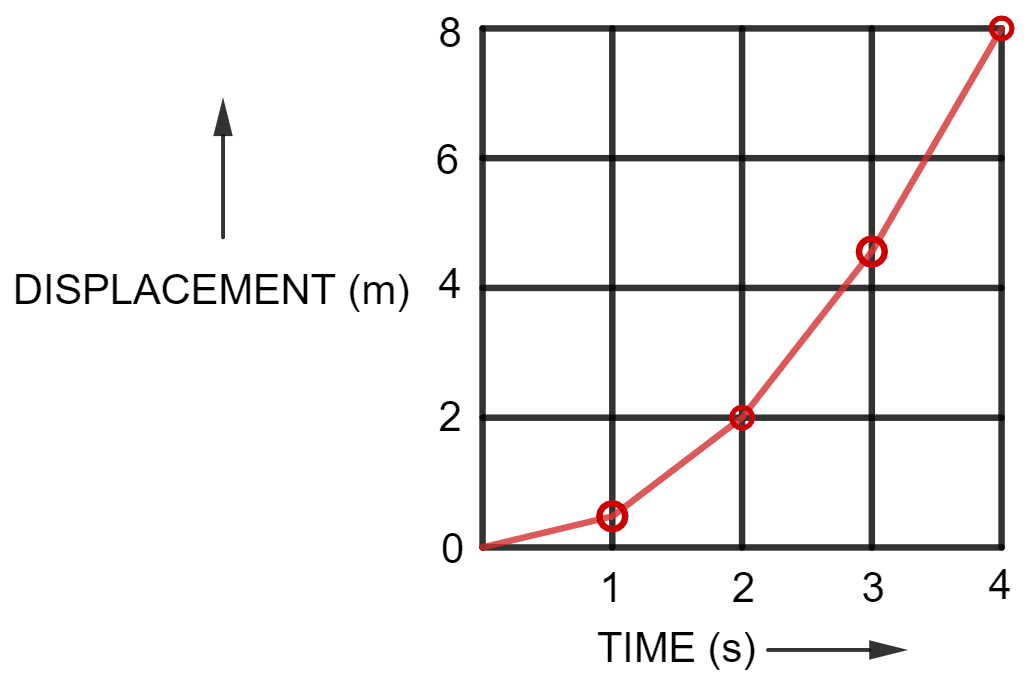
Question 8 — The figure (a) below shows the velocity-time graph for the motion of a body. Use it to find the displacement of the body at t = 1 s, 2 s, 3 s and 4 s, then draw the displacement-time graph for it in figure (b).
The figure (a) below shows the velocity-time graph for the motion of a body. Use it to find the displacement of the body at t = 1 s, 2 s, 3 s and 4 s, then draw the displacement-time graph for it in figure (b).
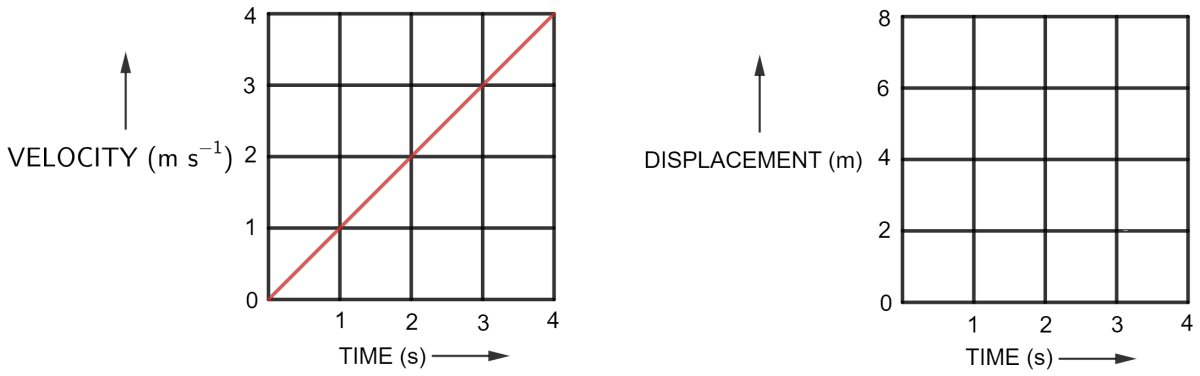
As we know, the displacement of body at any instant can be obtained by finding the area enclosed by the straight line with the time axis up to that instant.
The table below gives the displacement of body at different instants.
| Time (in s) | 1 | 2 | 3 | 4 |
| Displacement (in m) | 0.5 | 2 | 4.5 | 8 |
The displacement time graph is shown below :
Question 9 — The figure given below shows a velocity-time graph for a car starting from rest. The graph has three parts AB, BC and CD. (i) State how is the distance travelled in any part determined from this graph. (ii) Compare the distance travelled in part BC with the distance travelled in part AB. (iii) Which part of graph shows motion with uniform (a) velocity (b) acceleration (c) retardation?

(i) State how is the distance travelled in any part determined from this graph.
(ii) Compare the distance travelled in part BC with the distance travelled in part AB.
(iii) Which part of graph shows motion with uniform (a) velocity (b) acceleration (c) retardation?
(b) Compare the magnitude of acceleration and retardation.
Answer(i) The distance travelled in any part of the graph can be obtained by finding the area enclosed by the graph in that part with the time axis.
When we observe the graph, we find,
Distance travelled in part BC = Area of rectangle EBCF
∴ Distance travelled in part BC = length x breadth
Distance travelled in part AB = Area of triangle ABT
Comparing [1] and [2] we get,
(iii) The different parts of the graph are mentioned below:
(a) Uniform velocity is shown in part BC of the graph, as the velocity is constant with time.
(b) Uniform acceleration is shown in part AB of the graph, as the velocity is increasing with time.
(c) Uniform retardation is shown in part CD of the graph, as the velocity is decreasing with time.
(iv) (a) The magnitude of acceleration is lower, as slope of line AB is less than that of line CD.
(b) Acceleration in part AB = slope of AB
Retardation in part CD = slope of CD
Magnitude of acceleration : Magnitude of retardation = Slope of line AB : Slope of line CD
Question 10 — The velocity-time graph of a moving body is shown below in the figure. Find — (i) the acceleration in parts AB, BC and CD. (ii) displacement in each part AB, BC, CD, and (iii) total displacement.
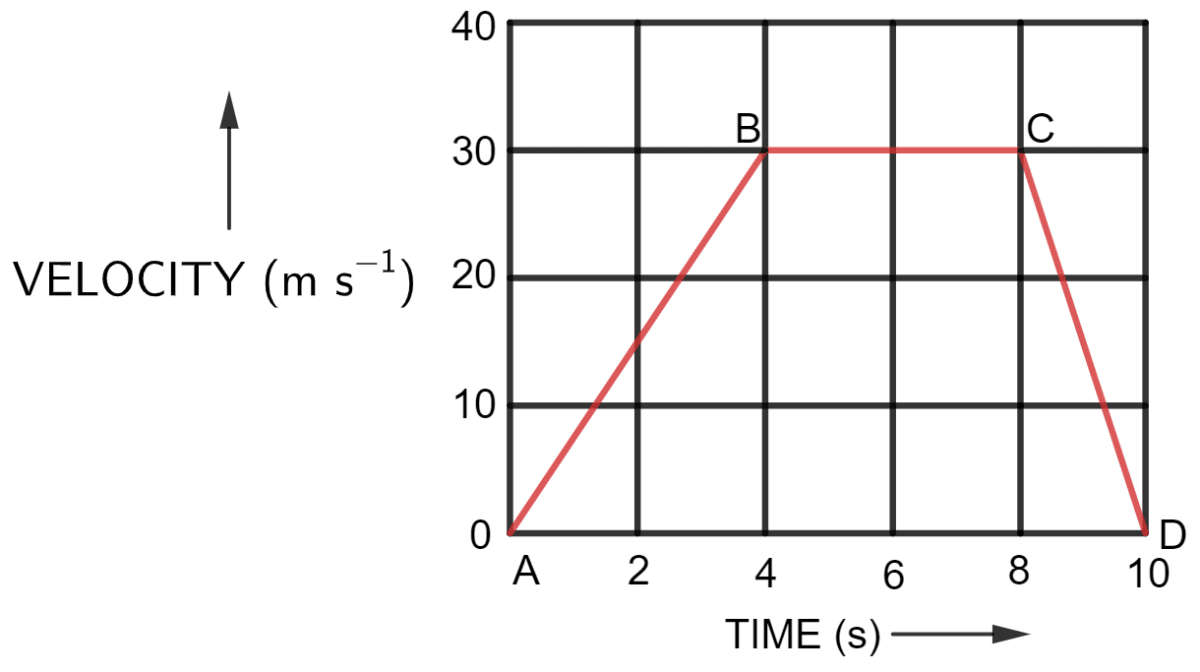
Find —
(i) the acceleration in parts AB, BC and CD.
(ii) displacement in each part AB, BC, CD, and
(iii) total displacement.
Answer(i) Acceleration in part AB = slope of AB
Acceleration in part BC = slope of BC
Acceleration in part CD = slope of CD
Hence, acceleration in part CD is -15 m s−1
(ii) Displacement in each part is as follows —
(a) Displacement of part AB = Area of triangle ABE
Substituting the values in the formula above, we get,
(b) Displacement of part BC = Area of Square EBCF
= length × breadth
Substituting the values in the formula above, we get,
Hence, displacement of part BC is 120 m.
(c) Displacement of part CD = Area of triangle CDF
Substituting the values in the formula above, we get,
Hence, displacement of part CD is 30 m.
(iii) Total displacement = Displacement of part AB + Displacement of part BC + Displacement of part CD
Hence, total displacement is 210 m.
Question 11 — A ball moves on a smooth floor in a straight line with a uniform velocity 10 m s−1 for 6 s. At t = 6 s, the ball hits a wall and comes back along the same line to the starting point with same speed. Draw the velocity-time graph and use it to find the total distance travelled by the ball and its displacement.
A ball moves on a smooth floor in a straight line with a uniform velocity 10 m s−1 for 6 s. At t = 6 s, the ball hits a wall and comes back along the same line to the starting point with same speed. Draw the velocity-time graph and use it to find the total distance travelled by the ball and its displacement.
Answer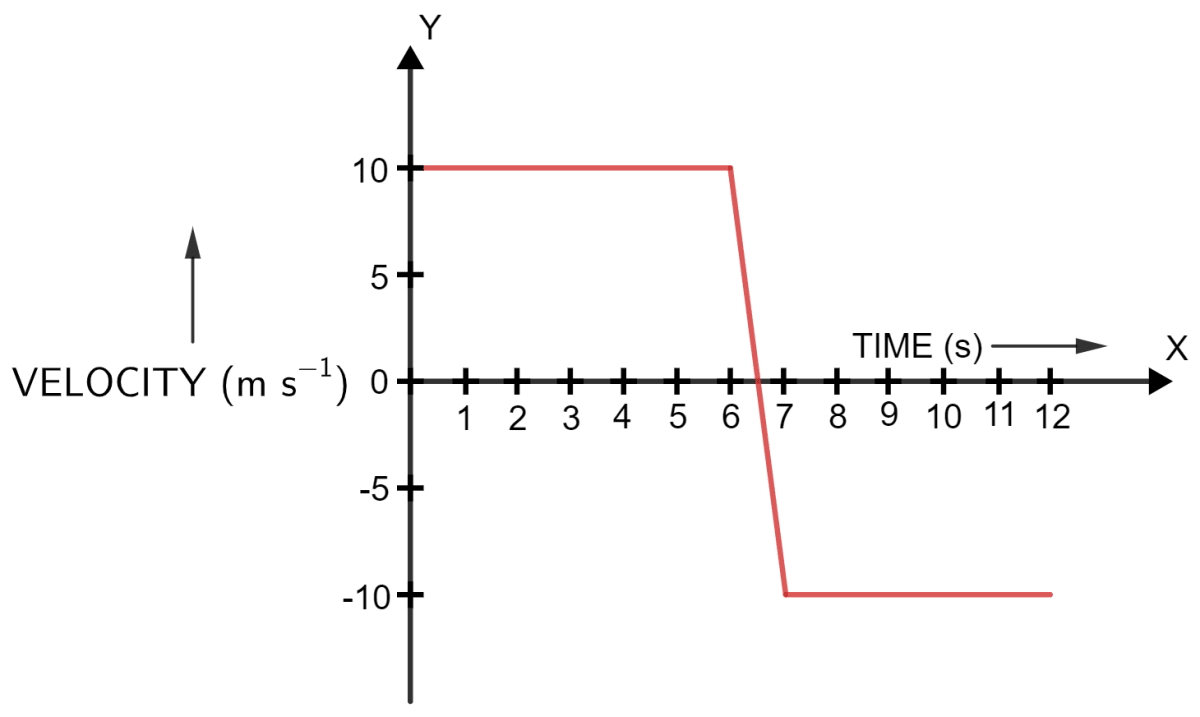
As we know,
Distance = velocity x time
Substituting the values in the formula above we get,
Displacement = distance travelled in the forward direction - distance travelled while coming back
Question 12 — The figure below shows the velocity-time graph of a particle moving in a straight line. (i) State the nature of motion of particle. (ii) Find the displacement of particle at t = 6 s. (iii) Does the particle change its direction of motion? (iv) Compare the distance travelled by the particle from 0 to 4 s and from 4 s to 6 s. (v) Find the acceleration from 0 to 4 s and retardation from 4 s to 6 s.
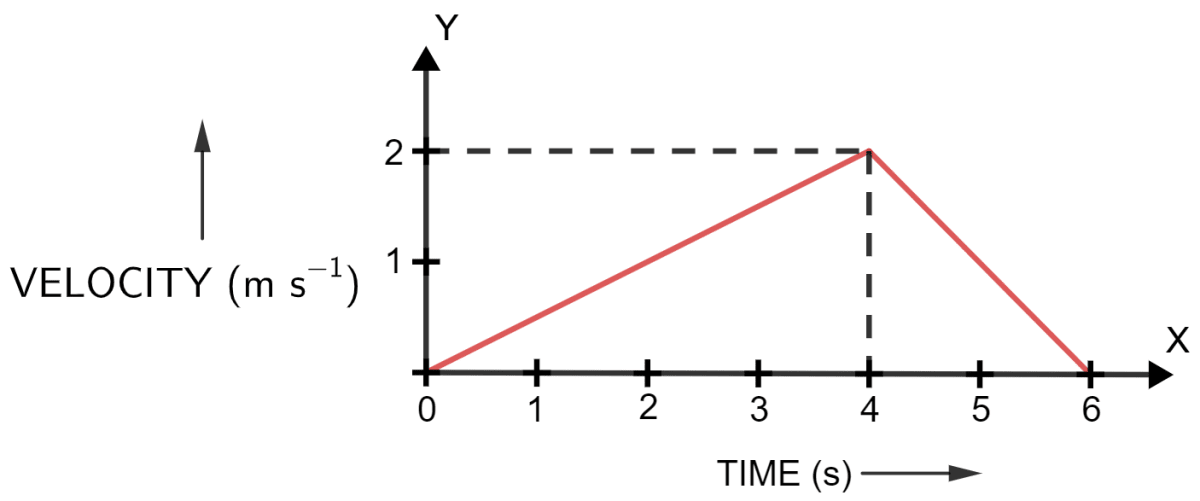
(i) State the nature of motion of particle.
(iii) Does the particle change its direction of motion?
(iv) Compare the distance travelled by the particle from 0 to 4 s and from 4 s to 6 s.
(v) Find the acceleration from 0 to 4 s and retardation from 4 s to 6 s.
Answer(i) As we observe the graph, we find that, the nature of motion of particle is that, the particles are uniformly accelerated from 0 to 4s and then uniformly retarded from 4s to 6s.
(ii) As we know,
displacement of particles can be obtained by finding the area enclosed by the graph in that part with the time axis up to that instance.
Displacement = area of triangle
Substituting the values in the formula above, we get,
(iii) No, the particle does not change its direction of motion.
Distance covered = area of triangle
Substituting the values in the formula above, we get,
Distance covered = area of triangle
Substituting the values in the formula above, we get,
Hence, distance covered between 4s to 6 s is 2 m.
Hence, acceleration in part 0 s to 4 s is 0.5 m s−2.
As we know,
Hence, retardation in part 4 s to 6 s is 1 m s−2.
Exercise 2(C) — Multiple Choice Type
Question 1(i) — When a body starts from rest, the equation of motion takes the form : v = u v = at v = 1/2 at2 S = ut + 1/2 at2
When a body starts from rest, initial velocity is zero (u = 0), then v = at.
Question 1(ii) — If a body is moving with a uniform retardation, then its acceleration will be : Positive Negative Zero Cannot say
Positive Negative Zero Cannot say
AnswerNegative
When a body is moving with uniform retardation, then acceleration will be negative.
Question 1(iii) — A car acquires a velocity of 54 m s−1 in 20 s starting from rest, then its acceleration is : 5.4 m s−2 2.7 m s−2 7.2 m s−2 2.0 m s−2
5.4 m s−2 2.7 m s−2 7.2 m s−2 2.0 m s−2
Answer2.7 m s−2
Given,
Question 1(iv) — A particle starts to move in a straight line from a point with velocity 10 m s−1 and acceleration -2.0 m s−2. Its position at t = 5 s will be : 5 m 10 m 20 m 25 m
5 m 10 m 20 m 25 m
Answer25 m
Given,
Question 1(v) — A body initially at rest, starts moving with a constant acceleration of 0.5 m s−2 and travels a distance 25 m, then its final velocity is : 5 m s−1 20 m s−1 15 m s−1 -15 m s−1
5 m s−1 20 m s−1 15 m s−1 -15 m s−1
Answer5 m s−1
Given,
Question 1(vi) — A car starting from rest accelerates uniformly to acquire a speed 20 km h−1 in 30 min. The distance travelled by car in this time interval will be — 600 km 5 km 6 km 10 km
600 km 5 km 6 km 10 km
Answer5 km
As we know,
Given,
Substituting the values in the formula above, we get,
Now,
Substituting the values in the formula above we get,
Question 1(vii) — A car starting from rest moves on a straight path for time t = 0 to t = T with a uniform acceleration a and then stops with a uniform retardation. The average speed of the car will be : aT/4 3aT/2 aT/2 aT
aT/4 3aT/2 aT/2 aT
AnsweraT/2
Assuming, uniform retardation has the same value as the uniform acceleration (a).
Case 1 : When car is accelerating
Given,
As,
On putting values
= aT
By using,
On putting values
Case 2 : When car is retarding
Given,
As,
On putting values
By using,
On putting values
Here,
= aT²
= T + T
Then,
∴ Average speed of the car is aT/2.
Exercise 2(C) — Very Short Answer Type
Question 1 — Write three equations of uniformly accelerated motion relating the initial velocity (u), final velocity (v), time (t), acceleration (a) and displacement (S).
Write three equations of uniformly accelerated motion relating the initial velocity (u), final velocity (v), time (t), acceleration (a) and displacement (S).
AnswerThe equations of uniformly accelerated motion relating to the initial velocity (u), final velocity (v), time (t), acceleration (a) and displacement (S) are as follows —
Question 2 — Write an expression for the distance S covered in time t by a body which is initially at rest and starts moving with a constant acceleration a.
According to equation of motion —
Where,
Hence, we get,
Hence, we get,
Exercise 2(C) — Long Answer Type
Question 1 — Derive the following equations for a uniformly accelerated motion graphically — (i) v = u + at (ii) S = ut + 1/2 at2 (iii) v2 = u2 + 2aS where the symbols have their usual meanings.
where the symbols have their usual meanings.
AnswerConsider the linear motion of a body with an initial velocity u. The body accelerates uniformly with acceleration a and in time t, it acquires the final velocity v. The velocity–time graph is a straight line AB as shown below :

(i) From the graph,
Acceleration = change in velocity/time taken Acceleration = final velocity - initial velocity/time taken
Thus,
Hence, we get,
(ii) From the graph,
Distance travelled = Avg. Velocity × time
or
Therefore,
Hence, we get,
(iii) From the graph,
Distance travelled = Avg. Velocity × time
Therefore,
Hence,
Exercise 2(C) — Numericals
Question 1 — A body starts from rest with a uniform acceleration of 2 m s−2. Find the distance covered by the body in 2 s.
According to equation of motion —
Where,
Question 2 — A body starts with an initial velocity of 10 m s−1 and acceleration 5 m s−2. Find the distance covered by it in 5 s .
A body starts with an initial velocity of 10 m s−1 and acceleration 5 m s−2. Find the distance covered by it in 5 s .
AnswerAccording to equation of motion —
Where,
Substituting the values in the formula, we get,
Question 3 — A vehicle is accelerating on a straight road. Its velocity at any instant is 30 km h−1, after 2 s, it is 33.6 km h−1 and after further 2 s, it is 37.2 km h−1. Find the acceleration of vehicle in m s−2. Is the acceleration uniform ?
A vehicle is accelerating on a straight road. Its velocity at any instant is 30 km h−1, after 2 s, it is 33.6 km h−1 and after further 2 s, it is 37.2 km h−1. Find the acceleration of vehicle in m s−2. Is the acceleration uniform ?
AnswerAs we know,
Converting km h−1 to m s−1
We get,
Hence, 30 km h−1 is equal to 8.33 m s−1.
Now,
Converting km h−1 to m s−1
We get,
Hence, 33.6 km h−1 is equal to 9.33 m s−1
Substituting the values in the formula above, we get,
For the next 2 s,
Converting km h−1 to m s−1
We get,
Hence, 37.2 km h−1 is equal to 10.33 m s−1.
Substituting the values in the formula above, we get,
Hence, acceleration is 0.5 m s−2.
Yes, the acceleration is uniform as the acceleration in both instances is same.
Question 4 — A body, initially at rest, starts moving with a constant acceleration 2 m s−2. Calculate — (i) the velocity acquired and (ii) the distance travelled in 5 s.
Calculate —
(i) the velocity acquired and
(ii) the distance travelled in 5 s.
AnswerAs we know, from the equation of motion,
Given,
Substituting the values in the formula, we get,
(ii) According to equation of motion —
Substituting the values in the formula, we get,
Question 5 — A bullet initially moving with a velocity 20 m s−1 strikes a target and comes to rest after penetrating a distance 10 cm in the target. Calculate the retardation caused by the target.
According to equation of motion —
Given,
Substituting the values in the formula above, we get,
Hence, retardation is 2000 m s−2
Question 6 — A train moving with a velocity of 20 m s−1 is brought to rest by applying brakes in 5 s. Calculate the retardation.
According to equation of motion —
Given,
Substituting the values in the formula above, we get,
Hence, retardation is 4 m s−2.
Question 7 — A train travels with a speed of 60 km h−1 from station A to station B and then comes back with a speed 80 km h−1 from station B to station A. Find — (i) the average speed, and (ii) the average velocity of train.
Find —
(i) the average speed, and
(ii) the average velocity of train.
AnswerAs we know,
Avg Speed = Total Distance/Total time
Given,
From A to B
Distance travelled = dAB = d
From B to A
Distance travelled = dBA = d
Substituting the values from the equations 1 and 2 in the formula we get,
(ii) We know,
Average velocity = Displacement/Total time
As the train starts from station A and comes back to same station, hence, displacement is zero.
Therefore, the average velocity is also zero.
Question 8 — A train is moving with a velocity of 90 km h−1. It is brought to stop by applying the brakes which produce a retardation of 0.5 m s−2. Find — (i) the velocity after 10 s, and (ii) the time taken by the train to come to rest.
Find —
(i) the velocity after 10 s, and
(ii) the time taken by the train to come to rest.
Answer(i) As we know, according to the equation of motion,
Given,
velocity in m s−1
Hence, 90 km h−1 is equal to 25 m s−1.
Substituting the values in the formula above we get,
Hence, the velocity after 10 s is 20 m s−1.
(ii) As we know, according to the equation of motion,
Substituting the values in the formula above, to get the time taken by the train to come to rest.
Question 9 — A car travels a distance 100 m with a constant acceleration and average velocity of 20 m s−1. The final velocity acquired by the car is 25 m s−1. Find: (i) the initial velocity and (ii) acceleration of car.
Find:
(i) the initial velocity and
(ii) acceleration of car.
Answer(i) Given,
As we know,
Substituting the value we get,
Hence, initial velocity of the car is 15 m s−1
(ii) We know, from the equation,
Substituting the values in the formula above we get,
Question 10 — When brakes are applied to a bus, the retardation produced is 25 cm s−2 and the bus takes 20 s to stop. Calculate — (i) the initial velocity of bus, and (ii) the distance travelled by bus during this time.
Calculate —
(i) the initial velocity of bus, and
(ii) the distance travelled by bus during this time.
AnswerAs we know,
Given,
Expressing it in m s−2
Substituting the values in the formula above we get,
(ii) As we know, from the equation of motion,
Substituting the values, we get,
Question 11 — A body moves from rest with a uniform acceleration and travels 270 m in 3 s. Find the velocity of the body at 10 s after the start.
As we know,
Given,
Substituting the values in the formula above we get,
Substituting the values in the formula above we get,
Question 12 — A body moving with a constant acceleration travels the distances 3 m and 8 m respectively in 1 s and 2 s. Calculate — (i) the initial velocity, and (ii) the acceleration of body.
Calculate —
(i) the initial velocity, and
(ii) the acceleration of body.
AnswerAs we know,
Let,
Substituting the values in the formula above we get,
For 3 m distance :
For 8 m distance :
Solving Equations 1 & 2,
We get,
Hence, the acceleration of body is 2 m s−2.
Question 13 — A car travels with a uniform velocity of 25 m s−1 for 5 s. The brakes are then applied and the car is uniformly retarded and comes to rest in further 10 s. Find — (i) the distance which the car travels before the brakes are applied, (ii) the retardation, and (iii) the distance travelled by the car after applying the brakes.
Find —
(i) the distance which the car travels before the brakes are applied,
(ii) the retardation, and
(iii) the distance travelled by the car after applying the brakes.
Answer(i) As we know,
Distance = Speed x time
Given,
Substituting the values in the formula above we get,
Hence, distance covered is 125 m.
(ii) Retardation = -a = (v − u)/t
Substituting the values in the formula above we get,
Hence, retardation of the car is 2.5 m s−2.
(iii) As we know,
Substituting the values in the formula above we get,
Question 14 — A space craft flying in a straight course with a velocity of 75 km s−1 fires its rocket motors for 6.0 s. At the end of this time, its speed is 120 km s−1 in the same direction. Find — (i) the space craft’s average acceleration while the motors were firing , (ii) the distance travelled by the space craft in the first 10 s after the rocket motors were started, the motors having been in action for only 6.0 s.
Find —
(i) the space craft’s average acceleration while the motors were firing ,
(ii) the distance travelled by the space craft in the first 10 s after the rocket motors were started, the motors having been in action for only 6.0 s.
Answer(i) As we know,
Given,
Substituting the values in the formula above we get,
Hence, acceleration is 7.5 km s−2.
(ii) As we know,
For the first 6 s
For the next 4 s
Given,
Substituting the values in the formula above, we get,
Question 15 — A train starts from rest and accelerates uniformly at a rate of 2 m s−2 for 10 s. It then maintains a constant speed for 200 s. The brakes are then applied and the train is uniformly retarded and comes to rest in 50 s. Find — (i) the maximum velocity reached, (ii) the retardation in the last 50 s, (iii) the total distance travelled, and (iv) the average velocity of the train.
A train starts from rest and accelerates uniformly at a rate of 2 m s−2 for 10 s. It then maintains a constant speed for 200 s. The brakes are then applied and the train is uniformly retarded and comes to rest in 50 s.
Find —
(i) the maximum velocity reached,
(ii) the retardation in the last 50 s,
(iii) the total distance travelled, and
(iv) the average velocity of the train.
AnswerAs we know,
Given,
Substituting the values in the formula above we get,
(ii) Retardation in last 50 s,
As we know,
Given,
Substituting the values in the formula above we get,
(iii) As we know,
For the first 10 s
For the next 200 s
where
Substituting the values in the formula above we get,
For the next 50 s
So,
(iv) Average velocity = Total distance covered/Time taken
Substituting the values in the formula above we get,
Exercise 2(C) — Assertion Reason Type
Question (i) — Assertion (A) : The displacement of a body can be zero even if the distance travelled by it is not zero.
(R) : Displacement is the shortest distance from the initial to the final position of body.
Both A and R are true and R is the correct explanation of A Both A and R are true and R is not the correct explanation of A Assertion is false but reason is true Assertion is true but reason is false
Both A and R are true and R is the correct explanation of A
Assertion (A) is true because if a body moves and comes back to its starting point (e.g., in a circular path or a round trip), the displacement is zero because the initial and final positions are the same, but the distance travelled is not zero.
(R) is true because by definition, displacement is the shortest straight line distance between the initial and final positions of the body. So, the reason correctly explains the assertion.
Question (ii) — Assertion (A) : For a given time interval, average velocity and average speed can have different values.
(R) : Speed is a scalar quantity whereas velocity is a vector quantity.
Both A and R are true and R is the correct explanation of A Both A and R are true and R is not the correct explanation of A Assertion is false but reason is true Assertion is true but reason is false
Both A and R are true and R is the correct explanation of A
Assertion (A) is true because :
Average speed = Total distance/Total time
and
Average velocity = Net displacement/Total time
(R) is true because speed has only magnitude (no direction) i.e., scalar and velocity has both magnitude and direction i.e., vector. Hence, the reason correctly explains why average speed and average velocity can differ because velocity depends on displacement (vector) and speed depends on distance (scalar).
Question (iii) — Assertion (A) : The slope of displacement-time graph gives the velocity.
Assertion (A) : The slope of displacement-time graph gives the velocity.
Reason(R) : Velocity is the product of displacement and time.
Both A and R are true and R is the correct explanation of A Both A and R are true and R is not the correct explanation of A Assertion is false but reason is true Assertion is true but reason is false
Assertion is true but reason is false
Slope = Change in displacement/Change in time = velocity
(R) is false because velocity is not the product of displacement and time.
Instead,
Velocity = Displacement/Time
Question (iv) — Assertion (A) : The velocity-time graph of a body in motion can be a straight line parallel to the time axis.
(R) : This is because the motion of body is with non-uniform velocity.
Both A and R are true and R is the correct explanation of A Both A and R are true and R is not the correct explanation of A Assertion is false but reason is true Assertion is true but reason is false
Assertion is true but reason is false
Assertion (A) is true because a straight line parallel to the time (x) axis implies same velocity at all times so this happens when the velocity remains constant over time, i.e., uniform velocity.
(R) is false because a horizontal velocity-time graph (parallel to the time axis) indicates uniform velocity not non-uniform velocity which shows the velocity doesn’t change with time.
Hence, assertion is true but reason is false.
Question (v) — Assertion (A) : The acceleration-time graph of а body is a straight line parallel to time axis.
(R) : This depicts the motion of freely falling body under gravity.
Both A and R are true and R is the correct explanation of A Both A and R are true and R is not the correct explanation of A Assertion is false but reason is true Assertion is true but reason is false
Both A and R are true and R is the correct explanation of A
(R) is true because for a freely falling body under gravity (ignoring air resistance), the acceleration is constant and equal to g (= 9.8 m s−2) and this produces a horizontal acceleration-time graph so the reason correctly explains the assertion.
Question (vi) — Assertion (A) : Acceleration of a moving body is always positive.
(R) : Acceleration is the rate of change of velocity with time.
Both A and R are true and R is the correct explanation of A Both A and R are true and R is not the correct explanation of A Assertion is false but reason is true Assertion is true but reason is false
Assertion is false but reason is true
Assertion (A) is false because acceleration can be positive, negative (retardation), or zero depending on whether the velocity is increasing, decreasing, or constant.
(R) is true because acceleration of a body is given by :
Acceleration = Change in velocity/Time interval
Exercise 2(C) — Case Study
Question 1 — A lift starts from rest at the ground floor and moves vertically upward along a straight shaft. During the first 4 s, the lift moves with uniform acceleration and attains a velocity of 2 m s−1. It then moves with uniform velocity for the next 6 s. Finally, it is brought to rest uniformly in 2 s at the top floor. Assuming the motion to be one-dimensional, answer the following:
A lift starts from rest at the ground floor and moves vertically upward along a straight shaft. During the first 4 s, the lift moves with uniform acceleration and attains a velocity of 2 m s−1. It then moves with uniform velocity for the next 6 s. Finally, it is brought to rest uniformly in 2 s at the top floor.
Assuming the motion to be one-dimensional, answer the following:
(a) Calculate the acceleration of the lift during the first 4 s.
(b) Calculate the total height between the ground floor and the top floor.
(c) Draw the velocity-time graph for the complete motion and mark the regions of acceleration, retardation and zero acceleration.
(d) Use the graph to calculate the average velocity of the lift during the upward journey.
(e) If the lift now moves downward following the same pattern, how would the signs of acceleration and displacement change?
(f) "The lift has maximum acceleration when it starts moving." Is this statement correct? Give reason.
AnswerGiven,
On using,
On putting values,
Hence, the acceleration of the lift during the first 4 s is 0.5 m s−2.
(b) Stage 1 : 0 – 4 s : Uniform acceleration
On using,
Stage 2 : 4 – 10 s : Uniform velocity
Stage 3 : 10 – 12 s : Retardation
On using,
The total height is the sum of displacements in three stages i.e.,
Hence, the total height between the ground floor and the top floor is 18 m.
(c) The velocity–time graph has three straight segments:
From 0–4 s: velocity increases from 0 to 2 m s−1 (uniform acceleration). From 4–10 s: horizontal line at 2 m s−1 (zero acceleration). From 10–12 s: velocity decreases from 2 m s−1 to 0 m s−1 (uniform retardation).
So, the velocity-time graph for the complete motion is shown below :

(d) Average veloctiy of the lift is given by,
Average velocity = Net displacement/Total time taken
Where the net displacement covered by an object is given by the area under velocity-time graph.
Then,
Net displacement = Area under v-t graph
On putting values,
Hence, the average velocity of the lift during the upward journey is 1.5 m s−1.
(e) If the lift moves downward, the direction of motion reverses. Therefore:
Displacement becomes negative (taking upward as positive). Acceleration also becomes negative (taking upward as positive).
(f) No, the statement is not correct because the lift has uniform acceleration during the first 4 s, which means its acceleration remains constant, not maximum only at the start and it does not suddenly peak at the beginning; it remains the same throughout the acceleration phase.
Frequently Asked Questions
What is motion in one dimension?
When a body moves along a straight-line path, its motion is called one-dimensional motion.
What is the difference between distance and displacement?
Distance is the total path length and is a scalar quantity. Displacement is the shortest directed distance from the initial position to the final position and is a vector quantity.
What does the slope of a displacement-time graph give?
The slope of a displacement-time graph gives velocity.
What does the area under a velocity-time graph give?
The signed area gives displacement. The arithmetic sum of the magnitudes of positive and negative areas gives total distance.
What are the three equations of uniformly accelerated motion?
They are v = u + at, S = ut + ½at², and v² = u² + 2aS.
What is the average value of acceleration due to gravity?
The average value of g near the Earth’s surface is 9.8 m s⁻², often approximated as 10 m s⁻².





0 Comments