
Reflection of Light: Plane Mirrors
Interactive question bank with MCQs, short answers, long answers, numerical solutions, diagrams, and step-by-step explanations.
Exercise 7(B) — Multiple Choice Questions
Q1
In a barber's shop, two plane mirrors are placed:
Answer: parallel to each other
Reason: In a barber's shop, in order to see the hairs at the back of the head, two plane mirrors are placed parallel to each other at the front and at the back of the viewer.
Reason: In a barber's shop, in order to see the hairs at the back of the head, two plane mirrors are placed parallel to each other at the front and at the back of the viewer.
Q2
For two mirrors kept parallel to each other, the number of images formed is:
Answer: infinity
n = 360° / θ
For parallel mirrors, θ = 0°
n = 360° / 0° = infinite
Reason: When two mirrors are kept parallel to each other, the angle between them is 0°. Hence, an infinite number of images are formed.
Q3
The number of images formed for two mirrors kept perpendicular to each other is:
Answer: 3
θ = 90°
n = 360° / θ
n = 360° / 90°
n = 4
Since n is even:
Number of images = n - 1
Number of images = 4 - 1 = 3
Reason: Hence, for two mirrors kept perpendicular to each other, three images are formed for an object kept in between them.
Q4
A thick plane mirror, silvered at its back, forms multiple number of images. Out of these, the brightest image is:
Answer: second image
Reason: A thick plane mirror forms a number of images due to multiple reflections within the glass from the front surface and back reflecting surface. Out of these, the second image formed due to reflection from the back reflecting surface is the brightest.
Reason: A thick plane mirror forms a number of images due to multiple reflections within the glass from the front surface and back reflecting surface. Out of these, the second image formed due to reflection from the back reflecting surface is the brightest.
Q5
How many plane mirrors are used in a periscope and kaleidoscope?
Answer: 2 and 3 respectively
Reason: In a periscope, two parallel plane mirrors each inclined at 45° with the vertical walls are placed facing each other. In a kaleidoscope, three plane mirrors inclined with each other at 60° are used.
Reason: In a periscope, two parallel plane mirrors each inclined at 45° with the vertical walls are placed facing each other. In a kaleidoscope, three plane mirrors inclined with each other at 60° are used.
Q6
In a kaleidoscope, three plane mirrors are inclined with each other at an angle of:
Answer: 60°
Reason: In a kaleidoscope, three plane mirrors inclined with each other at 60° are used.
Reason: In a kaleidoscope, three plane mirrors inclined with each other at 60° are used.
Q7
In a periscope, two plane mirrors are inclined at an angle of ............... with the vertical walls.
Answer: 45°
Reason: In a periscope, two parallel plane mirrors each inclined at 45° with the vertical walls are placed facing each other.
Reason: In a periscope, two parallel plane mirrors each inclined at 45° with the vertical walls are placed facing each other.
Q8
Two mirrors are placed at right angles to each other. A ray of light PQ strikes mirror OM at an angle of incidence 30°. What would be its angle of reflection from mirror ON?

Answer: 60°

Reflection from mirror OM:
Angle of incidence = 30°
By law of reflection:
Angle of incidence = Angle of reflection = 30°
The reflected ray makes an angle of 30° with the normal to OM, that is, 60° with mirror OM.
Since OM and ON are at 90°, the ray makes:
90° - 60° = 30° with mirror ON.
Therefore, angle between incident ray and normal to ON = 60°.
Hence, angle of reflection from mirror ON = 60°.
Angle of incidence = 30°
By law of reflection:
Angle of incidence = Angle of reflection = 30°
The reflected ray makes an angle of 30° with the normal to OM, that is, 60° with mirror OM.
Since OM and ON are at 90°, the ray makes:
90° - 60° = 30° with mirror ON.
Therefore, angle between incident ray and normal to ON = 60°.
Hence, angle of reflection from mirror ON = 60°.
Exercise 7(B) — Very Short Answer Type
Q1
What is the most common use of a plane mirror?
Looking glass.
Q2
How does an optician increase the effective length of his room by using a mirror? Where does he place the sign board?
To increase the effective length of the optician's room, a plane mirror is placed on the front wall and the sign board is placed on the opposite wall, just behind the patient.
With this arrangement, the sign board is at nearly double the length of the room for the patient.
With this arrangement, the sign board is at nearly double the length of the room for the patient.
Q3
What relationship do the images formed by two inclined plane mirrors have for their location with respect to the object placed between them?
The images lie on the circumference of a circle whose centre lies at the point of intersection of the two mirrors and whose radius is equal to the distance of the object from the point of intersection.
Exercise 7(B) — Short Answer Type
Q1
Two plane mirrors are placed making an angle θ in between them. Write an expression for the number of images formed if an object is placed in between the mirrors. State the condition, if any.
There are two cases possible when the angle θ° between the mirrors is such that:
1. The number of images is n, when the object is placed asymmetrically between the mirrors.
2. The number of images is n - 1, when the object is placed symmetrically, that is, on the bisector of the angle between the mirrors.
Case 2: If n = 360° / θ° is even:
The number of images is always n - 1 for all positions of the object in between the mirrors.
n = 360° / θ°
Case 1: If n = 360° / θ° is odd:1. The number of images is n, when the object is placed asymmetrically between the mirrors.
2. The number of images is n - 1, when the object is placed symmetrically, that is, on the bisector of the angle between the mirrors.
Case 2: If n = 360° / θ° is even:
The number of images is always n - 1 for all positions of the object in between the mirrors.
Q2
Two plane mirrors are placed making an angle θ° in between them. For an object placed in between the mirrors, if angle is gradually increased from 0° to 180°, how will the number of images change: increase, decrease or remain unchanged?
When two plane mirrors are placed making an angle θ° in between them and an object is placed in between the mirrors, and the angle is gradually increased from 0° to 180°, then the number of images decreases.
Q3
State two uses of a plane mirror.
The uses of a plane mirror are:
1. The most common and wide use is as a looking glass.
2. In the optician's room to increase the effective length of the room.
1. The most common and wide use is as a looking glass.
2. In the optician's room to increase the effective length of the room.
Exercise 7(B) — Long Answer Type
Q1
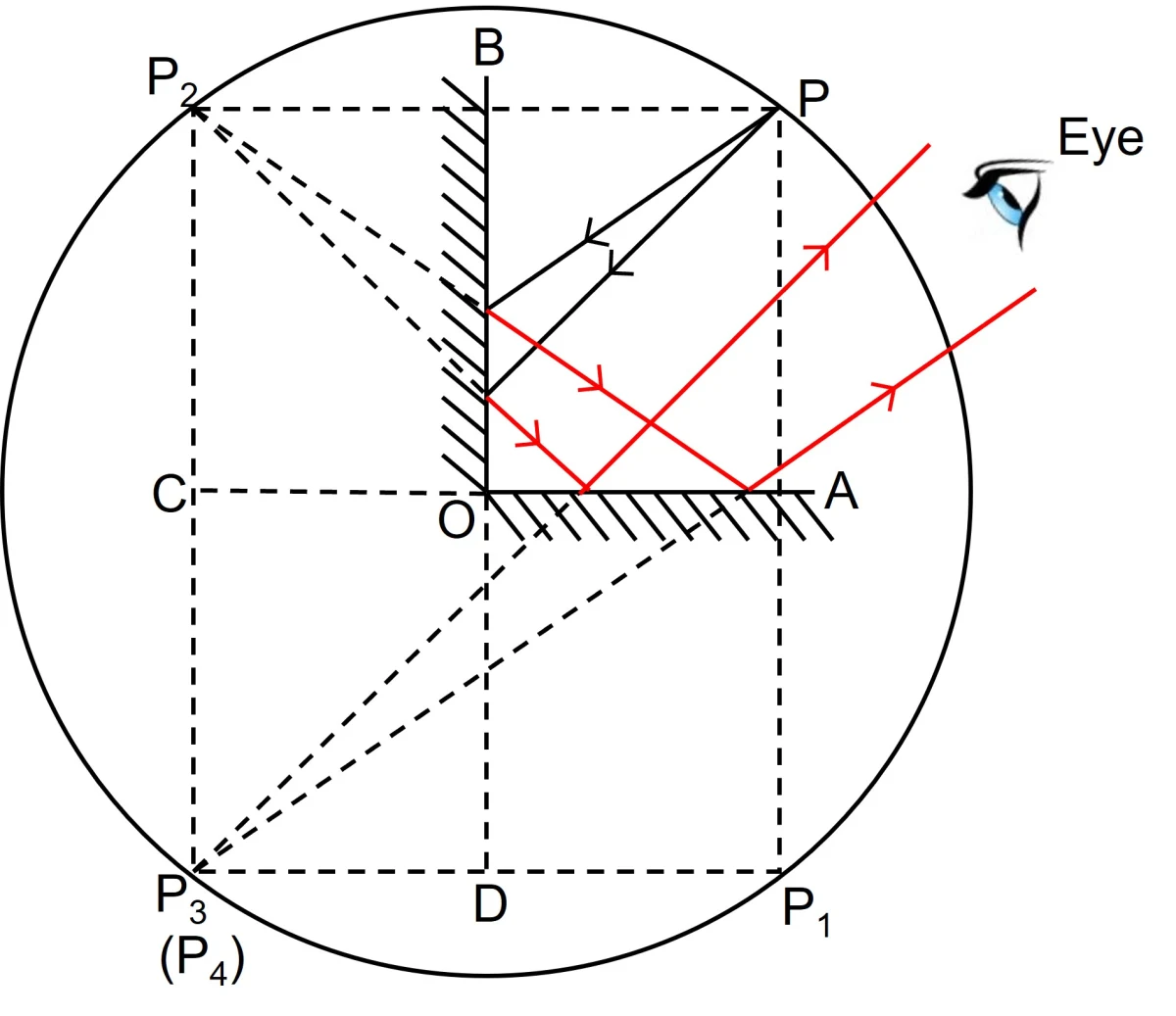
How many images are formed for a point object kept in between the two plane mirrors at right angles to each other? Show them by drawing a ray diagram.
Three images will be formed when a point object is placed between two plane mirrors that are at right angles to each other.
Q2
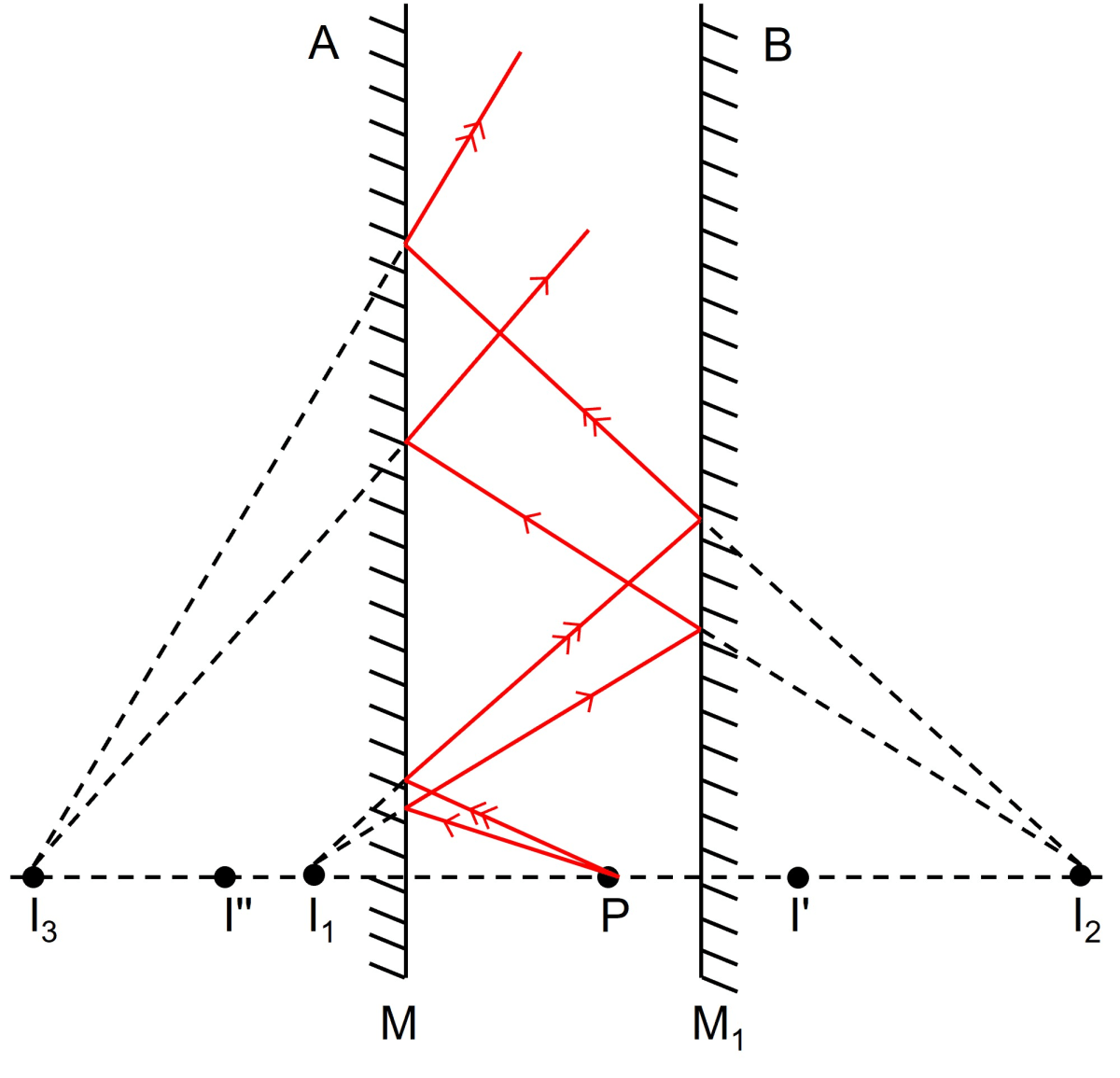
Two plane mirrors are arranged parallel and facing each other at some separation. How many images are formed for a point object kept in between them? Show the formation of images with the help of a ray diagram.
Infinite number of images are formed when two plane mirrors are arranged parallel and facing each other at some separation.
Exercise 7(B) — Numericals
Q1
State the number of images of an object placed between the two plane mirrors, formed in each case when the mirrors are inclined to each other at (a) 90°, and (b) 60°.
(a) When θ = 90°
(b) When θ = 60°
n = 360° / 90°
n = 4
Since n = 4 is even, number of images = n - 1
Number of images = 4 - 1
Number of images = 3
Hence, for two mirrors kept perpendicular to each other, three images are formed for an object kept in between them.
n = 4
Since n = 4 is even, number of images = n - 1
Number of images = 4 - 1
Number of images = 3
(b) When θ = 60°
n = 360° / 60°
n = 6
Since n = 6 is even, number of images = n - 1
Number of images = 6 - 1
Number of images = 5
Hence, for two mirrors kept at 60° to each other, five images are formed for an object kept in between them.
n = 6
Since n = 6 is even, number of images = n - 1
Number of images = 6 - 1
Number of images = 5
Q2
An object is placed (i) asymmetrically (ii) symmetrically, between two plane mirrors inclined at an angle of 50°. Find the number of images formed.
(i) Object placed asymmetrically
(ii) Object placed symmetrically
θ = 50°
n = 360° / 50°
n = 7.2
n = 7
Hence, 7 images are formed.
n = 360° / 50°
n = 7.2
n = 7
(ii) Object placed symmetrically
Number of images = n - 1
Number of images = 7 - 1
Number of images = 6
Therefore, 6 images will be formed when the object is placed symmetrically between two plane mirrors inclined at an angle of 50°.
Number of images = 7 - 1
Number of images = 6





0 Comments