
Exercise 7(C) — Reflection of Light
Interactive question-answer format with animated sections, answer reveal buttons, formula boxes, responsive tables, and diagram placeholders for image links.
Exercise 7(C) — Multiple Choice Type
19 QuestionsQuestion 1(i)
A ............... mirror is made by silvering the ............... surface of a piece of a hollow sphere.
convex, outer
plane, outer
concave, outer
concave, inner
concave, outer
Reason — A concave mirror is made by silvering the outer (or bulging) surface of a piece of a hollow sphere such that the reflection takes place from the hollow (or concave) surface.
Question 1(ii)
A ............... mirror is made by silvering the ............... surface of a piece of a hollow sphere.
concave, inner
convex, inner
convex, outer
None of the above
convex, inner
Reason — A convex mirror is made by silvering the inner surface of a piece of a hollow sphere such that the reflection takes place from the outer (or bulging) surface.
Question 1(iii)
The correct statement(s) is/are :
(i) The radius of a sphere of which the spherical mirror is a part is called the radius of curvature.
(ii) The geometric centre of the spherical surface of a mirror is called the centre of curvature.
(iii) Principal axis is the straight line joining the pole of the mirror to its aperture.
(i)
(ii)
(iii)
None of the above
(i)
Reason — For spherical mirrors :
The radius of a sphere of which the spherical mirror is a part is called the radius of curvature.
The geometric centre of the spherical surface of a mirror is called the pole of the mirror.
Principal axis is the straight line joining the pole of the mirror to its centre of curvature.
Question 1(iv)
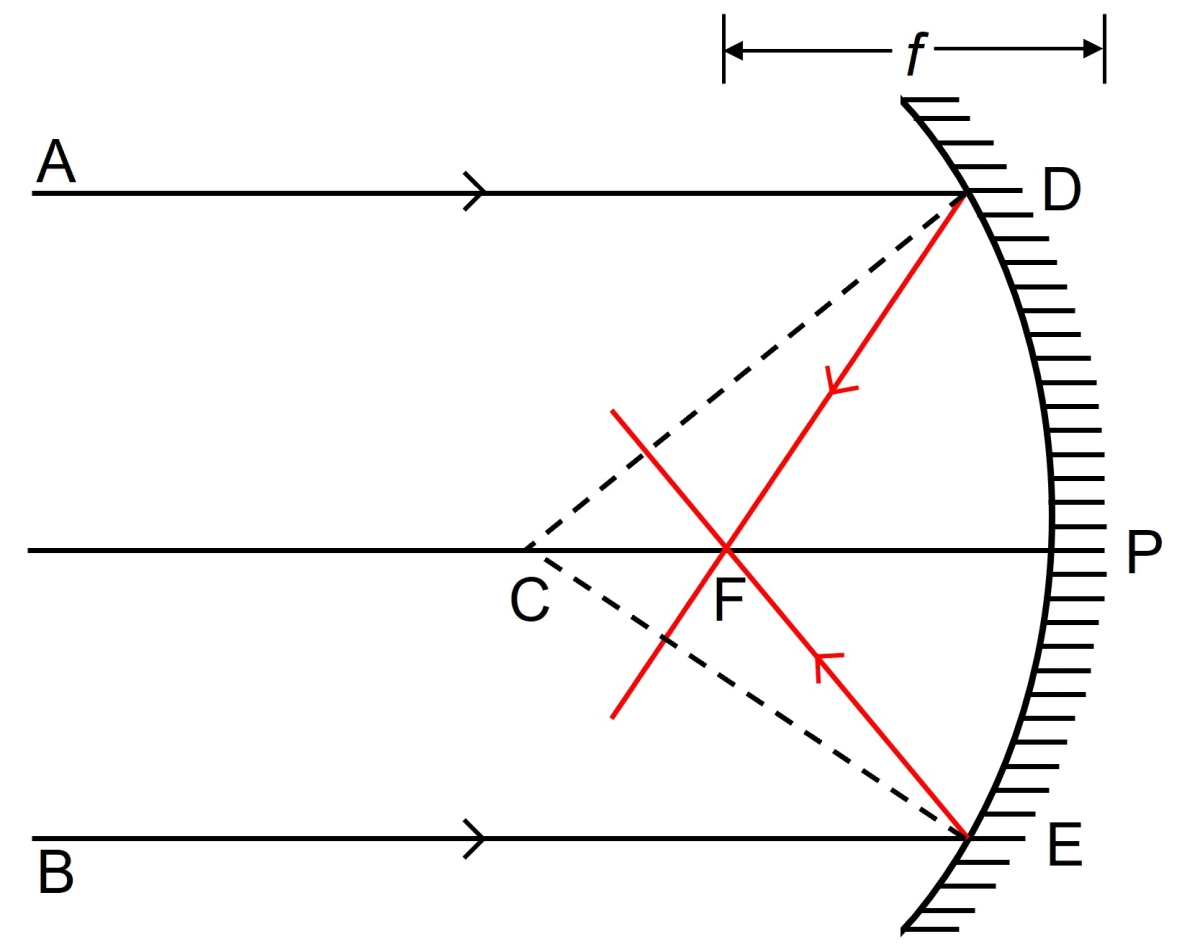
The focus of a concave mirror is a point on the ............... through which the light rays incident ............... to the principal axis pass after reflection from the mirror.
centre of curvature, perpendicular
principal axis, parallel
principal axis, perpendicular
aperture, parallel
principal axis, parallel
Reason — The focus of a concave mirror is a point on the principal axis through which the light rays incident parallel to the principal axis, pass after reflection from the mirror.
Question 1(v)
For an incident ray directed towards center of curvature of a spherical mirror, the reflected ray:
retraces its path
passes through the focus
passes through the pole
becomes parallel to the principal axis.
retraces its path
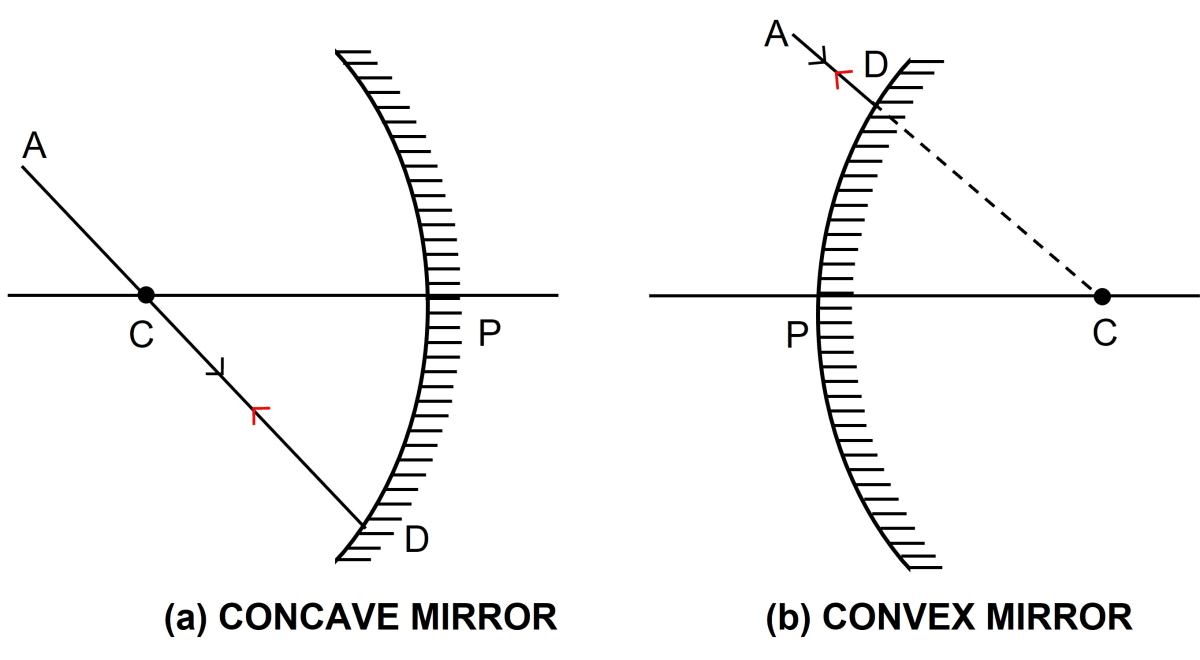
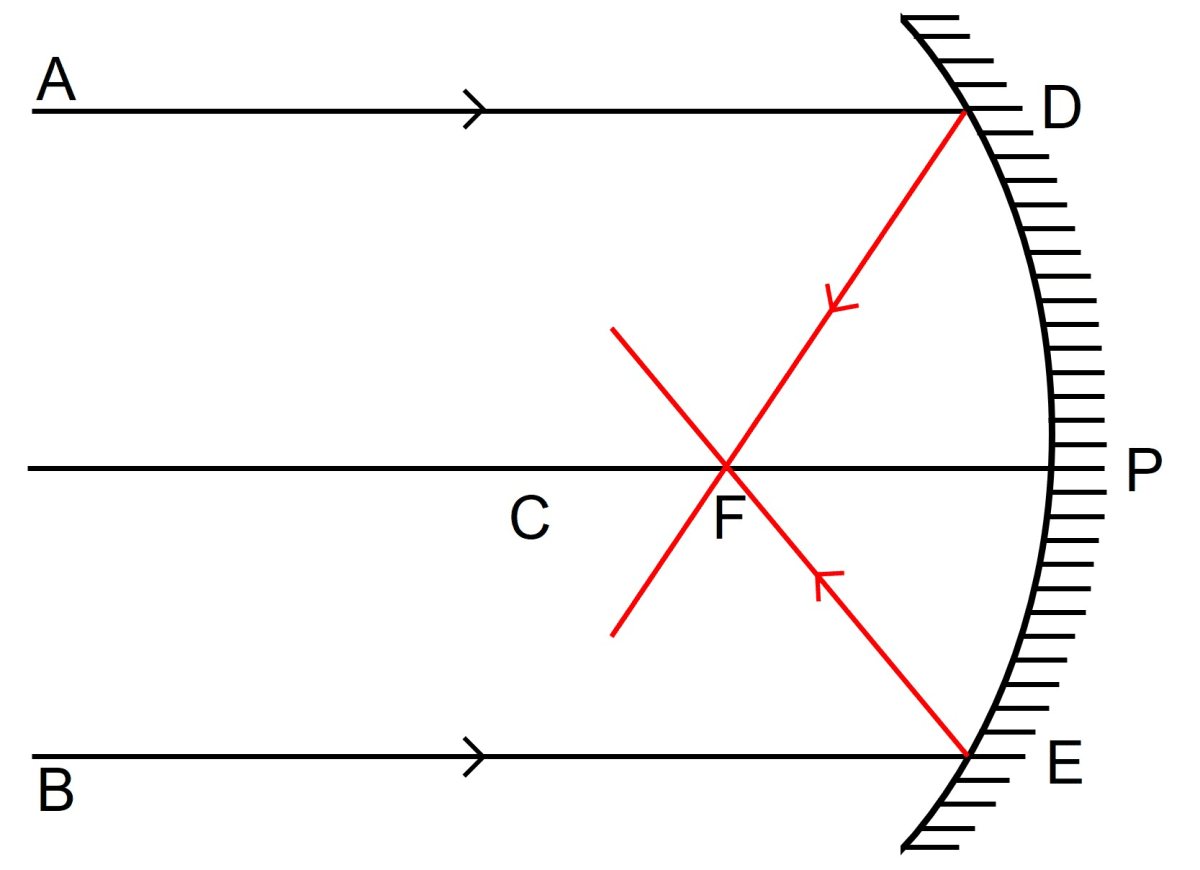
Reason — A line joining the centre of curvature to any point on the surface of mirror is normal to the mirror at that point, so a ray AD passing through the center of curvature C (or appearing to pass through through the centre of curvature C) is incident normally on the spherical mirror.
Since it's angle of incidence is zero, therefore the angle of reflection will also be zero and the ray AD gets reflected along it's own path DA as shown below.
Question 1(vi)
A ray either incident from the focus (or converging at the focus), after reflection from a spherical mirror :
becomes perpendicular to the principal axis
becomes parallel to the principal axis
becomes normal to the focus
passes through the centre of curvature
becomes parallel to the principal axis
Reason — A ray either incident from the focus (or converging at the focus), after reflection from a spherical mirror becomes parallel to the principal axis.
Question 1(vii)
For a concave mirror, when the object is at infinity, the nature of the image formed at focus is
virtual, inverted
virtual, diminished to a point
real, enlarged, inverted
real, inverted, diminished to a point
real, inverted, diminished to a point
Reason — For a concave mirror, when the object is at infinity, the nature of the image formed at focus is real, inverted, diminished to a point.
Question 1(viii)
For a concave mirror, when the object is at the centre of curvature, the place and nature of the image formed is :
at focus, real, inverted
at focus, virtual, inverted
at centre of curvature, real, inverted, diminished
at centre of curvature, real, same size as that of the object
at centre of curvature, real, same size as that of the object
Reason — For a concave mirror, when the object is at the centre of curvature, the image is also at the centre of curvature. It is real and same size as that of the object.
Question 1(ix)
For a concave mirror, when the object is at focus, the size of the image formed is:
magnified
highly magnified
diminished
of the same size
highly magnified
Reason — For a concave mirror, when the object is at focus, the image is at infinity. It is real, inverted and highly magnified.
Question 1(x)
The image formed by a convex mirror is:
erect and diminished
erect and enlarged
inverted and diminished
inverted and enlarged.
erect and diminished
Reason — In a convex mirror, the image formed is always virtual, erect and diminished. It is always situated between it's pole and focus irrespective of the distance of object in front of the mirror.
Question 1(xi)
For a convex mirror, when the object is in front of the mirror, the image formed is :
real, upright and magnified
real, inverted and diminished
virtual, upright and magnified
virtual, upright and diminished
virtual, upright and diminished
Reason — For a convex mirror, when the object is in front of the mirror, the image is between the pole and the focus. It is virtual, upright and diminished.
Question 1(xii)
The wrong rule of sign convention is :
(i) All distances are measured from the centre of curvature of the mirror taken as origin.
(ii) The distances measured along the principal axis in the direction of incident light are positive.
(iii) The distances above the principal axis are taken positive.
(i)
(ii)
(iii)
both (i) and (ii)
(i)
Reason — The rules of sign convention are :
All distances are measured from the pole of the mirror taken as origin.
The distances measured along the principal axis in the direction of incident light are positive while those opposite to the incident light are negative.
The distances above the principal axis are taken positive and those below the principal axis are taken negative.
Question 1(xiii)
For a convex mirror, the value of u is always ............... and the value of v is ...............
positive, positive
positive, negative
negative, negative
negative, positive
negative, positive
Reason — For a convex mirror, the value of u is always negative and the value of v is always positive.
Question 1(xiv)
A real and enlarged image can be obtained by using a:
convex mirror
plane mirror
concave mirror
either convex or plane mirror
concave mirror
Reason — The image formed by a concave mirror is real and enlarged, when the object is between centre of curvature and focus or at focus.
Question 1(xv)
The type of mirror used as a reflector in the street lights is :
plane mirror
convex mirror
concave mirror
parabolic mirror
convex mirror
Reason — A convex polished metallic surface is used in street lamps as a reflector so as to diverge light over a larger area.
Question 1(xvi)
The type of mirror used as a shaving mirror in daily life is :
plane mirror
convex mirror
concave mirror
parabolic mirror
concave mirror
Reason — When a concave mirror is held near the face (such that the face is between pole and focus of the mirror), it gives an upright and magnified image so that even tiny hair can be seen.
Hence, for this concave mirror of large focal length and large aperture is used.
Question 1(xvii)
Which mirror always forms a diminished image for all positions of the object placed in front of it ?
plane mirror
convex mirror
concave mirror
parabolic mirror
convex mirror
Reason — A convex mirror always forms a diminished image for all positions of the object placed in front of it.
Question 1(xviii)
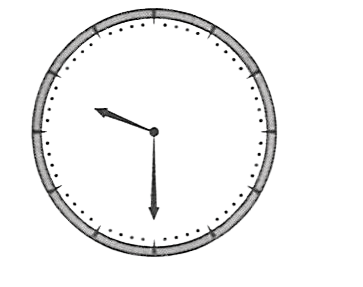
The figure shows the image of a clock as seen in the plane mirror. The correct time is :
4:30
6:30
2:30
3:30
2:30
Reason — As the mirror image of the clock shows that hour hand is pointing slightly past 9 and minute hand at 6 (i.e., 30 minutes) so the mirror image shows 9:30. Since a plane mirror always produces laterally inverted images so in this case the hour hand should actually point slightly past 2 and minute hand will suffer no inversion due to symmetry so the clock will show 2:30.
Question 1(xix)
We use a concave polished metallic surface as a reflector in a torch to obtain a parallel beam of light. The position of the bulb is :
at the centre of curvature of the reflector.
at the focus of the reflector
between the focus and centre of curvature of the reflector
can be any of the above options
at the focus of the reflector
Reason — In a torch, we want the light rays to come out as a parallel beam as this helps the light travel a long distance in a specific direction and a concave mirror reflects light rays parallel to the principal axis if the source is placed at its focus.
So, if we want a parallel beam of light (which is the case in a torch), the bulb should be placed at the focus of the concave mirror.
Exercise 7(C) — Very Short Answer Type
15 QuestionsQuestion 1
What is a spherical mirror?
A reflecting surface which is a part of a sphere is called a spherical mirror.
Question 2
Define centre of curvature of a spherical mirror.
The centre of curvature of a mirror is the centre of the sphere of which the mirror is a part.
Question 3
Define radius of curvature of a spherical mirror.
The radius of the sphere of which the spherical mirror is a part, is called the radius of curvature of the mirror.
Question 4
What is the aperture of a spherical mirror ?
The plane surface area of the mirror through which light rays enter and fall on the mirror is called its aperture.
Question 5
Define the pole of a spherical mirror.
The geometric centre of the spherical surface of mirror is called the pole of the mirror.
Question 6
Name the spherical mirror which always produces an erect and virtual image. How is the size of image related to the size of object?
A convex mirror always produces an erect and virtual image. The size of the image is shorter than the size of the object.
Question 7
(a) For what position of object, the image formed by a concave mirror is magnified and erect?
(b) State whether the image in part (a) is real or virtual?
(a) When the object is between the pole and focus of a concave mirror then the image formed is magnified and erect.
(b) The image is virtual.
Question 8
(a) State the position of object for which the image formed by a concave mirror is of same size.
(b) Write two more characteristics of the image.
(a) When the object is at the centre of curvature of a concave mirror, the image is of the same size as the object.
(b) The images thus formed is real and inverted.
Question 9
(a) What is a real image?
(b) What type of mirror can be used to obtain a real image of an object?
(c) Does the mirror mentioned in part (b) form real image for all locations of the object?
(a) A real image is one that can be obtained on a screen.
(b) A concave mirror can be used to obtain a real image of an object.
(c) No, concave mirror does not form real image for all the locations of the object.
Question 10
Name the kind of mirror used to obtain —
(a) a real and enlarged image,
(b) a virtual and enlarged image,
(c) a virtual and diminished image,
(d) a real and diminished image.
(a) Concave mirror is used to obtain a real and enlarged image.
(b) Concave mirror is used to obtain a virtual and enlarged image.
(c) Convex mirror is used to obtain a virtual and diminished image.
(d) Concave mirror is used to obtain a real and diminished image.
Question 11
How is the focal length of a spherical mirror related to its radius of curvature?
The focal length 'f' is related to the radius of curvature 'R' in the following way —
f = R / 2
Question 12
Write the spherical mirror's formula and explain the meaning of each symbol used in it.
The formula for the spherical mirror is —
1/u + 1/v = 1/f
u = distance of object,
v = distance of image and
f = focal length.
Question 13
State the kind of mirror used
(a) by a dentist,
(b) as a search-light reflector.
(a) Concave mirror is used by a dentist.
(b) Concave mirror is used as a search-light reflector.
Question 14
Which mirror will you prefer to use as a rear view mirror in a car : plane mirror or convex mirror? Give one reason.
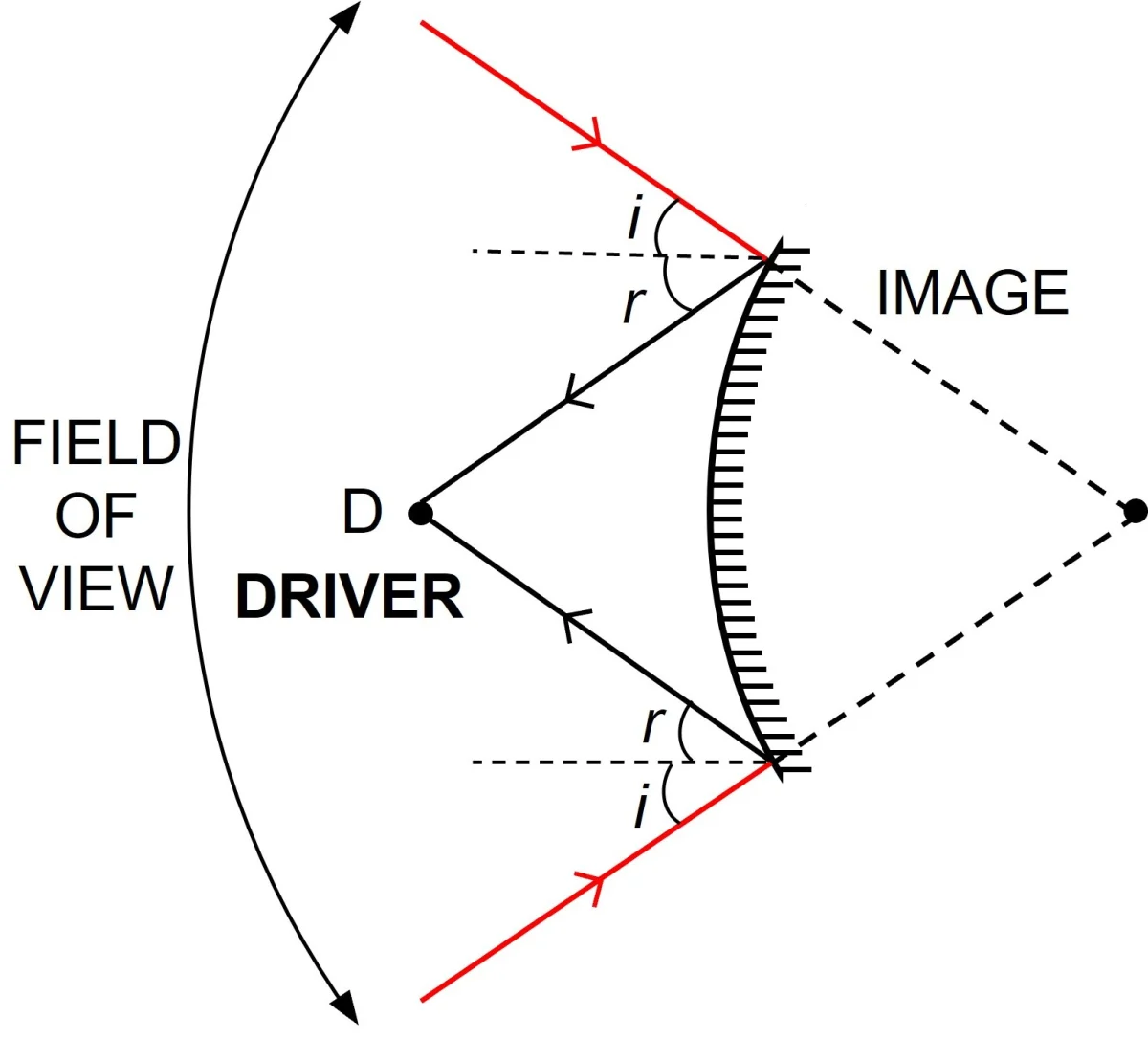
A convex mirror would be preferred in comparison to a plane mirror for use as a rear view mirror in a car because it provides a much wider field view as compared to a plane mirror of the same size. The below ray diagram shows this:
Question 15
How is magnification (m) related to the distance of the object (u) and the distance of the image (v) ?
Magnification (m) is related to the distance of the object (u) and the distance of the image (v) as follows —
Magnification (m) = Length of image (I) / Length of object (O)

OR

m = I / O = -v / u
where
'I' is the length of the image,
'O' is the length of the object,
'v' is the distance of the image and
'u' is the distance of the object.
Exercise 7(C) — Short Answer Type
11 QuestionsQuestion 1
Name the two kinds of spherical mirrors and distinguish between them.
Depending on whether the inner or outer surface of the sphere is silvered, spherical mirrors are of two types —
Concave mirror
Convex mirror
Difference between the two mirrors are —
| Concave mirror | Convex mirror |
|---|---|
| It is made by silvering the outer surface of a part of the hollow sphere, so reflection takes place from the inner surface. | It is made by silvering the inner surface of a part of the hollow sphere, so reflection takes place from the bulging surface. |
| The light rays incident on it converge after reflection. | The light rays incident on it diverge after reflection. |
| The image formed by it is real as well as virtual. For all positions of the object at or beyond the focus, the image is real, while for positions of the object between the focus and the pole, the image is virtual. | The image formed by it is always virtual for all positions of the object infront of it. |
| For object away from the centre of curvature, the image is diminished, for object at the centre of curvature, image is of same size and for object within the centre of curvature, image is diminished. | The image is always diminished for all positions of the object infront of it. |
Question 2
Define the terms pole, principal axis and center of curvature with reference to a spherical mirror.
Pole — The geometric centre of the spherical surface of mirror is called the pole of the mirror.
Principal axis — It is the straight line joining the pole of the mirror to it's centre of curvature.
Centre of curvature — The centre of curvature of a mirror is the centre of sphere of which the mirror is a part.
Question 3
Name the spherical mirror which (i) diverges (ii) converges the beam of light incident on it. Justify your answer by drawing a ray diagram in each case.
(i) A convex mirror diverges a beam of light incident on it.
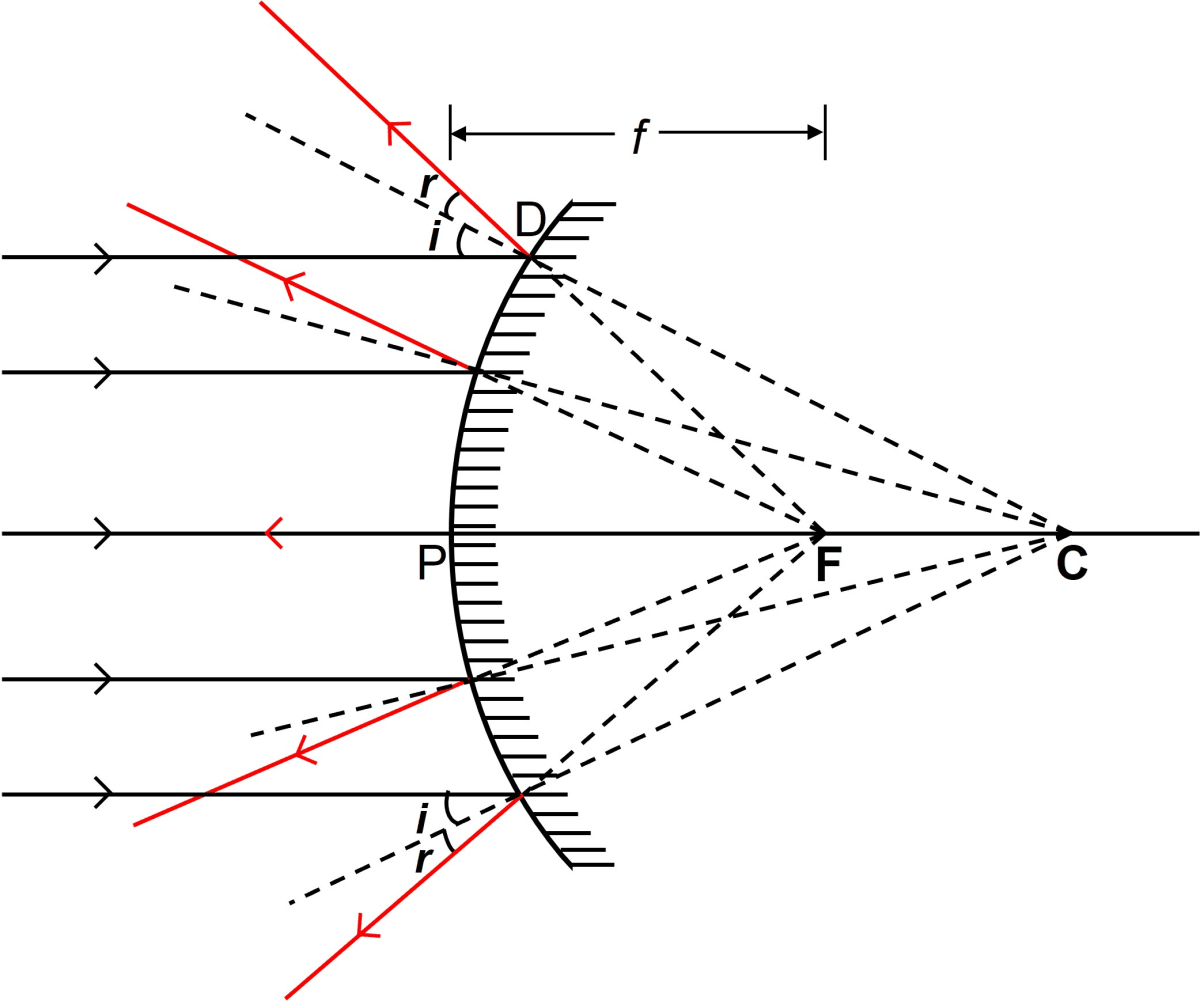
(ii) A concave mirror converges a beam of light incident on it.
Question 4
Define the terms focus and focal length of a concave mirror. Draw a diagram to illustrate your answer.
Focus of a concave mirror — The focus of a concave mirror is a point on the principal axis through which the light rays incident parallel to the principal axis, pass after reflection from the mirror.
Focal length of a concave mirror — The distance of focus F from the pole P of the mirror is called the focal length of the mirror.
i.e., focal length (f) = PF
Question 5
State the direction of incident ray which after reflection from a spherical mirror retraces its path. Give a reason to your answer.
When the incident ray is directed towards the centre of curvature, after reflection from a spherical mirror, it retraces its path.
It is because the ray is normal to the spherical mirror, so ∠i (angle of incidence) = 0, therefore, ∠r (angle of reflection) = 0.
Question 6
What is meant by magnification? Write its expression. What is its sign for the (a) real (b) virtual, image?
The ratio of length of the image to the length of object, is called linear magnification.
So,
Magnification (m) = Length of image (I) / Length of object (O)

OR

m = I / O = -v / u
where
'I' is the length of the image,
'O' is the length of the object,
'v' is the distance of the image,
'u' is the distance of the object.
(a) For a real image, linear magnification m is negative.
(b) For a virtual image, linear magnification m is positive.
Question 7
Upto what maximum distance from the pole, the image in a convex mirror can be obtained ? What will be the location of object then ?
The maximum distance from the pole, in a convex mirror where the image can be obtained is till the focal length of the mirror. The object would then has to be at infinity.
Question 8
Upto what maximum distance from a concave mirror, the image can be obtained? What will be the location of object for it?
The maximum distance from the concave mirror, where the image can be obtained is infinity. The object would then be at focus.
Question 9
How will you distinguish between a plane mirror, a concave mirror and a convex mirror, without touching them?
In order to distinguish between a plane mirror, a concave mirror and a convex mirror, the given mirror is held near the face and the image obtained is seen.
There can be the following three cases —
Case 1 — If image is upright, of same size and it does not change in size by moving the mirror towards or away from the face, then the mirror is plane.
Case 2 — If image is upright, magnified and increases in size on small movement of the mirror away from the face then the mirror is concave.
Case 3 — If image is upright, dimished and decreases in size on small movement of the mirror away from the face then the mirror is convex.
Question 10
State two uses of a concave mirror.
Uses of a concave mirror are as follows —
As a shaving mirror — When a concave mirror is held near the face (such that the face is between pole and focus of the mirror), it gives an upright and magnified image. Hence even tiny hair can be seen.
As a reflector — In torch, searchlight and head light of automobiles, cycles etc., a concave polished metallic surface is used to obtain a parallel beam of light.
Question 11
(a) When a concave mirror is used as a shaving mirror, where is the person's face in relation to the focus of mirror?
(b) State three characteristics of the image seen in part (a)
(a) When a concave mirror is used as a shaving mirror, the person's face should be between the pole and the focus.
(b) The image formed is erect, virtual and magnified.
Exercise 7(C) — Long Answer Type
15 QuestionsQuestion 1
Draw suitable diagrams to illustrate the action of (i) concave mirror, and (ii) convex mirror, on a beam of light incident parallel to the principal axis.
(i) Below ray diagram illustrates the action of concave mirror on a beam of light incident parallel to the principal axis:
(ii) Below ray diagram illustrates the action of convex mirror on a beam of light incident parallel to the principal axis:
Question 2
Explain the meaning of the terms focus and focal length in case of a convex mirror, with the help of a suitable ray diagram.
Focus of a convex mirror — The focus of a convex mirror is a point on the principal axis from which, the light rays that are incident parallel to the principal axis, appear to come, after reflection from the mirror.
Focal length of a concave mirror — The distance of focus F from the pole P of the mirror is called the focal length of the mirror.
i.e., focal length (f) = PF.
Question 3
(i) Name the mirrors shown in below figures (a) and (b).
(ii) In each case (a) and (b), draw the reflected rays for the given incident rays and mark focus by the symbol F.
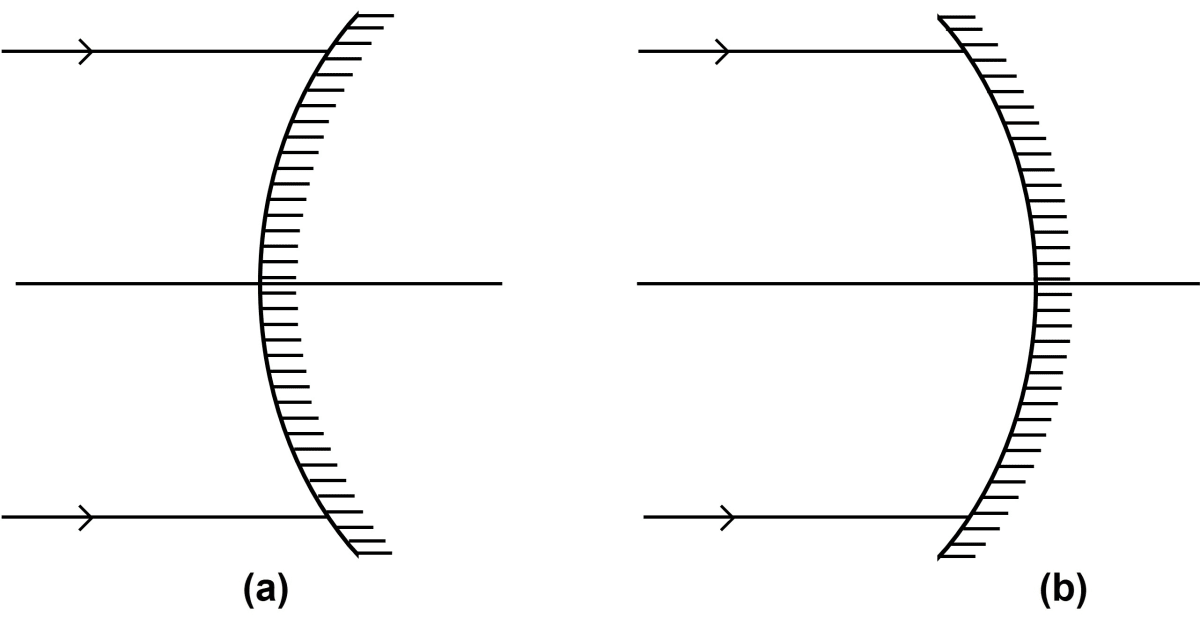
(i) The figure (a) shows convex mirror and figure (b) shows concave mirror.
(ii) Diagrams showing reflected rays are shown below:
(a)
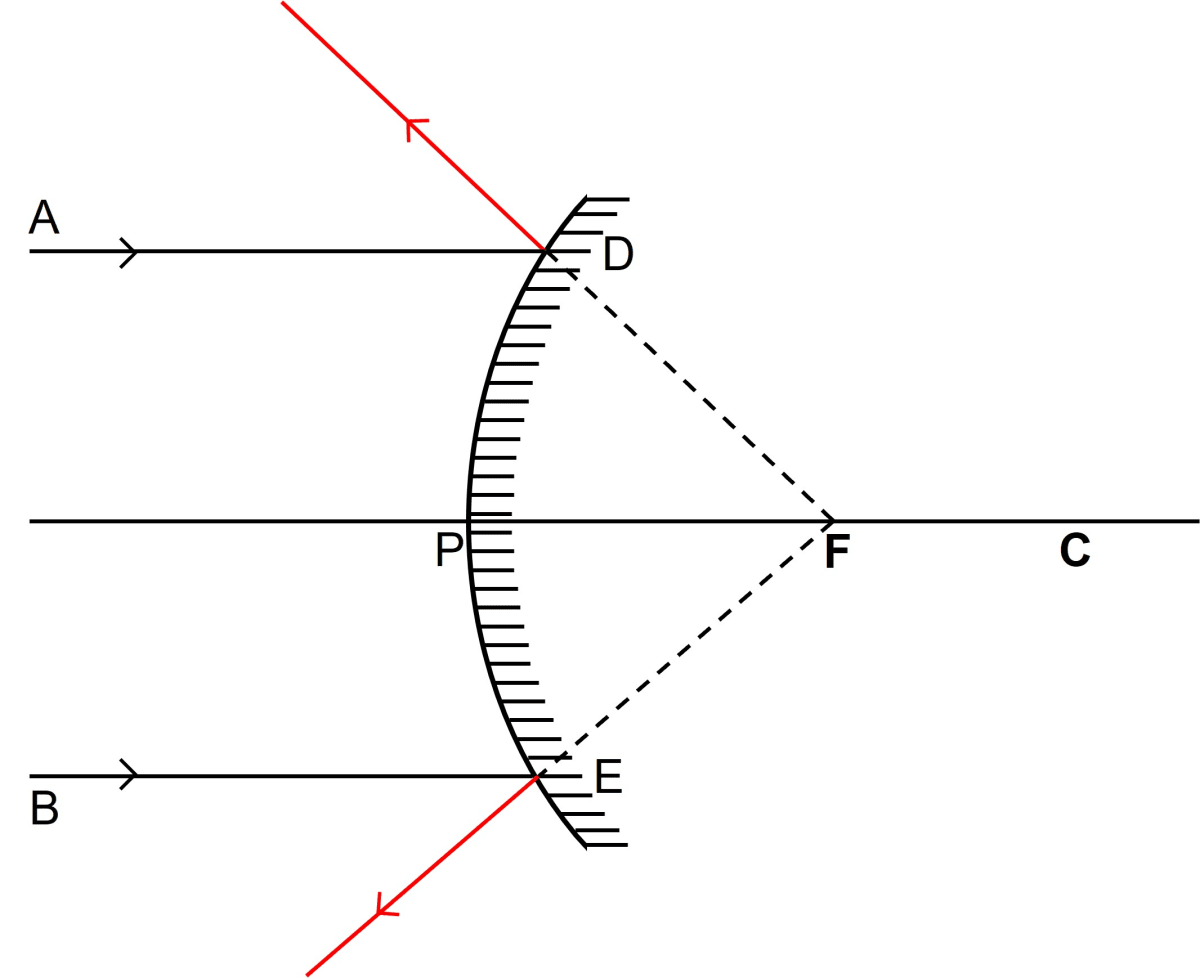
(b)
Question 4
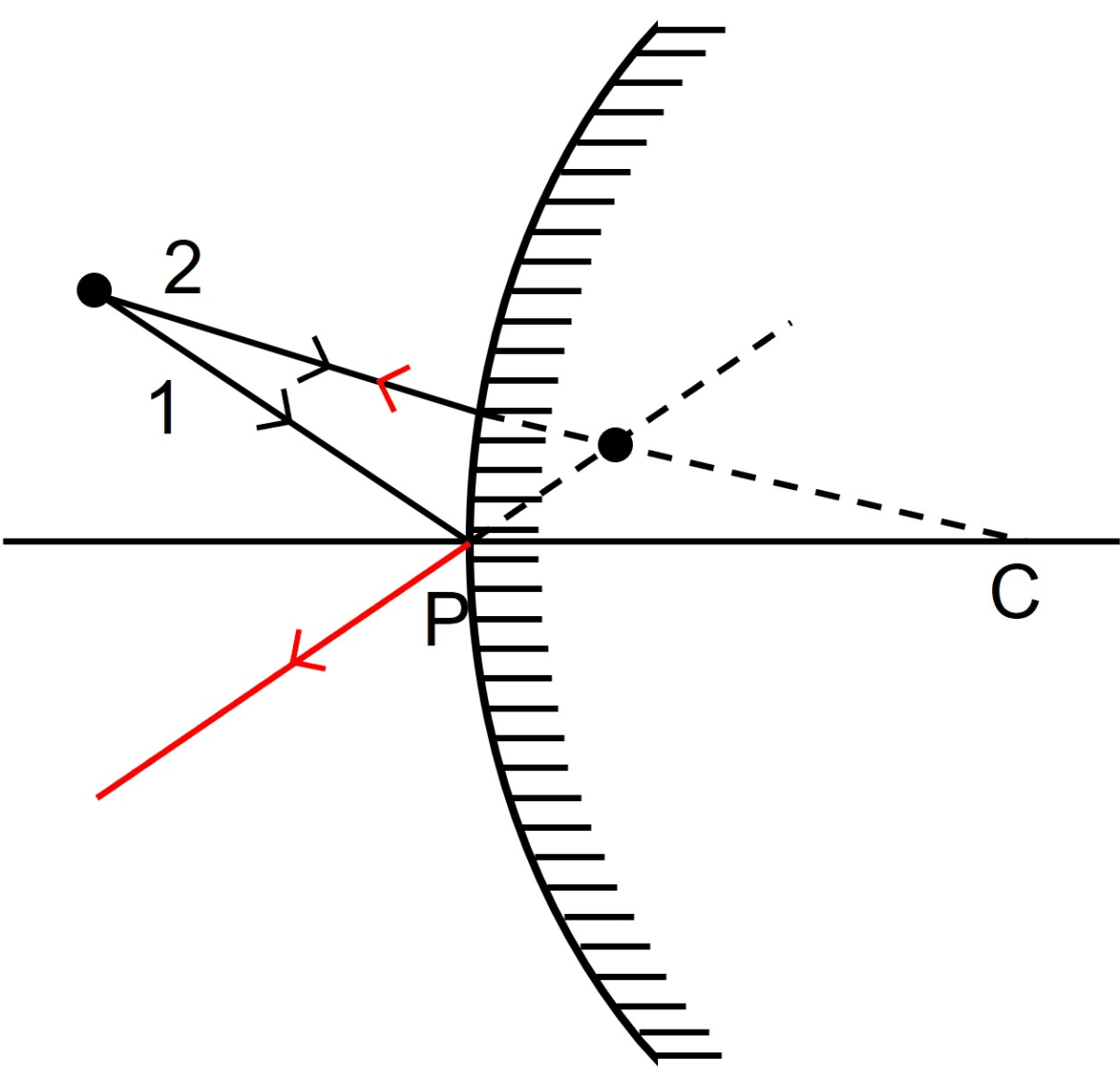
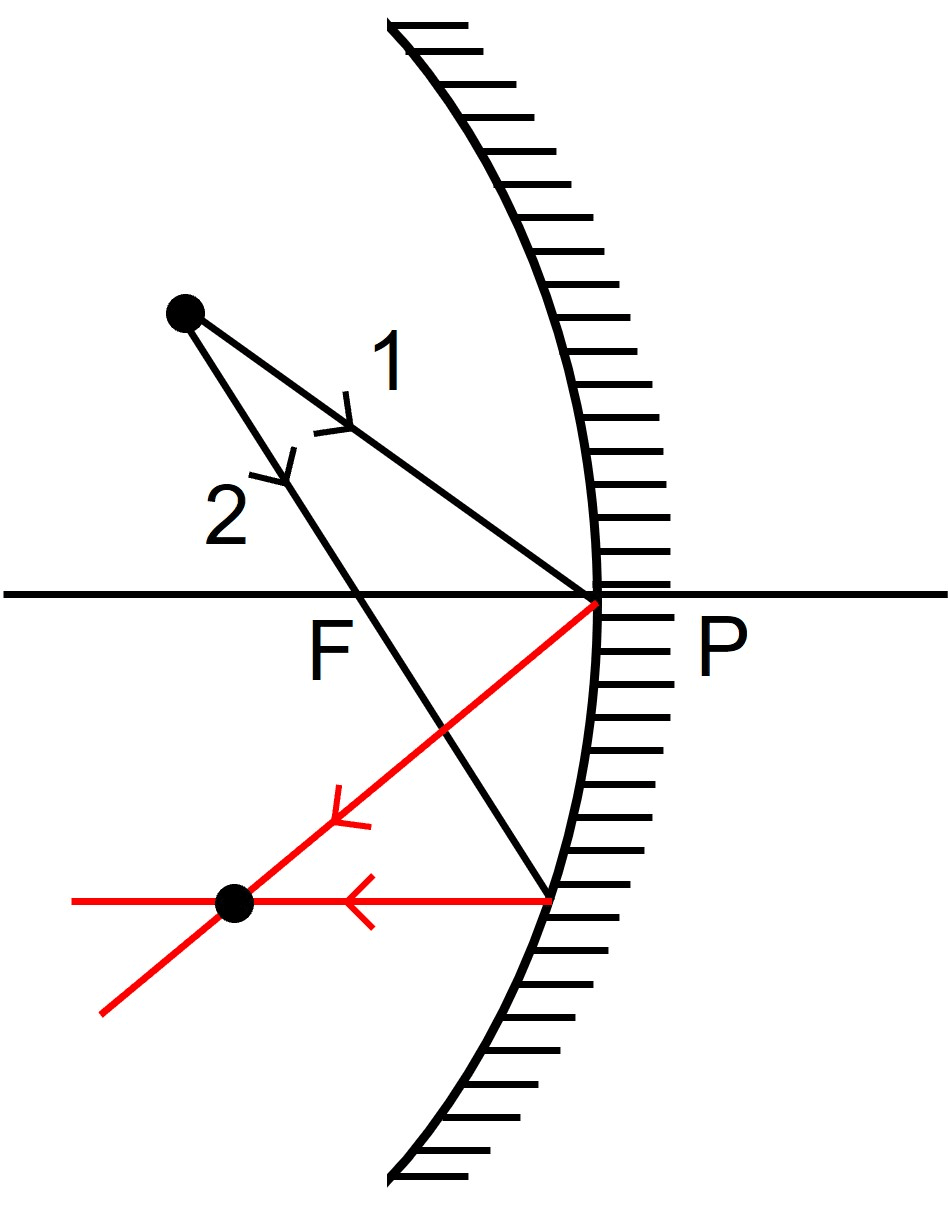
Complete the following diagrams in below figure by drawing the reflected rays for the incident rays 1 and 2.
Below are the completed diagrams showing the reflected rays for the incident rays 1 and 2:
(a)
(b)
Question 5
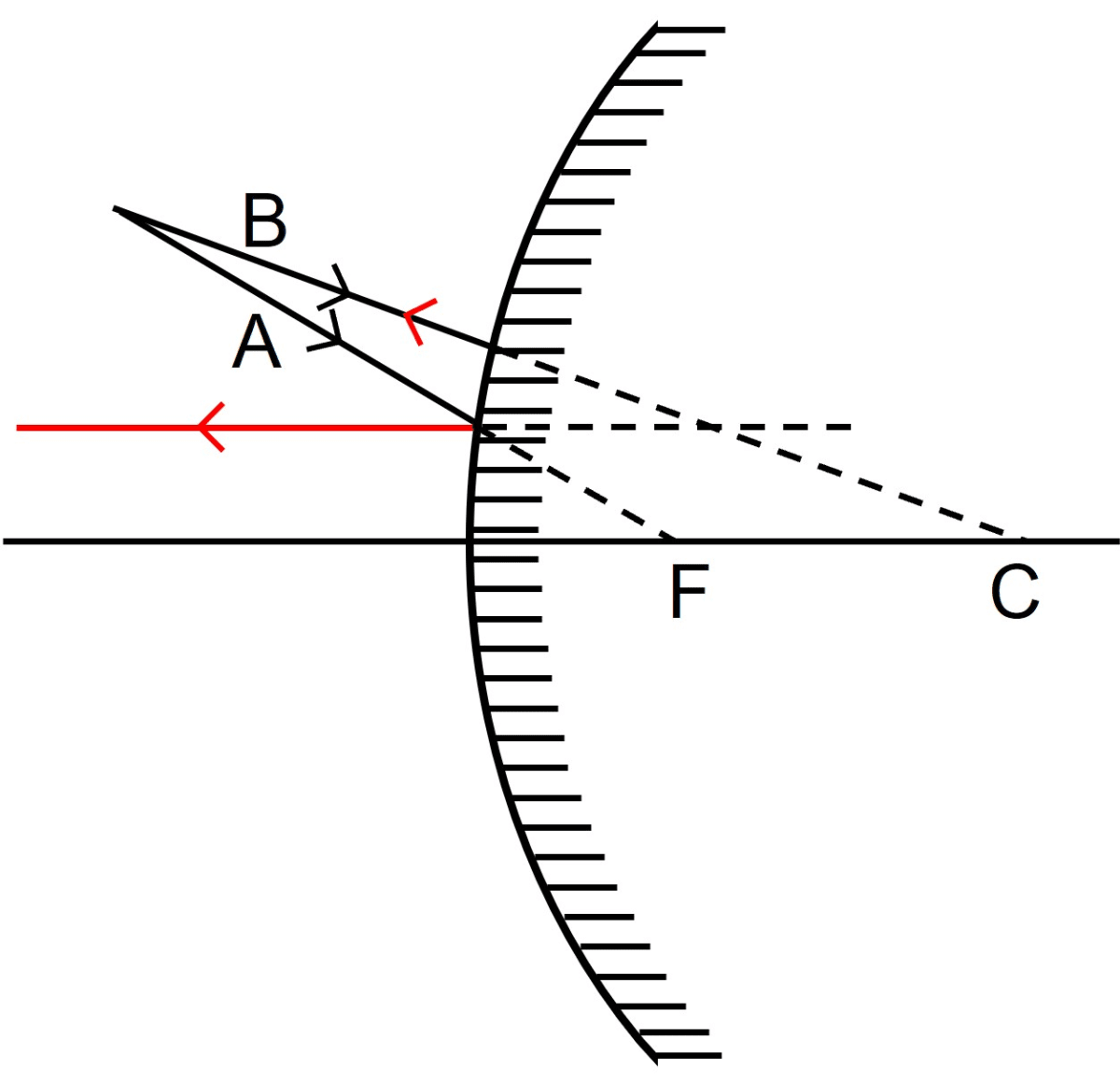
Complete the following diagrams shown in below figure by drawing the reflected ray for each of the incident ray A and B.
Below are the completed diagrams showing the reflected rays for the incident rays A and B:
(a)
(b)
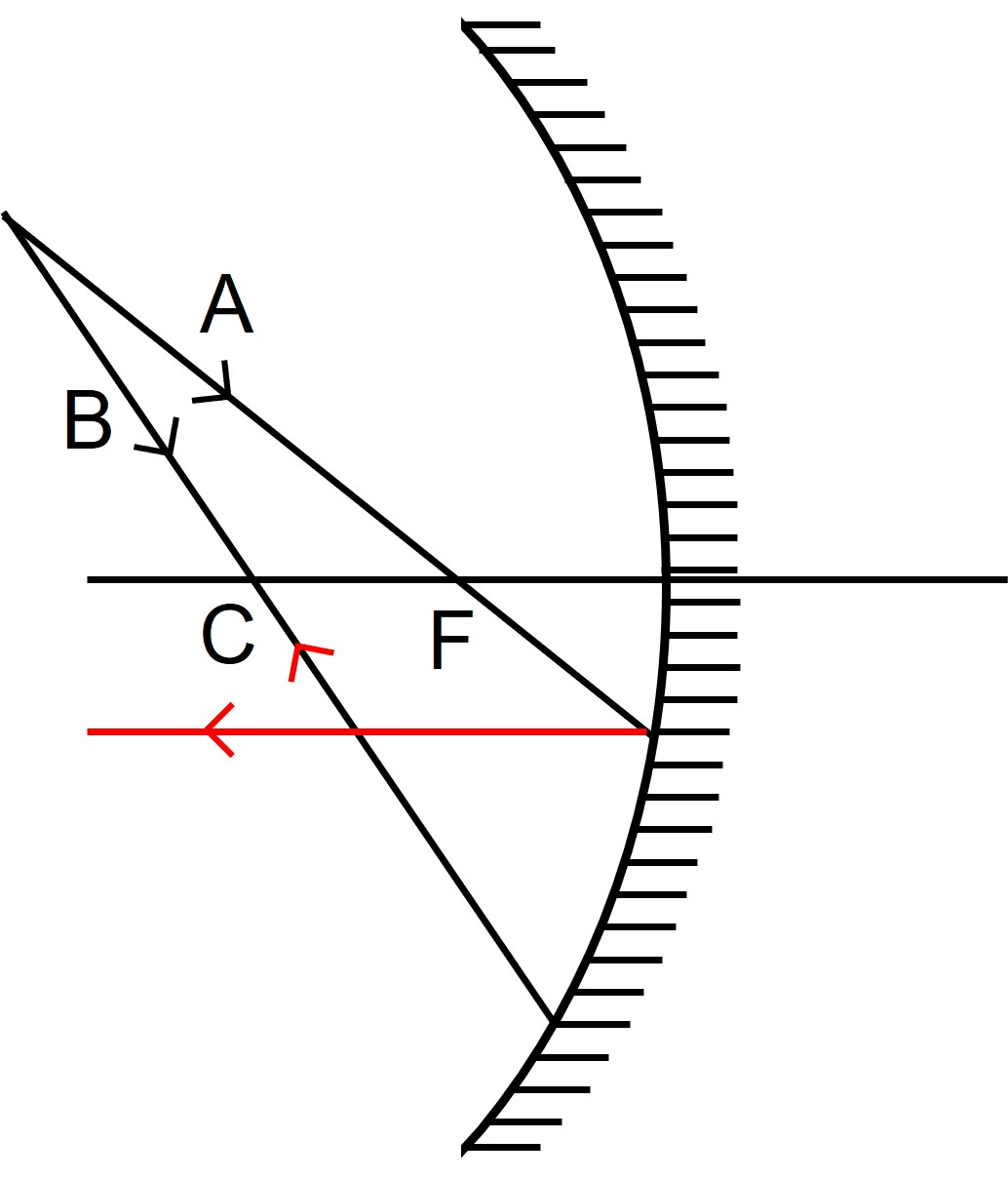
Question 6
State the two convenient rays that are chosen to construct the image by a spherical mirror for a given object? Explain your answer with the help of suitable ray diagrams.
The two convenient rays, chosen to construct the image by a spherical mirror are —
(i) A ray that passes through the center of curvature.
A line joining the centre of curvature to any point on the surface of mirror is normal to the mirror at that point, therefore a ray AD passing through the center of curvature C (or appearing to pass through through the centre of curvature C) is incident normally on the spherical mirror.
Since it's angle of incidence is zero, therefore the angle of reflection will also be zero and the ray AD gets reflected along it's own path DA as shown below:
(ii) A ray parallel to the principal axis.
A ray of light AD incident parallel to the principal axis, after reflection passes either through the focus F(in a concave mirror) or will appear to come from the focus F (in a convex mirror) along DB as shown below:
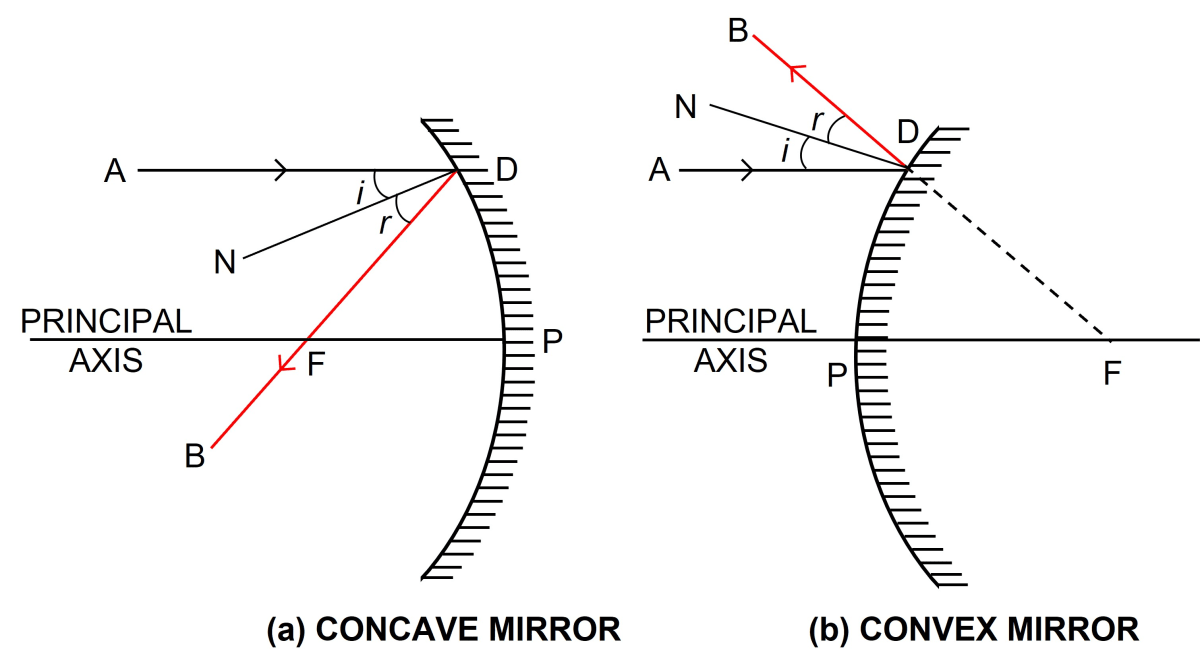
Question 7
Below figure shows a concave mirror with its pole at P, focus F and center of curvature C. Draw ray diagram to show the formation of image of an object OA.
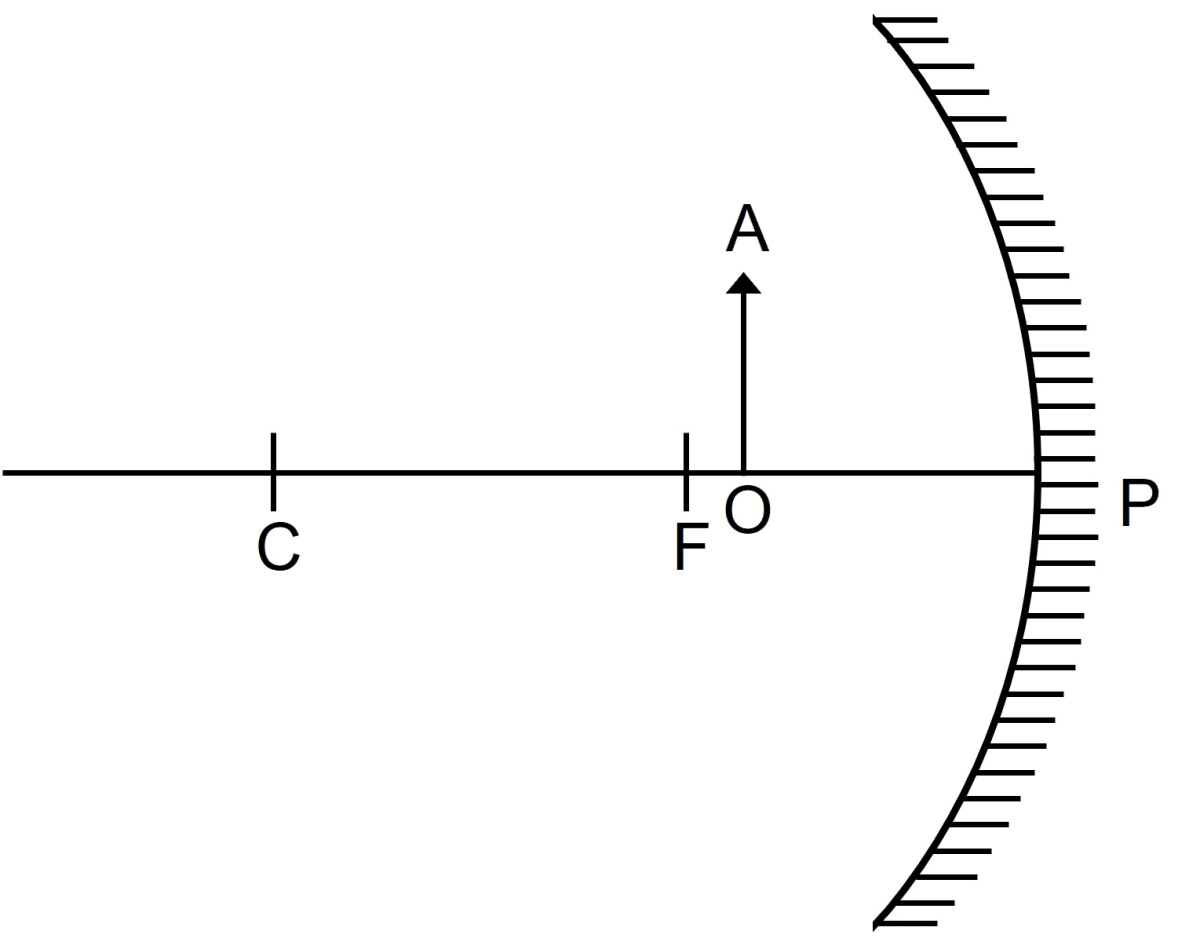
Ray diagram showing the formation of the image is given below:
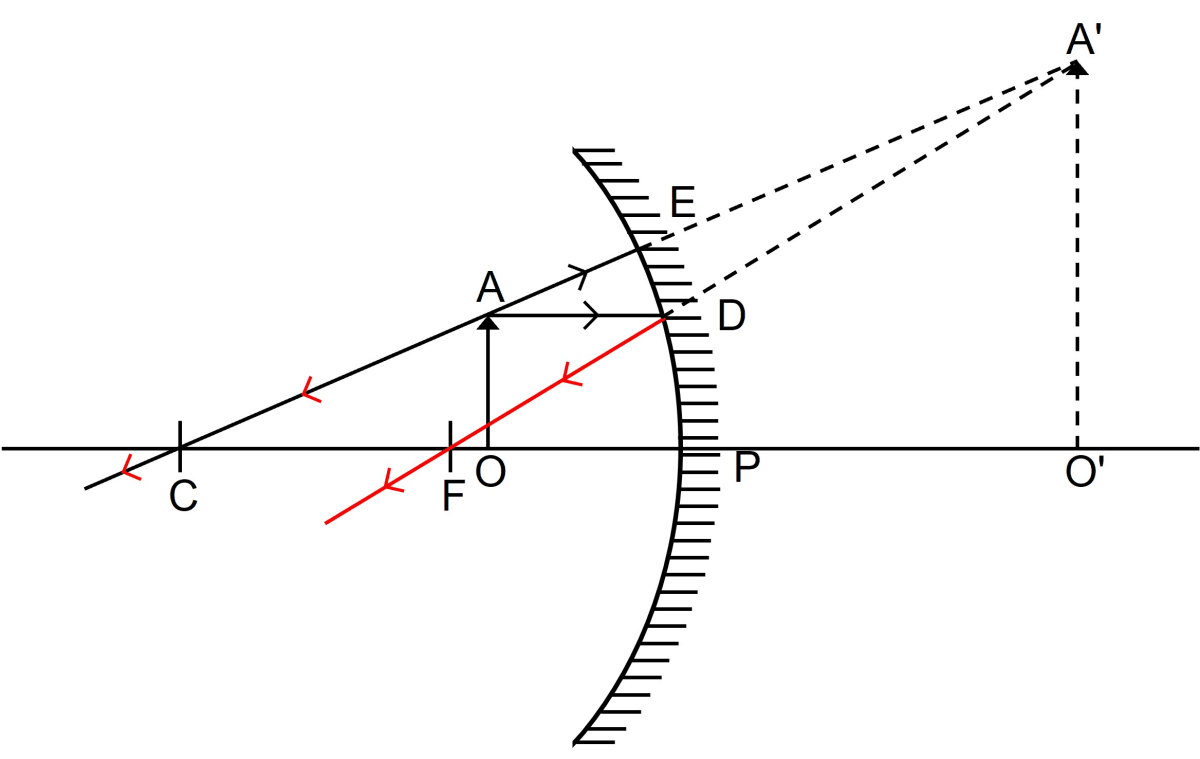
Question 8
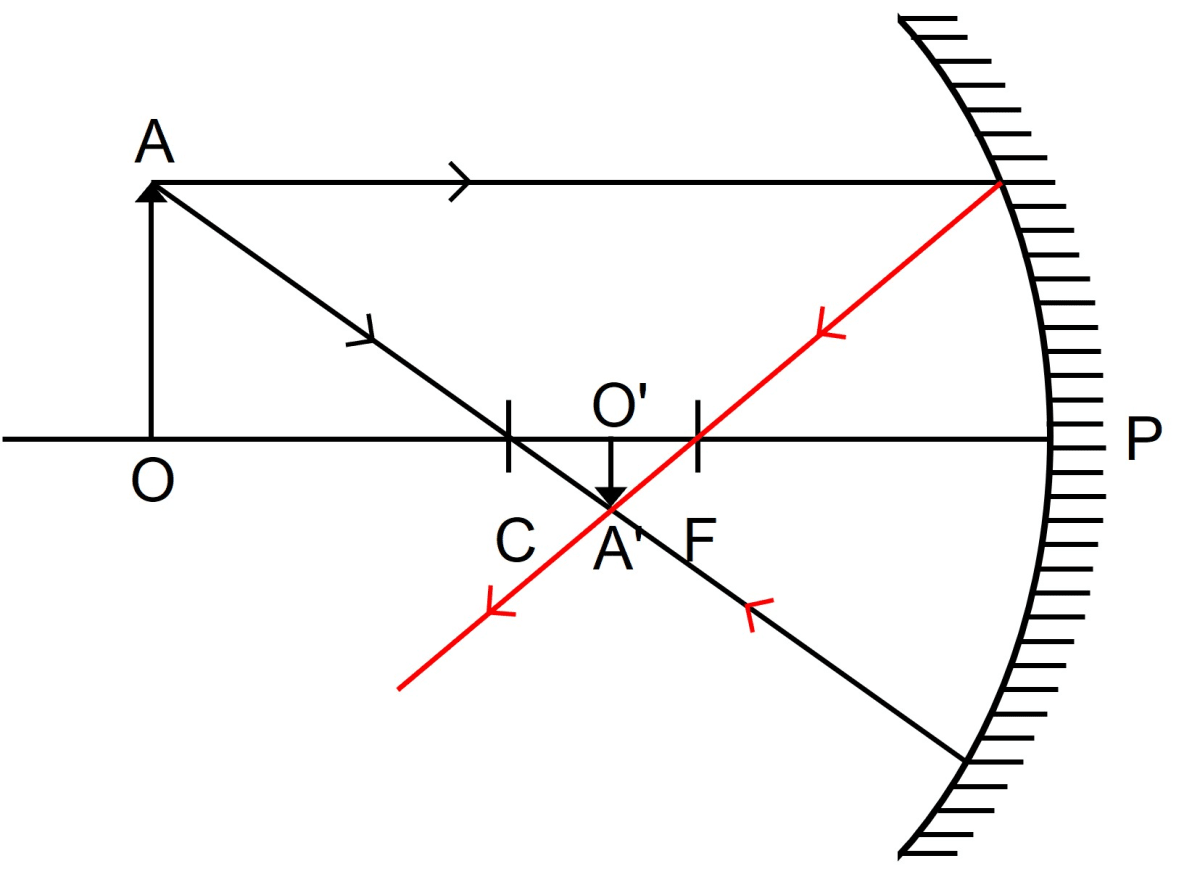
Below figure shows a concave mirror with its pole at P, focus F and center of curvature C. Draw ray diagram to show the formation of image of an object OA.
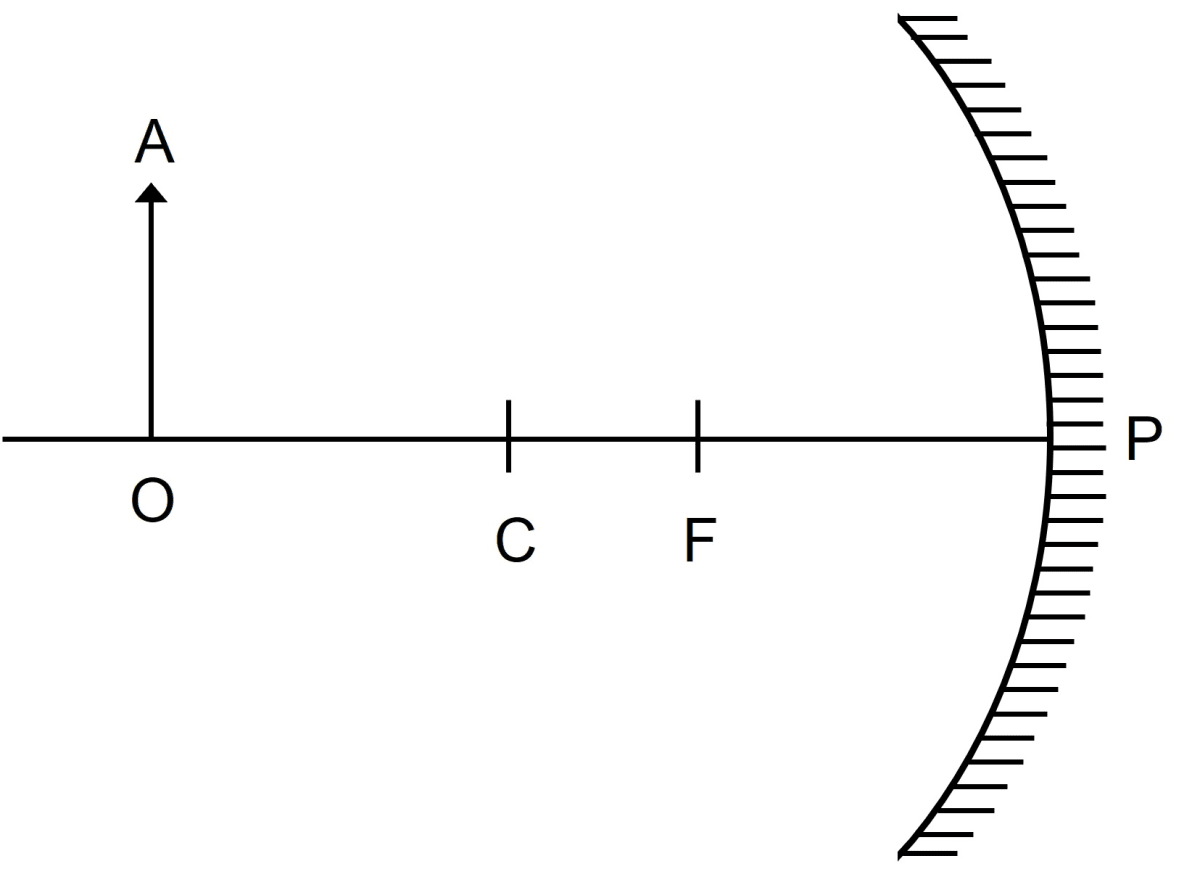
Ray diagram showing the formation of the image is given below:
Question 9
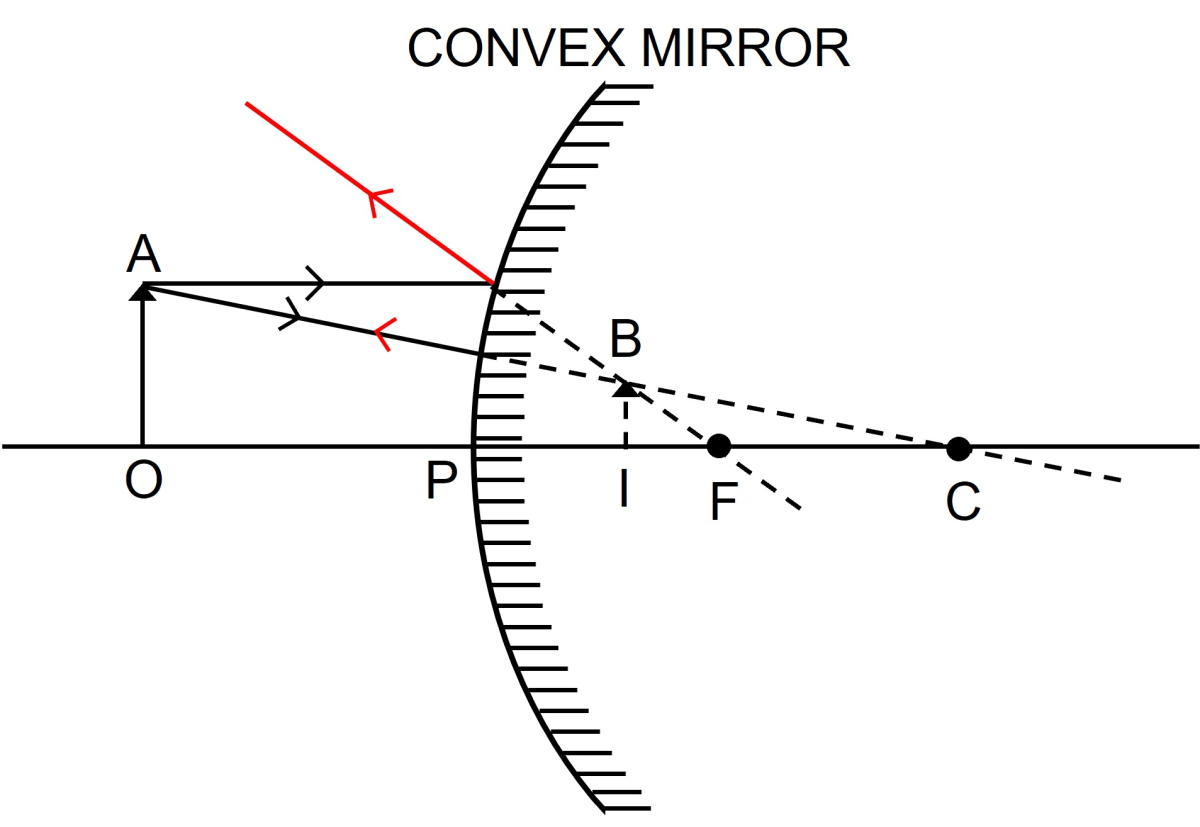
The diagram below in figure shows a convex mirror. C is its center of curvature and F is its focus. (i) Draw two rays from A and hence locate the position of image of object OA. Label the image IB. (ii) State three characteristics of the image.
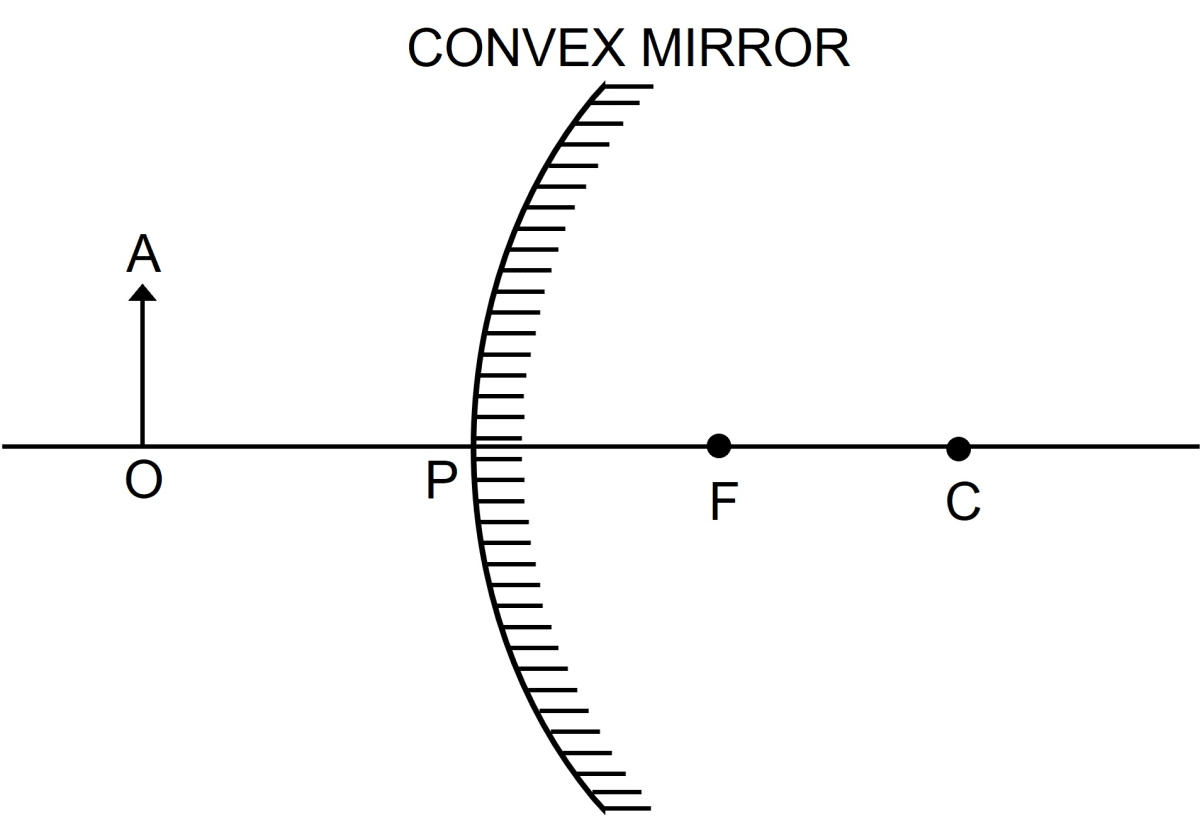
(i) Below completed ray diagram shows the position of the image of object OA:
(ii) The three characteristics of the image are virtual, upright and diminished.
Question 10
Draw a ray diagram to show the formation of image by a concave mirror for an object placed between its pole and focus. State three characteristics of the image.
Below is the ray diagram showing the formation of image by a concave mirror for an object placed between it's pole and focus:
When the object is between the focus F and the pole P, the image is formed behind the mirror. It is virtual, upright and magnified.
Question 11
Draw a ray diagram to show the formation of image by a concave mirror for an object beyond its center of curvature. State three characteristics of the image.
The image by a concave mirror for an object beyond it's center of curvature is shown below:
When object is beyond the centre of curvature C, the image is between the focus F and the centre of curvature C. It is real, inverted and diminished.
Question 12
Draw a ray diagram to show the formation of image of an object kept in front of a convex mirror. State three characteristics of the image.
The diagram below shows the formation of image when the object is kept in front of a convex mirror.
When the object is in in front of the convex mirror, the image is between the pole P and focus F on the other side of the mirror.
The image formed is virtual, upright and diminished.
Question 13
Discuss the position and nature of image formed by a concave mirror when an object is moved from infinity towards the pole of mirror.
The image formed moves away from the concave mirror when an object is moved from infinity towards the pole of mirror.
The image is diminished when the object is beyond centre of curvature, but it becomes magnified as the object comes within the centre of curvature. The image is of the same size of the object when the object is at the centre of curvature.
For the object situated beyond focus, the image is always real and inverted, whereas for the object situated between the focus and pole the image is upright and virtual.
The table below shows the position, size and nature of the image formed by a concave mirror for different positions of the object.
| No. | Position of the object | Position of the image | Size of the image | Nature of the image |
|---|---|---|---|---|
| 1 | At infinity | At the focus | Diminished to a point | Real and inverted |
| 2 | At very far distance | In focal plane | Highly diminished | Real and inverted |
| 3 | Beyond the centre of curvature | Between the centre of curvature and focus | Diminished | Real and inverted |
| 4 | At the centre of curvature | At the centre of curvature | Same size | Real and inverted |
| 5 | Between the centre of curvature and focus | Beyond the centre of curvature | Magnified | Real and inverted |
| 6 | At focus | At infinity | Highly magnified | Real and inverted |
| 7 | Between the focus and the pole | Behind the mirror | Magnified | Virtual and upright |
Question 14
Discuss the position and nature of image formed by a convex mirror when an object is moved from infinity towards the pole of mirror.
In a convex mirror, the image formed is always virtual, upright and diminished. It is always situated between it's pole and focus irrespective of the distance of object in front of the mirror.
As the object comes closer to the mirror from infinity towards the pole, it's image shifts from focus towards the pole and increase in size.
The table below shows the position, size and nature of the image formed by a convex mirror
| No. | Position of the object | Position of the image | Size of the image | Nature of the image |
|---|---|---|---|---|
| 1. | At infinity | At focus | Diminished to a point | Virtual and upright |
| 2. | At any other point | Between focus and the pole | Diminished | Virtual and upright |
Question 15
Why does a driver use a convex mirror instead of a plane mirror as a rear view mirror? Illustrate your answer with the help of a ray diagram.
A convex mirror diverges the incident light beam and always forms a virtual, small and erect image behind the mirror between it's pole and focus. This fact enables the driver to use it as a rear view mirror in vehicles to see all the traffic approaching from behind.
Although a plane mirror can also be used as a rear view mirror, but a convex mirror provides a much wider field view as compared to a plane mirror of the same size.
The below diagram shows how a convex mirror provides a better field view than a plane mirror.
Exercise 7(C) — Numericals
14 QuestionsQuestion 1
The radius of curvature of a convex mirror is 40 cm. find its focal length.
Focal length = 1/2 × Radius of curvature
Given,
R = 40 cm
Substituting the values in the formula above we get,
Focal length = 1/2 × 40
             = 20 cm
Hence, focal length of the convex mirror is 20 cm.
Question 2
The focal length of a concave mirror is 10 cm. Find its radius of curvature.
Focal length = 1/2 × Radius of curvature
Given,
f = -10 cm
Substituting the values in the formula above we get,
-10 = 1/2 × Radius of curvature
Radius of curvature = -20 cm
Hence, radius of curvature of concave mirror is 20 cm (negative).
Question 3
An object of height 2 cm is placed at a distance 20 cm in front of a concave mirror of focal length 12 cm. Find the position, size and nature of the image.
Given,
Object height (O) = 2 cm
Focal length (f) = -12 cm
Object distance (u) = -20 cm
Using the mirror formula :
1/u + 1/v = 1/f
Substituting the values in the formula above we get,
1/(-20) + 1/v = 1/(-12)
-1/20 + 1/v = -1/12
1/v = -1/12 + 1/20
1/v = (-5 + 3)/60
1/v = -2/60
1/v = -1/30
v = -30 cm
Hence, the image is formed at a distance of 30 cm in front of the mirror.
Now,
Magnification of a mirror is given by,
m = I/O = -v/u
I/2 = -(-30)/(-20)
I/2 = -30/20
I = -(30 × 2)/20
I = -3 cm
Hence, the length of the image is 3 cm the image is real, inverted and magnified.
Question 4
An object is placed at 4 cm distance in front of a concave mirror of radius of curvature 24 cm. Find the position of image. Is the image magnified?
Given,
Radius of curvature (R) = -24 cm
Object distance (u) = - 4 cm
Focal length = 1/2 × Radius of curvature
Substituting the values in the formula above, we get,
Focal length = 1/2 × (-24)
             = -12 cm
Hence, focal length of the concave mirror is -12 cm.
Using the mirror formula
1/u + 1/v = 1/f
Now, substituting the values in the mirror formula , we get,
1/(-4) + 1/v = 1/(-12)
-1/4 + 1/v = -1/12
1/v = -1/12 + 1/4
1/v = (-1 + 3)/12
1/v = 2/12
1/v = 1/6
v = 6 cm
Thus, the image is formed 6 cm behind the mirror.
Computing linear magnification:
m = -v/u
m = -6/(-4)
m = 6/4
m = 1.5
As, the length of image is 1.5 times the image of object, hence, the image is magnified.
Question 5
At what distance from a concave mirror of focal length 25 cm should an object be placed so that the size of image is equal to the size of the object.
To get an image of same size the object should be placed at the center of the curvature of a concave mirror.
Given,
Focal length = -25 cm
As,
Centre of curvature = 2 × Focal length
Therefore,
Centre of curvature = 2 × (-25)
                    = -50 cm
Hence, the object should be kept at 50 cm in front of the mirror so that the size of image is equal to the size of object.
Question 6
An object 5 cm high is placed at a distance 60 cm in front of a concave mirror of focal length 10 cm. Find (i) the position and (ii) size, of the image.
Given,
Object height (O) = 5 cm
focal length (f) = -10 cm
Object distance (u) = -60 cm
(i)
Using the mirror formula,
1/u + 1/v = 1/f
Substituting the values in the formula above, we get,
1/(-60) + 1/v = 1/(-10)
-1/60 + 1/v = -1/10
1/v = -1/10 + 1/60
1/v = (-6 + 1)/60
1/v = -5/60
1/v = -1/12
v = -12 cm
Thus, the image distance (v) is 12 cm infront of the mirror.
(ii) Magnification of a mirror is given by,
m = I/O = -v/u
I/5 = -(-12)/(-60)
I/5 = -12/60
I = -(12 × 5)/60
I = -1 cm
Hence, the length of the image is 1 cm and negative sign shows that the image will be inverted.
Question 7
A point light source is kept in front of a convex mirror at a distance of 40 cm. The focal length of the mirror is 40 cm. Find the position of image.
Given,
u = -40 cm
f = 40 cm
Mirror formula:
1/u + 1/v = 1/f
Substituting the values in the formula above, we get,
1/(-40) + 1/v = 1/40
-1/40 + 1/v = 1/40
1/v = 1/40 + 1/40
1/v = (1 + 1)/40
1/v = 2/40
1/v = 1/20
v = 20 cm
Hence, the image is formed 20 cm behind the mirror.
Question 8
When an object of height 1 cm is kept at a distance 4 cm from a concave mirror, its erect image of height 1.5 cm is formed at a distance 6 cm behind the mirror. Find the focal length of the mirror.
Given,
u = -4 cm
v = 6 cm
Using the mirror formula,
1/u + 1/v = 1/f
Substituting the values in the formula above, we get,
1/(-4) + 1/6 = 1/f
-1/4 + 1/6 = 1/f
1/f = (-3 + 2)/12
1/f = -1/12
f = -12 cm
Hence, the focal length of concave mirror is 12 cm.
Question 9
An object of length 4 cm is placed in front of a concave mirror at a distance 30 cm. The focal length of mirror is 15 cm. (a) Where will the image form? (b) What will be the length of image?
(a) Given,
u = -30 cm
f = -15 cm
Using the mirror formula,
1/u + 1/v = 1/f
Substituting the values in the formula above, we get,
1/(-30) + 1/v = 1/(-15)
-1/30 + 1/v = -1/15
1/v = -1/15 + 1/30
1/v = (-2 + 1)/30
1/v = -1/30
v = -30 cm
Thus, the image is formed at 30 cm in front of the mirror
(b) Magnification of a mirror is given by,
m = I/O = -v/u
I/4 = -(-30)/(-30)
I/4 = -30/30
I/4 = -1
I = -4 cm
Hence, the length of the image is 4 cm and negative sign represents that the image is inverted.
Question 10
A concave mirror forms a real image of an object placed in front of it at a distance 30 cm, of size three times the size of object. Find (a) the focal length of mirror (b) position of image.
(a) Given,
Distance of the object (u) = -30 cm
Image height = 3 times the height of object
So, magnification (m) = -3 (negative for the real image)
m = -v/u
-3 = -v/(-30)
v = 3 × (-30)
v = -90 cm
Thus, the image is formed 90 cm in front of the mirror.
Using the mirror formula,
1/u + 1/v = 1/f
Substituting the values in the mirror formula we get,
1/(-30) + 1/(-90) = 1/f
-1/30 - 1/90 = 1/f
1/f = (-3 - 1)/90
1/f = -4/90
f = -22.5 cm
Hence, focal length of the mirror = -22.5 cm
(b) The image is formed 90 cm in front of the mirror
Question 11
A concave mirror forms a virtual image of size twice that of the object placed at a distance 5 cm from it. Find : (a) the focal length of the mirror (b) position of the image.
(a) Given,
Distance of the object (u) = -5 cm
Magnification (m) = 2 (positive for the virtual image)
m = -v/u
2 = -v/(-5)
2 = v/5
v = 2 × 5
v = 10 cm
Thus, the image is formed 10 cm behind the mirror.
Using the mirror formula:
1/u + 1/v = 1/f
Substituting the values in the mirror formula, we get,
1/(-5) + 1/10 = 1/f
-1/5 + 1/10 = 1/f
1/f = (-2 + 1)/10
1/f = -1/10
f = -10 cm
Hence, focal length of the mirror = -10 cm
(b) The position of the image is 10 cm behind the mirror
Question 12
The image formed by a convex mirror is of size one-third the size of object. How are u and v related?
Given,
Size of the image = -1/3 × Size of the object
Magnification of a mirror is given by,
m = Size of image (I) / Size of object (O)
m = Image distance (v) / Object distance (u)
m = -1/3
Hence,
v = -1/3 u
Or
u = -3v
Question 13
The erect image formed by a concave mirror is of size double the size of object. How are u and v related?
Given,
Size of the image = -2 × Size of the object
Magnification of a mirror is given by,
m = Size of image (I) / Size of object (O)
m = Image distance (v) / Object distance (u)
m = -2
Hence,
v = -2u
Or
u = -1/2 v
Question 14
The magnification for a mirror is -3. How are u and v related?
Given,
Magnification (m) = -3
Magnification of a mirror is given by,
m = -v/u
-3 = -v/u
v = 3u
Hence, v = 3u
Exercise 7(C) — Assertion Reason Type
6 QuestionsQuestion (i)
Assertion (A) : For a ray of light incident at an angle of incidence i = 0°, angle of reflection is r = 0°.
Reason (R) : The angle of incidence i is equal to angle of reflection r.
Both A and R are true and R is the correct explanation of A
Both A and R are true and R is not the correct explanation of A
Assertion is false but reason is true
Assertion is true but reason is false
Both A and R are true and R is the correct explanation of A
Explanation
Assertion (A) is true because if a ray of light hits the mirror perpendicularly (i.e., along the normal), the angle of incidence is 0°, and the ray reflects back along the same path. So, angle of reflection is also 0°.
Reason (R) is true because its a law of reflection which states that during reflection, angle of incidence is always equal to angle of reflection so the Reason correctly explains the Assertion.
Question (ii)
Assertion (A) : The image of an object placed close to a concave mirror is a real image.
Reason (R) : A real image is formed due to the actual intersection of the reflected rays.
Both A and R are true and R is the correct explanation of A
Both A and R are true and R is not the correct explanation of A
Assertion is false but reason is true
Assertion is true but reason is false
Assertion is false but reason is true
Explanation
Assertion (A) is false because when an object is placed close to a concave mirror, i.e., between the pole (P) and the focus (F), the image formed is virtual, erect, and magnified, not real and only when the object is placed beyond the focus, the image formed is real and inverted.
Reason (R) is true because this is the definition of a real image which is formed when reflected rays actually meet.
Question (iii)
Assertion (A) : For a real image formed by a spherical mirror, linear magnification (m) is positive.
Reason (R) : Both u and v are negative for a real image.
Both A and R are true and R is the correct explanation of A
Both A and R are true and R is not the correct explanation of A
Assertion is false but reason is true
Assertion is true but reason is false
Assertion is false but reason is true
Explanation
Only a concave mirror can form a real image; convex mirrors cannot.
For a real image formed by a concave mirror:
Both u and v are negative.
m = -v/u
Magnification is negative, showing the image is inverted.
So the assertion is false (m is negative), but the reason is true (both distances are negative).
Question (iv)
Assertion (A) : For an object placed symmetrically when the angle θ between the mirrors is 72°, the number of images formed is 4.
Reason (R) : If n = 360°/θ is odd, the number of images for an object placed symmetrically is equal to n.
Both A and R are true and R is the correct explanation of A
Both A and R are true and R is not the correct explanation of A
Assertion is false but reason is true
Assertion is true but reason is false
Assertion is true but reason is false
Explanation
Assertion (A) is true because as :
n = 360°/θ - 1
Where :
θ = angle between the mirrors
n = number of images formed (if object is placed symmetrically)
Substitute, θ = 72° :
n = 360°/72° - 1
n = 5 - 1
n = 4
Reason (R) is false because if angle θ° between the mirrors is such that 360°/θ° is odd, then
(i) the number of images is n, when the object is placed asymmetrically between the mirrors.
(ii) the number of images is n - 1, when the object is placed symmetrically (i.e., on the bisector of the angle) between the mirrors.
Question (v)
Assertion (A) : Concave mirror is used as doctor's head mirror.
Reason (R) : If a parallel beam of light is incident on a concave mirror, the mirror focuses the beam to a point.
Both A and R are true and R is the correct explanation of A
Both A and R are true and R is not the correct explanation of A
Assertion is false but reason is true
Assertion is true but reason is false
Both A and R are true and R is the correct explanation of A
Explanation
Assertion (A) is true: A concave mirror is used as a doctor's head mirror because it can direct and concentrate light into the patient’s body parts (such as teeth, nose, throat, ear, etc.) for better visibility.
Reason is true: When a parallel beam of light (like light from a lamp) falls on a concave mirror, the mirror reflects and converges the rays to its focal point, producing a bright, concentrated spot of light.
This property of focusing parallel rays to a point is precisely why concave mirrors are used in head mirrors, as it enables the doctor to project an intense beam exactly where it is needed. Therefore, the reason correctly explains the assertion.
Question (vi)
Assertion (A) : A student is given a spherical mirror of focal length -10 cm. He identifies it as a concave mirror.
Reason (R) : Focal length of a concave mirror is always positive.
Both A and R are true and R is the correct explanation of A
Both A and R are true and R is not the correct explanation of A
Assertion is false but reason is true
Assertion is true but reason is false
Assertion is true but reason is false
Explanation
Assertion (A) is true because according to sign conventions (the mirror formula uses the Cartesian system), the focal length of a concave mirror is negative. So, a mirror with focal length –10 cm is indeed a concave mirror.
Reason (R) is false because the focal length of a concave mirror is always negative in mirror formula sign convention.
Exercise 7(C) — Case Study
2 QuestionsQuestion 1
A student stands between two parallel plane mirrors facing each other. Later, one of the plane mirrors is replaced with a convex mirror.
(a) Why are multiple images formed between two plane mirrors?
(b) When one plane mirror is replaced by a convex mirror, predict how the number and nature of images will change.
(c) If the two plane mirrors are kept perpendicular to each other, what will be the number of images formed?
(d) How many mirrors are used in a kaleidoscope and at what angle are they inclined?
(a) Multiple images are formed because light undergoes repeated reflections between the two parallel plane mirrors.
Each mirror forms an image of the object as well as of the images formed by the other mirror, resulting in a large number of images (ideally infinite if mirrors are perfectly parallel).
(b) When one plane mirror is replaced by a convex mirror, predict how the number and nature of images will change.
When one plane mirror is replaced by a convex mirror, the number of images decreases greatly.
This is because a convex mirror forms only one virtual, erect, and diminished image and causes the reflected rays to diverge. Therefore, repeated reflections are greatly reduced.
Hence, the images formed become fewer, virtual, erect, and smaller in size.
(c) When two plane mirrors are placed at 90°, the number of images formed is given by
n = 360°/90° - 1
n = 4 - 1
n = 3
So, 3 images are formed.
(d) A kaleidoscope typically uses three plane mirrors inclined at 60° to each other and this arrangement produces multiple symmetrical patterns due to repeated reflections.
Question 2
A car engineer tested different types of mirrors for side-view purposes.
One mirror produced accurately-sized images but with a limited field of view. Another mirror produced smaller images but provided a wider field of view.
(a) Which type of mirror should be preferred for side-view purposes? Give reason.
(b) State the quality of the image formed by the mirror answered by you above in (a).
(c) Can the same mirror be used as a doctor's head mirror? Give reason.
(d) State two other uses of the mirror used above in (a).
(a) A convex mirror should be preferred for side-view purposes because it provides a wider field of view. This allows the driver to see a larger area of the road and traffic behind the vehicle.
(b) A convex mirror forms images that are virtual, erect and diminished.
(c) No, a convex mirror cannot be used as a doctor’s head mirror because a doctor requires a bright, magnified image, which is provided by a concave mirror, not a convex mirror.
(d) Two other uses of a convex mirror are:
Reflector in street lamps
Road safety mirrors at blind turns





0 Comments