
Theory of Electromagnetism
Electromagnetism explains the powerful connection between electricity and magnetism. It helps us understand motors, generators, transformers, speakers, wireless communication, electromagnetic waves and many modern technologies.
What is Electromagnetism?
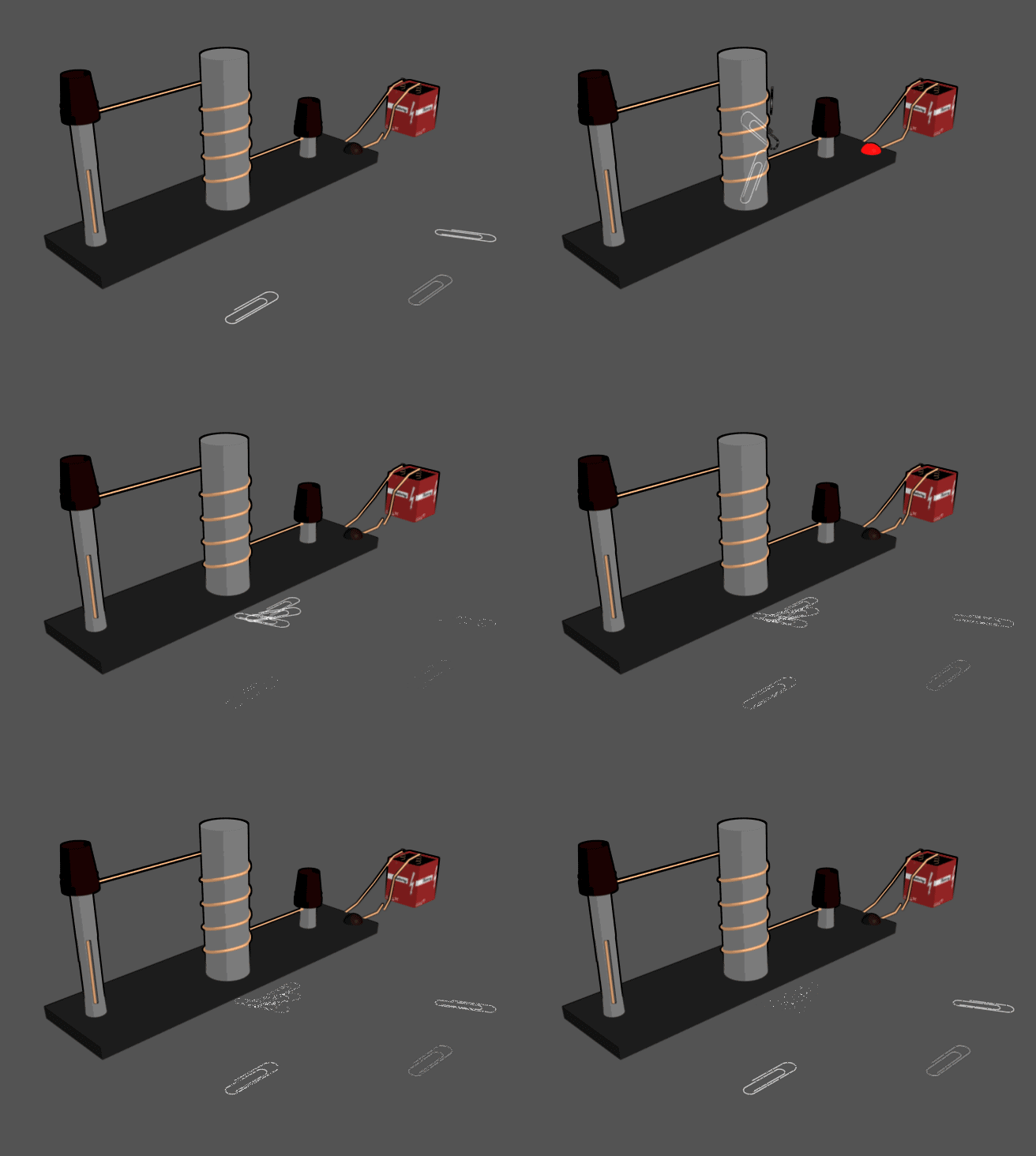
Electromagnetism is the branch of physics that studies the relationship between electric charges, electric fields, magnetic fields and electromagnetic waves. It shows that electricity can produce magnetism and changing magnetism can produce electricity.
Image: Electromagnetism Concept
Watch Video: Theory of Electromagnetism
Watch this video to understand the concept visually.
Advertisement
Main Ideas of Electromagnetism
Electric Field
An electric field is the region around a charged body where another charge experiences a force.
Magnetic Field
A magnetic field is the region around a magnet or current-carrying conductor where magnetic force acts.
Electromagnetic Induction
A changing magnetic field can produce electric current in a conductor. This is called electromagnetic induction.
Electromagnetic Waves
These waves are formed by vibrating electric and magnetic fields. Light, radio waves and X-rays are examples.
Interactive Concept Reveal
Click each button to reveal an important part of electromagnetism.
Important Laws and Principles
| Law / Principle | Meaning | Application |
|---|---|---|
| Oersted’s Experiment | Electric current produces a magnetic field. | Electromagnets |
| Faraday’s Law | Changing magnetic field induces electric current. | Generators, transformers |
| Lenz’s Law | Induced current opposes the change that produces it. | Electromagnetic braking |
| Maxwell’s Theory | Electric and magnetic fields are connected and can form waves. | Radio, light, wireless signals |
Key Formula Box
This formula shows that a charged particle can experience force due to both an electric field and a magnetic field.
Electromagnetic waves travel at the speed of light in vacuum.
Electromagnetic Spectrum
Electromagnetic waves have different wavelengths and frequencies. Together, they form the electromagnetic spectrum.
Radio Waves
Used in radio, TV and communication systems.
Microwaves
Used in microwave ovens, radar and satellite communication.
Infrared Rays
Used in remote controls and thermal imaging.
Visible Light
The part of the spectrum visible to human eyes.
Ultraviolet Rays
Present in sunlight and used for sterilization.
X-Rays
Used in medical imaging and security scanning.
Applications of Electromagnetism
Electric Motors
Convert electrical energy into mechanical energy.
Generators
Convert mechanical energy into electrical energy.
Transformers
Change voltage levels in electric circuits.
Mobile Communication
Uses electromagnetic waves to transmit information.
MRI Machines
Use strong magnetic fields for medical diagnosis.
Radio and Television
Transmit sound and images through electromagnetic waves.
Quick Quiz
Click the correct answer.
1. Who discovered that electric current produces a magnetic field?
2. Which device works on electromagnetic induction?
3. Light is a type of:
Frequently Asked Questions
Conclusion
Electromagnetism is one of the most important theories in physics. It explains how electric and magnetic fields interact and how electromagnetic waves travel. From simple electromagnets to advanced communication systems, electromagnetism plays a central role in modern science and technology.


0 Comments