
Vernier Calipers
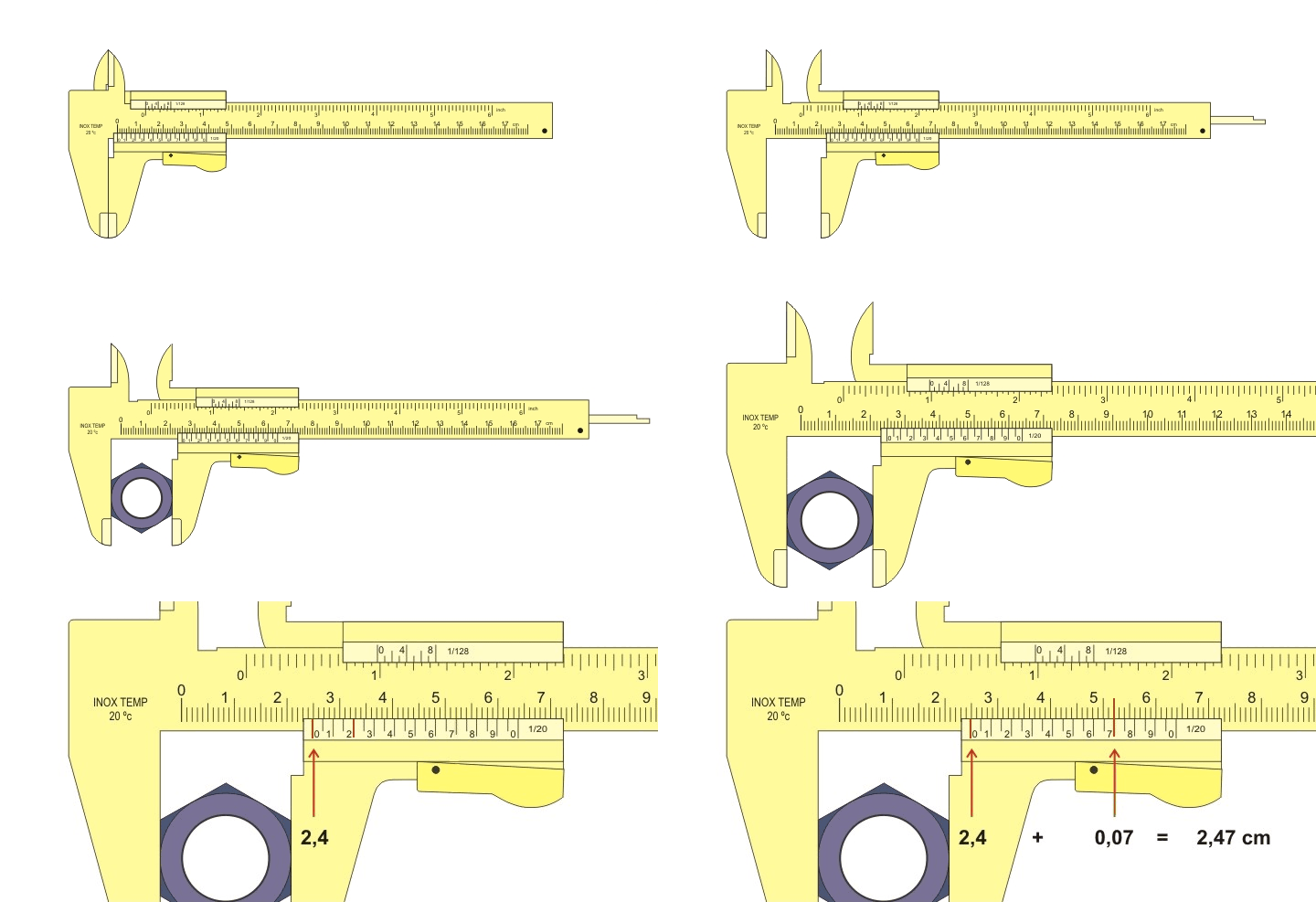
Vernier Calipers are precision measuring instruments used to measure length, external diameter, internal diameter and depth of objects accurately.
What are Vernier Calipers?
Vernier Calipers are measuring instruments used for taking accurate measurements of small lengths. They are more precise than an ordinary metre scale because they use two scales: the main scale and the vernier scale.
Animated representation of a vernier scale sliding over the main scale.
Image: Vernier Calipers
Watch Video: Vernier Calipers
Watch this video to understand Vernier Calipers visually.
Advertisement
Parts of Vernier Calipers
Main Scale
The fixed scale marked in centimetres and millimetres.
Vernier Scale
The sliding scale used to get more accurate readings.
Outer Jaws
Used to measure external diameter or thickness of an object.
Inner Jaws
Used to measure internal diameter of a hollow object.
Depth Rod
Used to measure depth of a hole or container.
Lock Screw
Used to hold the sliding scale at a fixed position while reading.
Interactive Concept Reveal
Click each button to understand important concepts.
Important Formula
How to Take Reading from Vernier Calipers
Interactive Vernier Reading Calculator
Enter the values below to calculate the Vernier Calipers reading.
Uses of Vernier Calipers
| Measurement | Part Used | Example |
|---|---|---|
| External Diameter | Outer Jaws | Diameter of a rod, pencil or sphere |
| Internal Diameter | Inner Jaws | Diameter of a hollow pipe or ring |
| Depth | Depth Rod | Depth of a beaker or small container |
| Thickness | Outer Jaws | Thickness of a coin, sheet or block |
Types of Zero Error
Positive Zero Error
When the zero of the vernier scale lies to the right of the zero of the main scale, the zero error is positive.
Negative Zero Error
When the zero of the vernier scale lies to the left of the zero of the main scale, the zero error is negative.
If zero error is positive, subtract it. If zero error is negative, subtracting it means it gets added to the observed reading.
Common Mistakes While Using Vernier Calipers
Parallax Error
Reading the scale from a wrong angle can give an incorrect value.
Loose Grip
The object should be held gently but firmly between the jaws.
Ignoring Zero Error
Zero error must be checked before taking the final reading.
Wrong Alignment
The object should be placed properly between the correct jaws.
Solved Example
Suppose:
- Main Scale Reading = 2.4 cm
- Vernier Scale Coincidence = 6
- Least Count = 0.01 cm
- Zero Error = 0 cm
Therefore, the measured length is 2.46 cm.
Quick Quiz
Click the correct answer.
1. Vernier Calipers are used to measure:
2. The sliding scale in Vernier Calipers is called:
3. Outer jaws are used to measure:
4. Correct reading is calculated by:
Frequently Asked Questions
Conclusion
Vernier Calipers are important measuring instruments in physics practicals. They help measure small dimensions more accurately than an ordinary scale. To get the correct measurement, students must understand the main scale reading, vernier scale coincidence, least count and zero error.




0 Comments