
Common Laboratory Apparatus and Equipment
Concise Chemistry Selina — complete Exercise I solutions with explanations, practice activities, answer reveals and laboratory-safety notes.
Before You Begin
Laboratory apparatus help us hold, heat, measure, mix, transfer and observe substances safely.
Exercise I — Objective Type Questions
Select an option and press “Check Answer”.
Evaporating dish is made of:
Reason: An evaporating dish is a shallow, bowl-shaped porcelain container used to evaporate solutions or liquids. Porcelain tolerates strong heating and is resistant to many chemicals. Ordinary glass may crack under direct, intense heat; some metals may react with chemicals; and plastic cannot withstand high temperatures.
Spirit lamp is made of:
Reason: A spirit lamp is a small burner that may be made of glass, brass or steel. It contains a wick and uses spirit, usually alcohol, as fuel. Glass makes the fuel level visible, while brass and steel provide durability.
The apparatus used to measure an accurate volume of a liquid is:
Reason: A measuring cylinder is a tall, graduated apparatus marked mainly in millilitres. It measures liquid volume more accurately than a beaker or conical flask. A test tube is used for small-scale experiments, not volume measurement.
To pass a gas from one vessel to another, you will use a:
Reason: A delivery tube provides a passage for transferring gases, and sometimes liquids, from one vessel to another. A gas jar collects gas, a glass rod stirs liquids and a test tube holds small quantities of substances.
To prevent the escape of a gas from a gas jar, you will cover its mouth with a:
Reason: A watch glass can be placed over a gas jar to reduce the escape of gas. It is also used to cover beakers or to evaporate a very small quantity of liquid. It is a loose cover, not an airtight seal.
Exercise I — Fill in the Blanks
Type the missing words. Minor differences in spacing or punctuation are accepted.
- observation
- for evaporating solutions
- test tube holder
- mortar and pestle
- Pyrex and borosilicate glass
Exercise I — State True or False
Choose True or False. A correction appears when a statement is false.
Exercise I — Match the Following
Select the correct function for each apparatus.
| Column A | Choose from Column B |
|---|---|
| (a) Iron stand | |
| (b) Test tube | |
| (c) Funnel | |
| (d) Beaker | |
| (e) Glass rod |
(a) Iron stand — (iv) To support apparatus
(b) Test tube — (i) To boil or strongly heat small quantities of chemicals
(c) Funnel — (v) To transfer liquids
(d) Beaker — (ii) To keep solutions
(e) Glass rod — (iii) To stir solutions
Exercise I — Short Answer Type Questions
Open each question to view its complete answer.
Question 1: From what materials are the following made?
| Apparatus | Material |
|---|---|
| (a) Test tube rack | Wood or plastic |
| (b) Test tube holder | Metal |
| (c) Measuring cylinder | Glass; some modern cylinders are also made of transparent plastic |
| (d) Wire gauze | Traditional textbook answer: iron wire with an asbestos centre. Modern safe version: metal wire with an asbestos-free ceramic-fibre centre. |
| (e) Mortar and pestle | Porcelain |
Question 2: Mention one use of each equipment
Exercise I — Long Answer Type Questions
Complete explanations in clear, exam-ready language.
Question 1(a): Why is chemistry known as an experimental science?
Chemistry is mainly based on experiments and observations. In an experiment, we create or study a phenomenon under controlled conditions and carefully observe the changes that occur. Chemical ideas and conclusions are tested through such practical work. Therefore, chemistry is known as an experimental science.
Question 1(b): Why are most laboratory apparatus made of glass?
Many laboratory apparatus are made of glass because:
- Glass is transparent, so we can observe substances and reactions clearly.
- Heat-resistant glass can tolerate high temperatures.
- Glass is easy to clean.
- Glass does not react with most chemicals used in school experiments.
- Borosilicate glass, often sold under names such as Pyrex, expands very little on heating and is less likely to crack from temperature changes than ordinary glass.
Question 2: List any five laboratory precautions
- Do not work alone in the laboratory.
- Always wear a laboratory coat to protect your clothes and skin.
- Follow the teacher’s instructions during every experiment.
- Do not touch or taste unknown substances, and never inhale an unknown gas directly.
- After the experiment, wash, clean and dry the apparatus, then return it to its proper place.
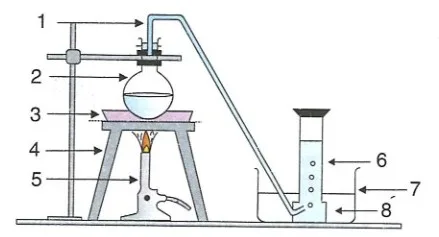
Question 3: Label the marked equipment and apparatus
Use the labels below for the marked laboratory setup.
Quick Revision Challenge
Answer the objective questions above, fill the blanks and complete the matching activity. Then calculate your practice score.
Frequently Asked Questions
Fast answers for revision.
What is the use of an evaporating dish?
An evaporating dish is used to heat a solution so that the liquid evaporates and a dissolved solid may remain behind.
Which apparatus measures liquid volume?
A measuring cylinder is used to measure liquid volume more accurately than a beaker or conical flask.
Why is borosilicate glass used in laboratories?
Borosilicate glass is transparent, chemically resistant and expands relatively little when heated, making it suitable for many laboratory apparatus.
What is the function of a delivery tube?
A delivery tube transfers a gas, and sometimes a liquid, from one vessel to another during an experiment.
What is the safest way to smell a gas in a laboratory?
Never smell an unknown gas directly. Only when a teacher instructs you, gently waft a small amount of vapour toward your nose from a safe distance.





0 Comments