
The Leaf
Interactive Selina Concise Biology questions, answers, reasons, diagrams and revision notes.
Chapter Overview
A leaf is a lateral part of the shoot system that usually arises from a node. Most leaves are broad, flat and green because they contain chlorophyll. Leaves perform vital functions such as photosynthesis, transpiration and gaseous exchange.
Conditions: sunlight and chlorophyll.
How to use this page
- Use the search box to find any topic or question.
- Select Show Answer to reveal each solution.
- Use Open All before revision or printing.
Multiple Choice Questions
Question 1(i)
Identify the plant which has compound leaves.
Answer: Rose
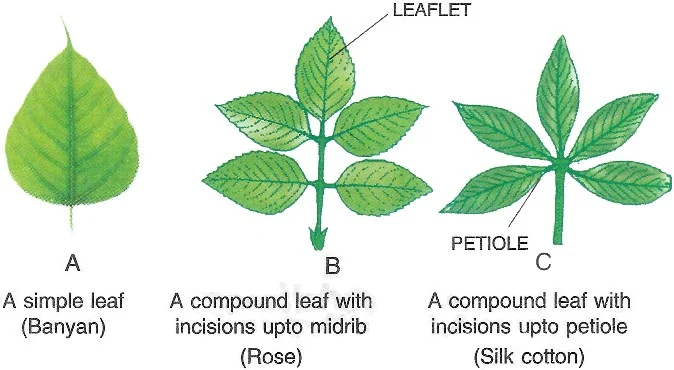
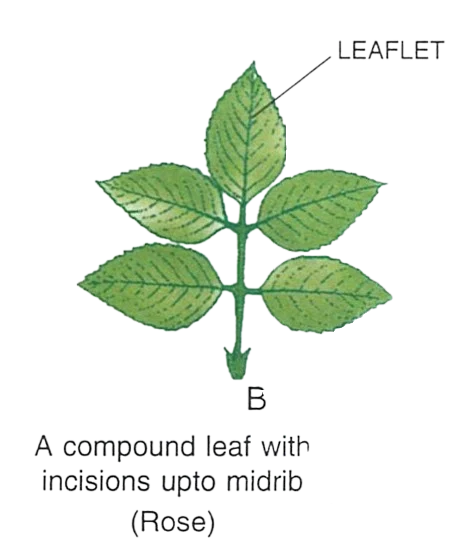
Reason: A compound leaf has its lamina divided into smaller leaflets. A rose leaf is compound because its incisions reach the midrib. Banana, banyan and mango have simple leaves.
Question 1(ii)
Which one of the following is not an insectivorous plant?
Answer: Cactus
Reason: Cactus leaves are modified into spines and do not trap insects. Pitcher plant, Venus flytrap and bladderwort are insectivorous plants that obtain nitrogen by trapping small organisms.
Question 1(iii)
Which leaf shows parallel venation?
Answer: Banana
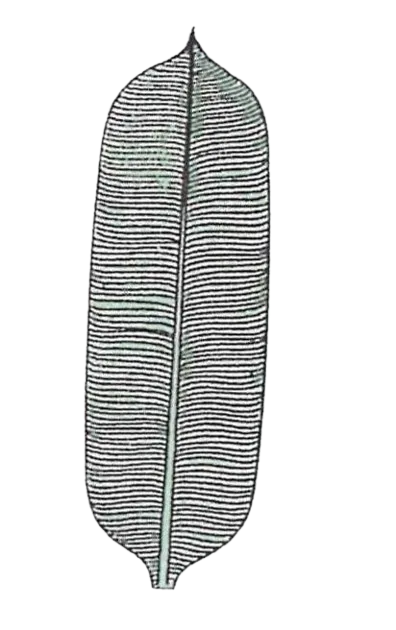
Reason: In a banana leaf, the main veins run parallel to one another from the base towards the tip. Mango, banyan and guava show reticulate venation.
Question 1(iv)
The point on the stem from where a leaf arises is called the:
Answer: Node
Reason: Leaves and branches arise from points on the stem called nodes. A petiole is the leaf stalk, the lamina is the flat blade and the trunk is the main woody stem.
Question 1(v)
Which one of the following is essential for photosynthesis?
Answer: Carbon dioxide
Reason: Green plants use carbon dioxide and water to prepare food in the presence of sunlight and chlorophyll. Oxygen is released during the process. Nitrogen supports growth but is not a raw material of photosynthesis.
Question 1(vi)
Which part of a leaf attaches the lamina to the stem?
Answer: Petiole
Reason: The petiole is the stalk that connects the leaf blade to the stem at a node. It also contains vascular tissues that carry water, minerals and prepared food.
Question 1(vii)
The bud found at the tip of a shoot is called the:
Answer: Apical bud
Reason: An apical or terminal bud is located at the apex of a shoot and is mainly responsible for increase in length. An axillary bud occurs in the leaf axil.
Question 1(viii)
The smaller divisions of the lamina in a compound leaf are called:
Answer: Leaflets
Reason: In a compound leaf, the lamina is divided into separate units called leaflets. Spines protect the plant, stipules occur near the petiole base in some plants and tendrils help in climbing.
Question 1(ix)
Which of the following is not an example of a compound leaf?
Answer: Prickly poppy
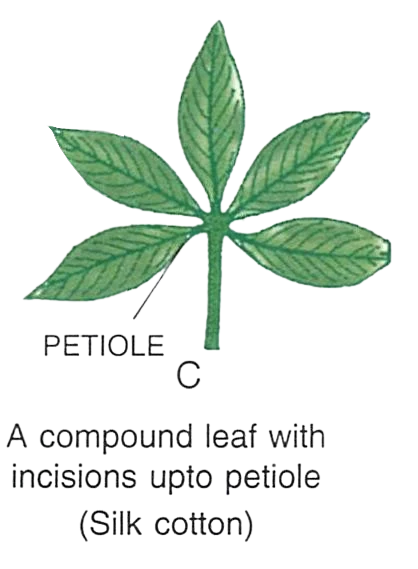
Reason: Prickly poppy has a simple leaf. Its lamina may be deeply lobed, but it is not divided into separate leaflets. Rose, silk cotton and neem have compound leaves.
Question 1(x)
Which plant has whorled phyllotaxy?
Answer: Nerium
Reason: In Nerium (oleander), more than two leaves arise from the same node, forming a whorl. Jasmine and mint commonly show opposite phyllotaxy, while peepal shows alternate phyllotaxy.
Assertion–Reason Questions
Question 2(i)
Assertion (A): Root hairs are fine, hair-like projections on roots that absorb water and minerals from the soil.
Reason (R): A fibrous root system consists of many fine roots arising from the base of the stem, so root hairs are not found.
Answer: A is true, but R is false.
Reason: Root hairs are present on young roots in both tap-root and fibrous-root systems. Therefore, the assertion is true, but the reason is false.
Question 2(ii)
Assertion (A): Leaves attached directly to the stem without a petiole are called sessile leaves.
Reason (R): Sessile leaves do not photosynthesise because they lack chlorophyll and a petiole.
Answer: A is true, but R is false.
Reason: Sessile leaves generally contain chlorophyll and carry out photosynthesis like other green leaves. They simply lack a petiole.
Question 2(iii)
Assertion (A): Terminal and axillary buds contribute to the growth of a plant.
Reason (R): Apical buds are present at the tips of stems and are responsible for vertical growth.
Answer: Both A and R are true, but R is not the complete explanation of A.
Reason: The reason explains the role of the terminal or apical bud, but it does not explain how axillary buds grow into lateral branches.
Question 2(iv)
Assertion (A): Insectivorous plants trap and digest insects to supplement their nutrition.
Reason (R): These plants commonly grow in nitrogen-poor soil and obtain additional nitrogen from insects.
Answer: Both A and R are true, and R is the correct explanation of A.
Reason: Insectivorous plants photosynthesise, but they trap insects mainly to obtain nitrogen and certain minerals that are deficient in their habitat.
Match the Following
Question 3: Match the following
Match each term in Column A with the correct function or feature in Column B.
| Column A | Column B |
|---|---|
| (i) Root system | (a) Photosynthesis |
| (ii) Stem | (b) New branches |
| (iii) Leaves | (c) Vegetative propagation |
| (iv) Axillary bud | (d) Node and internode |
| (v) Bryophyllum | (e) Fixation of the plant |
| Column A | Correct Match |
|---|---|
| (i) Root system | (e) Fixation of the plant |
| (ii) Stem | (d) Node and internode |
| (iii) Leaves | (a) Photosynthesis |
| (iv) Axillary bud | (b) New branches |
| (v) Bryophyllum | (c) Vegetative propagation |
Short Answer Questions
Question 1
Name the following:
- The part of the plant that usually grows below the ground.
- The part of the plant that grows above the soil.
- The broad, flat portion of a leaf.
- Root
- Shoot
- Lamina or leaf blade
Question 2
What are the four main functions of roots?
- They anchor the plant firmly in the soil.
- They absorb water and mineral salts from the soil.
- They conduct the absorbed water and minerals towards the shoot.
- They bind soil particles and help reduce soil erosion.
Question 3
Mention the functions of the following:
- Spines
- Tendrils
- Scale leaves
- Spines: They reduce water loss by transpiration and may protect the plant from animals.
- Tendrils: They coil around a support and help weak-stemmed plants climb.
- Scale leaves: Fleshy scale leaves store food, while dry scale leaves protect buds.
Question 4
Define venation. Name its main types.
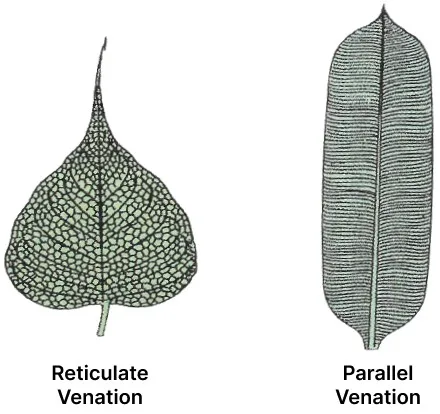
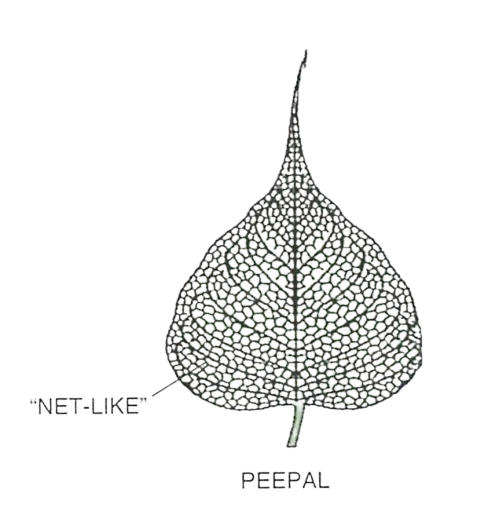
Venation is the arrangement of veins and veinlets in the lamina.
- Reticulate venation: Veins and veinlets form a network. Examples: mango and peepal.
- Parallel venation: Veins run nearly parallel to one another. Examples: banana and maize.
Question 5
Describe the leaf modification in any one insectivorous plant.
In the Venus flytrap, the leaf blade is divided into two lobes joined along the midrib like a hinge. Sensitive trigger hairs are present on the inner surface. When an insect touches the hairs, the lobes close rapidly and trap it. Digestive juices then break down the insect and the plant absorbs nutrients.
Question 6
Write the two main functions of leaves.
- Photosynthesis
- Transpiration
Question 7
Define photosynthesis and transpiration.
Photosynthesis: The process by which green leaves prepare food from carbon dioxide and water in the presence of sunlight and chlorophyll.
Transpiration: The loss of water as water vapour from the aerial parts of a plant, mainly through the leaves.
Question 8
Name the following:
- Two organ systems of a plant
- Two main types of root systems
- Five parts of the shoot system
- Three types of phyllotaxy
- Two types of venation
- Root system and shoot system
- Tap-root system and fibrous-root system
- Stem, buds, leaves, flowers and fruits
- Alternate, opposite and whorled
- Reticulate venation and parallel venation
Question 9
Define the following terms:
- Phyllotaxy
- Leaf
- Autotrophic nutrition
- Leaf tendril
- Vegetative propagation
- Phyllotaxy: The arrangement of leaves on a stem or branch. Its common types are alternate, opposite and whorled.
- Leaf: A usually flat, green, lateral structure that arises from a node and performs functions such as photosynthesis and transpiration.
- Autotrophic nutrition: A mode of nutrition in which an organism prepares its own food from simple inorganic substances. Green plants show autotrophic nutrition.
- Leaf tendril: A leaf or leaflet modified into a thin, coiling structure that helps a weak-stemmed plant climb.
- Vegetative propagation: Formation of new plants from vegetative parts such as roots, stems or leaves instead of seeds.
Question 10
Give the correct biological term:
- Fine, hair-like projections from young root branches
- The part of a stem between two successive nodes
- Leaves without a petiole
- The technical term for a leaf stalk
- The pigment that traps light energy for photosynthesis
- Root hairs
- Internode
- Sessile leaves
- Petiole
- Chlorophyll
Long Answer Questions
Question 1(i)
Differentiate between tap root and fibrous root, giving examples.
| Tap root | Fibrous root |
|---|---|
| One thick main root is clearly visible. | Many roots of nearly equal thickness arise in a cluster. |
| Usually penetrates deeply into the soil. | Usually remains comparatively shallow. |
| Common in dicot plants. | Common in monocot plants. |
| Examples: gram and pea. | Examples: maize and grass. |
Question 1(ii)
Differentiate between a simple leaf and a compound leaf, giving examples.
| Simple leaf | Compound leaf |
|---|---|
| The lamina is one continuous blade. | The lamina is divided into separate leaflets. |
| Incisions, when present, do not reach the midrib or petiole. | Incisions reach the midrib or petiole. |
| Examples: mango, banana and banyan. | Examples: rose, neem and clover. |
Question 1(iii)
Differentiate between parallel venation and reticulate venation, giving examples.
| Parallel venation | Reticulate venation |
|---|---|
| The veins run nearly parallel to one another. | The veins and veinlets form a network. |
| Common in monocot plants. | Common in dicot plants. |
| Examples: banana and maize. | Examples: peepal and mango. |
Question 2
What modification is seen in Bryophyllum? Explain.
- Adventitious buds develop along the margins of Bryophyllum leaves.
- These buds grow into small plantlets.
- When the plantlets detach and fall on suitable soil, they develop roots and grow into independent plants.
Question 3
What purpose is served by the spines on cactus leaves?
Cactus is adapted to dry habitats. Its leaves are modified into spines, which greatly reduce the surface area and therefore reduce water loss by transpiration. The spines also protect the plant from grazing animals.
Question 4
Why is leaf survival important to a plant?
- Leaves manufacture food through photosynthesis.
- They exchange gases for photosynthesis and respiration.
- They remove excess water through transpiration.
- Transpiration produces a cooling effect and helps create transpirational pull.
Question 5
Give examples and draw generalised diagrams of simple and compound leaves, and of parallel and reticulate venation.
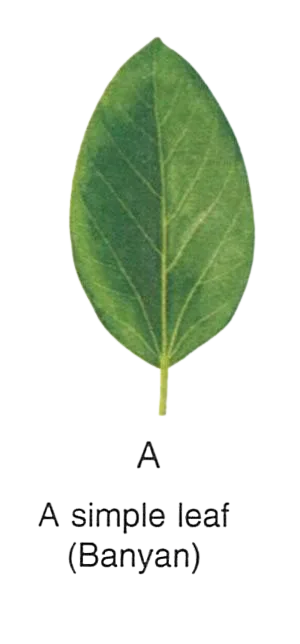
(i) Banyan is an example of a simple leaf, while rose is an example of a compound leaf.
(ii) Banana shows parallel venation, while peepal shows reticulate venation.
Question 6
List the advantages of transpiration to green plants.
- Cooling effect: Evaporation of water from leaf surfaces uses heat from the plant and helps prevent overheating.
- Transpirational pull: Water loss from leaves creates a pulling force that helps move water and dissolved minerals upward from the roots.
Question 7
Why do some plants trap insects?
Insectivorous plants usually grow in soils that are poor in nitrogen. They prepare carbohydrates by photosynthesis but trap and digest insects to obtain additional nitrogen and certain minerals needed for healthy growth.
Question 8
Explain some common modifications of leaves.
- Leaf tendrils: Leaves or leaflets become thin and coiling, helping weak-stemmed plants climb. Example: sweet pea.
- Leaf spines: Leaves become pointed spines that reduce water loss and protect the plant. Example: cactus.
- Scale leaves: Thick, fleshy scales may store food, while thin, dry scales protect buds. Examples: onion and ginger.
Question 9
What is a tendril? Explain its use to plants.
A tendril is a thin, wiry and coiling structure formed by the modification of a leaf, leaflet or another plant part. It is sensitive to touch and coils around a support, helping a weak-stemmed plant climb. Sweet pea has leaf tendrils.
Question 10(i)
Distinguish between spines and scale leaves on the basis of significance.
| Spines | Scale leaves |
|---|---|
| Reduce water loss by transpiration and may protect the plant. | Store food when fleshy and protect buds when dry. |
Question 10(ii)
Distinguish between vegetative and reproductive parts of a plant.
| Vegetative parts | Reproductive parts |
|---|---|
| Non-reproductive structures mainly involved in growth and nutrition, such as roots, stems and leaves. | Structures involved in sexual reproduction, such as flowers, fruits and seeds. |
Question 10(iii)
Distinguish between alternate and opposite phyllotaxy on the basis of the number of leaves at each node.
| Alternate phyllotaxy | Opposite phyllotaxy |
|---|---|
| One leaf arises at each node, and successive leaves occur alternately on the stem. | Two leaves arise at the same node, opposite each other. |
Question 10(iv)
Distinguish between pine and peepal leaves on the basis of shape.
| Pine | Peepal |
|---|---|
| Leaves are long, narrow and needle-like. | Leaves are broad and heart-shaped, usually with a long pointed tip. |
Question 10(v)
Give two examples each of reticulate and parallel venation.
| Reticulate venation | Parallel venation |
|---|---|
| Mango and guava | Banana and maize |
Question 11
Study a labelled simple, petiolate leaf with reticulate venation and answer the questions.
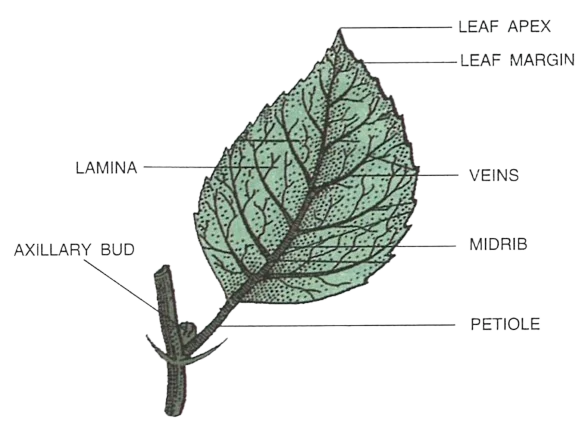
- (i) Function of an axillary bud: It can develop into a lateral shoot or branch.
- (ii) Two main functions of leaves: Photosynthesis and transpiration.
- (iii) Two plants with serrated leaf margins: Rose and China rose.
- (iv) Why some plants have tendrils: Tendrils coil around supports and help weak-stemmed plants climb.
- (v) Plant with leaves modified into spines: Cactus.
Question 12
Study the three insectivorous plants and answer the questions.
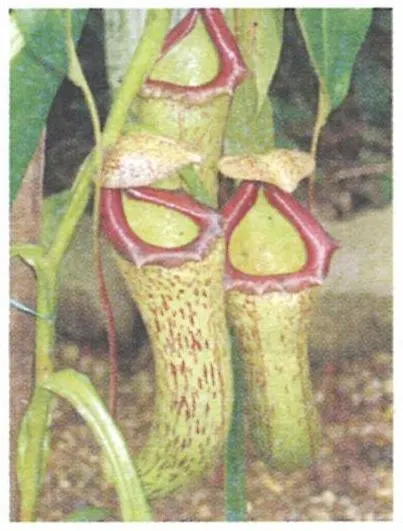
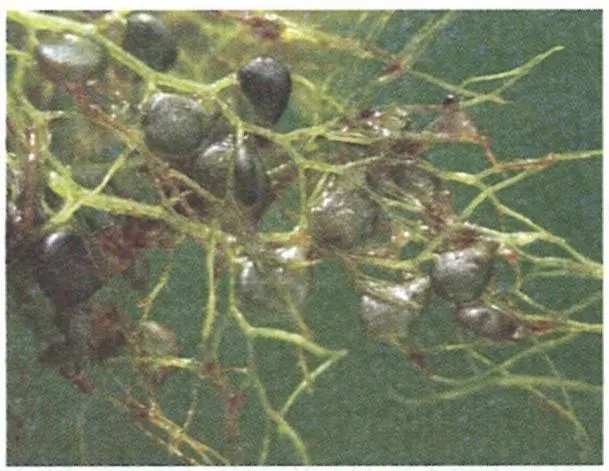
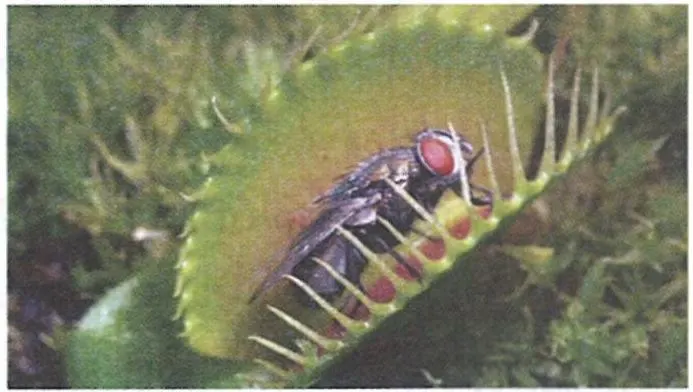
- (i) A: Pitcher plant; B: Bladderwort; C: Venus flytrap.
- (ii) They trap insects mainly to obtain nitrogen.
- (iii) Pitcher plant is found abundantly in Meghalaya.
- (iv) In the pitcher plant, the lamina is modified into a pitcher.
- (v) These plants commonly grow in soil deficient in nitrates.
Question 13
Study the different arrangements of leaves on a stem and answer the questions.
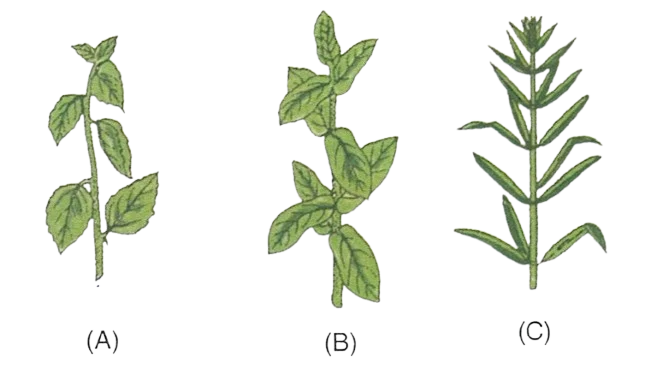
- (i) The technical term is phyllotaxy.
- (ii) A: Alternate; B: Opposite; C: Whorled.
- (iii) Alternate: Peepal; Opposite: Jasmine or mint; Whorled: Nerium (oleander).
Question 14
Draw neat diagrams and give one example of each leaf type.
Question 15
Complete the crossword using the clues.

Across
- Plant that bears buds on its leaves for propagation.
- The flattened green part of a leaf.
- The underground plant part.
- A structure that can develop into a flower.
Down
- The central main vein of a leaf.
- A leaf modification seen in cactus.
Across: 1. Bryophyllum; 2. Lamina; 3. Root; 4. Bud
Down: 5. Midrib; 6. Spine
Case Study Question
Case Study Question 1
John, Sandeep and Shubham collected banyan, rose and silk cotton leaves for a herbarium. They observed that the banyan leaf differed from the other two. Banyan has a simple leaf, whereas rose and silk cotton have compound leaves.
- What is the main difference between a simple leaf and a compound leaf?
- How do rose and silk cotton leaves differ even though both are compound?
- Classify neem, peepal, guava, mango, gulmohar and banana as simple or compound leaves.
- What is the difference between a petiole and a midrib?
- (i) A simple leaf has one undivided lamina. A compound leaf has its lamina divided into separate leaflets.
- (ii) Rose has a pinnately compound leaf, with leaflets arranged along the rachis. Silk cotton has a palmately compound leaf, with leaflets arising from one point at the end of the petiole.
- (iii) Simple leaves: peepal, guava, mango and banana. Compound leaves: neem and gulmohar.
- (iv) The petiole is the stalk attaching the leaf blade to the stem. The midrib is the main central vein running through the lamina.
Frequently Asked Questions
A leaf is usually a flat, green structure that arises from a node on the stem and performs functions such as photosynthesis and transpiration.
A simple leaf has one continuous lamina, while a compound leaf has its lamina divided into separate leaflets.
The two main types are reticulate venation, in which veins form a network, and parallel venation, in which veins run nearly parallel.
Phyllotaxy is the arrangement of leaves on a stem or branch. The common types are alternate, opposite and whorled.
Spines reduce the surface area of the leaf and therefore reduce water loss by transpiration. They may also protect the plant.
They usually grow in nitrogen-poor soil and digest insects to obtain additional nitrogen and minerals.
Transpiration is the loss of water as water vapour from the aerial parts of a plant, mainly through the leaves.
Adventitious buds grow along the leaf margins and develop into plantlets that can form new plants after falling on suitable soil.





0 Comments