
Respiratory System
Learn breathing, cellular respiration, gaseous exchange, respiratory organs and common diseases through animated explanations, self-check quizzes and exam-ready answers.
Quick Learn
Core ideas before you begin the exercises.
Breathing vs Respiration
Breathing is a physical process involving inhalation and exhalation. Cellular respiration is a biochemical process that releases energy inside living cells.
Inspired and Expired Air
Expired air has more carbon dioxide and water vapour than inspired air. Nitrogen remains almost unchanged.

Interactive Breathing Lab
Use the buttons to observe the relationship between ribs, diaphragm, chest volume and air pressure.
Multiple Choice Questions
Select an option to check your answer instantly.
In humans, taking air through nostrils into the nasal cavity is called
Show answer and explanation
Answer: Inhalation
Inhalation is the physical process by which the air containing oxygen is drawn into our lungs through nostrils into the nasal cavity.
Exhalation is releasing air out of the body. Cellular respiration is breakdown of food in cells. Internal respiration is gas exchange between blood and tissues.
The front opening of the wind pipe is guarded by
Show answer and explanation
Answer: Epiglottis
The epiglottis is a muscular flap located in the throat. It closes the wind pipe at the time of swallowing of food.
Glottis is opening of the larynx, not a guard. Exoglottis is not a biological structure. Trachea is the windpipe itself.
The process during which food is oxidised and energy is released is called
Show answer and explanation
Answer: Cellular respiration
Cellular respiration is the process of oxidation of glucose (breaking down of food) in the cells with the release of energy in the form of ATP molecules (Adenosine triphosphate).
Excretion is removal of waste products. Digestion is breakdown of food into simpler substances. Transpiration is loss of water vapour from plants
Which of the following is not a part of the respiratory system ?
Show answer and explanation
Answer: Mouth
In humans, the organs of the respiratory system are the nose, pharynx, larynx, trachea, bronchi and lungs. The mouth belongs to the digestive system and is not a respiratory organ — air should normally enter through the nose, not the mouth.
The common passage of wind pipe and food pipe is termed as :
Show answer and explanation
Answer: Pharynx
Pharynx or throat is a common passage for air and the food. It leads into two passages, one is the air tube called wind pipe or trachea and the other the gullet (food-pipe).
Larynx is voice box, only air passage. Glottis is the opening of the larynx. Epiglottis is the flap that prevents food entering windpipe.
The energy produced during cellular respiration is :
Show answer and explanation
Answer: ATP
During cellular respiration, glucose is oxidised in the cells and the energy released is stored in the form of adenosine triphosphate (ATP), along with carbon dioxide and water vapour. ADP (adenosine diphosphate) is the lower-energy molecule that is converted into ATP when energy is stored, so it is not the energy product. ADH (antidiuretic hormone) is a hormone that controls water balance in the body and has nothing to do with respiration.
The basic structural and functional unit of the lungs is :
Show answer and explanation
Answer: Alveolus
Alveolus is the basic structural and functional unit of the lungs.
Pleura is the membrane covering lungs. Capillary is the blood vessel, not lung unit. Diaphragm is the muscle for breathing.
Vocal cords are found in :
Show answer and explanation
Answer: Larynx
Larynx contains two ligamentous folds called 'vocal cords'.
Gullet is the food pipe (esophagus). Pharynx is the common passage for air and food. Glottis is the opening between vocal cords, not their location.
Which of the following is a respiratory pigment ?
Show answer and explanation
Answer: Haemoglobin
The oxygen from the lungs diffuses into the blood, and is picked up by haemoglobin in red blood cells. Carbon dioxide from the blood diffuses into the lungs and is exhaled out through the same passage.
Melanin is the skin pigment, gives color. Chlorophyll is the photosynthetic pigment in plants.
The muscular sheet which divides the body cavity into thorax and abdomen is termed as :
Show answer and explanation
Answer: Diaphragm
Diaphragmis a muscular sheet which internally divides the body cavity into two cavities, the chest cavity or thoracic cavity above, and the abdominal cavity below.
Inner pleura is the membrane covering lungs. Rib cage is the bony structure protecting chest. Outer pleura is the membrane around lungs.
Assertion–Reason Questions
Judge both statements and their logical relationship.
Assertion (A): The energy produced during the process of respiration is utilized by the body for various external and internal activities.
Reason (R): No energy is used by the body during sleep because all physical activities stop when we are asleep.
Show answer and explanation
Answer: A is true but R is false.
A is true as respiration releases energy in cells, and this energy is used for movement, growth, repair and internal functions.
R is false as even during sleep, the body uses energy for internal processes like breathing, heartbeat.
Therefore, A is true but R is false is the correct option.
Assertion (A): The front opening (glottis) of the wind pipe is guarded by a muscular flap called epiglottis which prevents the entry of food in the trachea.
Reason (R): The trachea is supported by C-shaped cartilage rings that keep it open for the passage of air.
Show answer and explanation
Answer: Both A and R are true but R is not the correct explanation of A.
A is true as the front opening (glottis) of the wind pipe is guarded by a muscular flap called epiglottis which prevents the entry of food in the trachea.
R is true as the trachea has C-shaped cartilage rings that prevent it from collapsing and keep the airway open. However, this describes a separate feature of the trachea and does not explain how the epiglottis prevents food from entering the windpipe.
Therefore, Both A and R are true but R is not the correct explanation of A is the correct option.
Assertion (A): Alveoli are the basic structural and functional units of lungs which are richly supplied with blood capillaries.
Reason (R): The thin walls of the blood capillaries allow faster diffusion of the respiratory gases into the lungs as alveoli are surrounded by blood capillaries.
Show answer and explanation
Answer: Both A and R are true and R is the correct explanation of A.
A is true as alveoli are the functional units of lungs which are richly supplied with blood capillaries covering their walls.
R is true as the walls of the blood capillaries are extremely thin and moist for allowing faster diffusion of gases.
Therefore, Both A and R are true and R is the correct explanation of A is the correct option.
Assertion (A): Air enters the lungs during inhalation because the pressure inside the lungs becomes lower than the air outside.
Reason (R): The chest cavity becomes smaller during inhalation, which forces air to rush in.
Show answer and explanation
Answer: A is true but R is false.
A is true as during inhalation, lung volume increases and internal pressure decreases, so air flows from higher external pressure to lower internal pressure.
R is false as during inhalation, the chest cavity actually expands (becomes larger), not smaller. This expansion reduces pressure inside the lungs and draws air in.
Therefore, A is true but R is false is the correct option.
Assertion (A): In an alveolus, carbon dioxide diffuses from the air into the blood.
Reason (R): Carbon dioxide concentration is higher in the blood than in the alveolar air.
Show answer and explanation
Answer: A is false but R is true.
A is false as carbon dioxide diffuses from the blood into the alveolar air.
R is true because blood coming from body tissues carries more CO₂ than the air in alveoli, so CO₂ moves from blood to alveoli by diffusion.
Therefore, A is false but R is true is the correct option.
Fill in the Blanks
Type the missing terms and check your answers.
Match the Following
Connect each term with its correct description.
| Column A | Column B |
|---|---|
| (i) Aerobic | (a) Two-lobed |
| (ii) Anaerobic | (b) Three-lobed |
| (iii) Trachea | (c) Absence of oxygen |
| (iv) Left lung | (d) Presence of oxygen |
| (v) Right lung | (e) C-shaped cartilaginous rings |
Reveal matching answers
| Term | Correct Match |
|---|---|
| (i) Aerobic | (d) Presence of oxygen |
| (ii) Anaerobic | (c) Absence of oxygen |
| (iii) Trachea | (e) C-shaped cartilaginous rings |
| (iv) Left lung | (a) Two-lobed |
| (v) Right lung | (b) Three-lobed |
Short Answer Questions
Open each card to study the exam-ready answer.
Q1(i)Why do our body cells require oxygen?
Our body cells require oxygen to break down glucose during aerobic cellular respiration and release usable energy in the form of ATP.
Q1(ii)What is the difference between breathing and respiration?
Difference between Breathing and Respiration:
| Breathing | Respiration |
|---|---|
| Breathing is a physical process. | Respiration is a bio-chemical process. |
| Air containing oxygen is taken into the lungs and air loaded with carbon dioxide is given out. | Oxygen taken in is used in oxidizing glucose and energy is released. |
| Lungs are mainly involved. | Occurs in all living cells of the body. |
Q1(iii)Name the by-products formed during the oxidation of food.
Carbon dioxide and Water are released as by-products during the oxidation of food.
Q1(iv)Name the agent which transports oxygen to all parts of the body.
Blood transports oxygen to all parts of the body. Haemoglobin present in red blood cells binds with oxygen and carries it to body tissues.
Q1(v)What is the role of epiglottis during swallowing?
Epiglottis closes the wind pipe at the time of swallowing the food.
Q2Name the gas which is expelled out during expiration. Where is it originally produced in our body?
Carbon dioxide is the gas which is expelled during expiration. It is produced in the cells of the body.
Q3Write one important role of each of the following . (i) Epiglottis (ii) Larynx (iii) Alveolus (iv) Pleura (v) Nasal chamber
(i)Epiglottis guards the front opening (glottis) of the wind pipe. It closes the wind pipe at the time of swallowing of food, and hence prevents any wrongful entry of food into the wind pipe.
(ii)Larynx contains two ligamentous folds called 'vocal cords'. Air expelled forcibly through the vocal cords vibrates them to produce sound.
(iii)Alveoli are richly supplied with blood capillaries covering their walls. The walls of the alveoli are extremely thin and moist for allowing faster diffusion of gases.
(iv)Pleura protects the lungs. The fluid filled in the space between the outer and inner pleura acts as a shock absorber for the lungs.
(v)The lining of the nasal chamber has mucous (a sticky fluid) which traps germs and dust, so they don't enter our body.
Q4Define the terms given below : (i) Respiration (ii) Breathing (iii) Lungs (iv) Inhalation (v) Exhalation
(i)Respiration — Respiration is the process of releasing energy by breaking down food (glucose) needed for various activities of the body.
(ii)Breathing — The process during which the air containing oxygen is drawn into the lungs and the air containing carbon dioxide is forced out from the lungs is called breathing. Breathing is a physical process.
(iii)Lungs — The lungs are a pair of pink and spongy, elastic organs located in the chest cavity and help in the exchange of gases. They take in oxygen from the air and remove carbon dioxide from the blood during the process of breathing.
(iv)Inhalation — Inhalation is the process of drawing in the air through the nostrils into the nasal cavity and finally into the lungs.
(v)Exhalation — Exhalation is the process of forcing out of the air from the lungs.
Q5Name the following. (i) Respiratory process in which oxygen is not utilized. (ii) Respiratory process in which oxygen is utilized. (iii) The microscopic air-sacs of the lungs. (iv) The two membranes which protect the lungs. (v) Six main parts of the human respiratory system. (vi) Two types of respiration. (vii) Three phases of respiration. (viii) Two steps of breathing. (ix) Three common respiratory diseases.
(i)Anaerobic Respiration.
(ii)Aerobic Respiration.
(iii)Alveoli.
(iv)Outer and inner pleura.
(v)Nose, Pharynx, Larynx, Trachea, Bronchi and the Lungs
(vi)Aerobic respiration and Anaerobic respiration
(vii)Breathing, Gaseous transport, and Cellular respiration
(viii)Inspiration and Expiration
(ix)Bronchitis, Asthma, and Pneumonia
Q6Correct the following statements by changing the first/ last word only : (i) BCG is a kind of vaccine used to prevent Pneumonia. (ii) Streptomycin is a kind of vaccine. (iii) Breathing is a bio-chemical process. (iv) The amount of oxygen in expired air is 21%. (v) The front opening of the trachea is guarded by a muscular flap called diaphragm.
(i)BCG is a kind of vaccine used to prevent Tuberculosis.
(ii)Streptomycin is a kind of antibiotic.
(iii)Respiration is a bio-chemical process.
(iv)The amount of oxygen in expired air is 16%.
(v)The front opening of the trachea is guarded by a muscular flap called epiglottis.
Long Answer Questions
Detailed explanations, comparisons and diagram-based answers.
Q1Why is a respiratory system necessary?
The respiratory system is necessary because:
It brings oxygen into the lungs and removes carbon dioxide from the body.
Oxygen diffuses into the blood and is carried by haemoglobin in red blood cells to body tissues.
Inside cells, oxygen helps in the oxidation of glucose during cellular respiration, releasing energy in the form of ATP for movement, growth, repair and other life processes.
Q2What factors are most likely to affect the breathing rate?
Some of the factors that affect the breathing rate are:
While exercising or doing intense physical activity, the body requires more energy due to which the demand of oxygen increases. This increases the rate of breathing of the person.
While sleeping and resting, the breathing rate decreases as the body requires less energy.
Allergic reactions increase the rate of breathing as allergic reactions narrow the nasal passage leading to a demand for more oxygen.
Stress and anxiety increases the breathing rate as the stress hormones trigger the body's fight or flight response.
Q3What happens to the energy liberated during respiration?
The energy liberated during respiration is not all in the form of heat but a large part of it is converted into chemical energy in the form of ATP (Adenosine Triphosphate). This energy is utilised by the body cells for a vast variety of activities like:
Digestion of food.
Production of enzymes.
Contraction of muscles for movement.
Conduction of electrical impulse in a nerve cell.
Production of new cells by cell division.
Keeping the body warm in warm-blooded animals.
Q4What do you understand by inhalation and exhalation? How are they different from each other?
Inhalation is the physical process by which the air containing oxygen is drawn into the lungs.
Exhalation is the physical process by which the air containing carbon dioxide is forced out from the lungs.
Differences between Inhalation and Exhalation are:
| Inhalation | Exhalation |
|---|---|
| Ribs move upwards and outwards. | Ribs move downwards and inwards. |
| Diaphragm is pushed downwards and flattens. | Diaphragm moves upwards and becomes dome-shaped. |
| Volume of chest cavity increases. | Volume of chest cavity decreases. |
| Lungs expand, air pressure becomes low. | Size of the lungs reduces, air pressure becomes high. |
| Atmospheric air at a higher pressure rushes into lungs. | Air rushes out of the lungs as atmospheric air pressure is lower. |
Q5What do you understand by the term respiratory diseases? Name any three common respiratory diseases.
The diseases that affect the respiratory organs of the body making respiration difficult are termed as respiratory diseases.
The three common respiratory diseases are:
Bronchitis
Asthma
Pneumonia
Q6State the cause and treatment for the following diseases: (i) Tuberculosis (ii) Pneumonia (iii) Bronchitis
(i)Tuberculosis
Cause — Tuberculosis is caused by the bacterium Mycobacterium tuberculosis and can spread through the air when an infected person coughs, sneezes or speaks.
Prevention — The BCG vaccine helps protect against severe forms of tuberculosis.
Treatment — Tuberculosis is treated by a doctor with a combination of antibiotics taken for the full prescribed duration. Streptomycin may be used only in selected cases.
(ii)Pneumonia
Cause — Pneumonia is an infection of the lungs that may be caused by bacteria, viruses or fungi.
Treatment — Treatment depends on the cause and severity. Bacterial pneumonia may require doctor-prescribed antibiotics, while rest, fluids and medical monitoring are also important.
(iii)Bronchitis
Cause — Acute bronchitis is commonly caused by viruses. Smoking, air pollution and other irritants can also inflame the bronchi.
Treatment — Rest, fluids and avoiding smoke may help. Medical advice is needed if symptoms are severe, persistent or accompanied by breathing difficulty.
Q7Describe in brief the function of ribs and diaphragm in breathing.
The function of Ribs and Diaphragm is to aid respiration:
Ribs — In breathing during inhalation, the Ribs move upwards and outward. This function increases the volume of chest cavity. As a result lungs expand and atmospheric air rushes into the lungs. During Exhalation, the Ribs move downwards and inward. This function decreases the volume of chest cavity as a result lungs contract and air rushes out of the lungs.
Diaphragm — The diaphragm helps in breathing by changing its shape. During inhalation, it contracts and flattens, allowing the lungs to expand. During exhalation, it relaxes and becomes dome-shaped, helping push air out of the lungs.
Q8The diagram shows a bell-jar model of breathing. Study it and answer: (i) Name and define the process. (ii) Identify phases (A) and (B). (iii) What body parts are represented by the bell jar, balloons and rubber sheet? (iv) How do the phases differ with respect to rib movement? (v) Does breathing rate generally differ between a young child and an adult or older person? Explain.
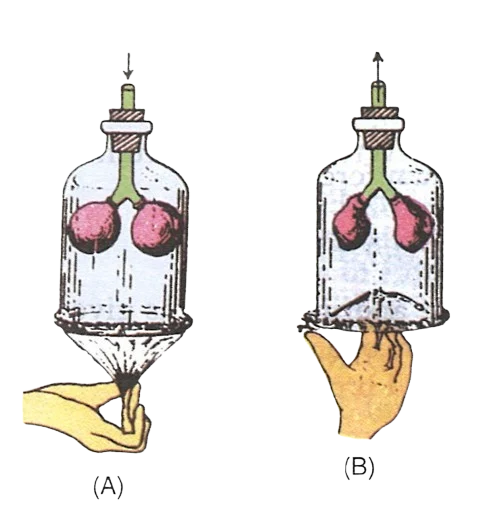
(i)The diagram demonstrates breathing. Breathing is the physical process in which oxygen-rich air is drawn into the lungs and carbon-dioxide-rich air is forced out.
(ii)Phase (A) shows inspiration or inhalation, and Phase (B) shows expiration or exhalation.
(iii)The body parts represented are:
(a)Bell jar — Chest cavity
(b)Balloons — Lungs
(c)Rubber sheet — Diaphragm
(iv)During inspiration, the ribs move upwards and outwards. During expiration, the ribs move downwards and inwards.
(v)Yes. Young children generally have a faster breathing rate than healthy adults because of their higher metabolic needs and smaller lungs. In older people, breathing rate can vary with health, fitness and lung function, so it should not be assumed to be slower only because of age.
Q9The diagram shows the human respiratory system. Study it and answer: (i) Label parts 1 to 4. (ii) Define the structure shown as part 2. (iii) Name the basic structural and functional unit of part 3. (iv) State one structural feature of the inner lining of part 1. (v) Name the muscular sheet on which part 3 rests.
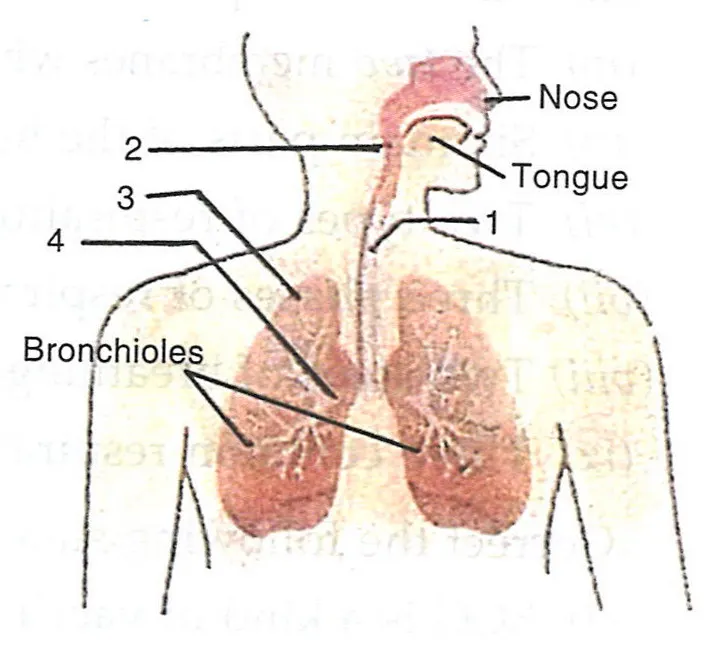
(i)The guidelines 1 to 4 show:
Trachea
Larynx
Lung
Bronchus
(ii)At the entrance of the trachea, there is a voice box called larynx. It contains two ligamentous folds called 'vocal cords'. Air expelled forcibly through the vocal cords vibrates them, to produce sound.
(iii)Alveoli is the basic structural and functional unit of part 3, i.e., lungs.
(iv)The inner linings of the trachea, bronchi and bronchioles have ciliated epithelium. The continuous movement of the cilia pushes out the unwanted particles that may be present in the inhaled air.
(v)Diaphragm is the muscular sheet upon which the lungs rest.
Case Study Question
Apply respiratory-system concepts to a real-life situation.
Q1Vivaan is a class 6 boy who loves playing football and shouting instructions to his teammates on the field. One afternoon, during an intense match, he starts feeling like something is stuck in his throat. He keeps clearing it, but it doesn't help. By the end of the game, his voice becomes weak and hoarse, and speaking starts to hurt. Answer the following questions: (i) Write the technical term for the voice-box found in the human body that was affected in Vivaan's case. (ii) What is the exact location of the voice-box in our body? (iii) What could be the possible reason for Vivaan temporarily losing his voice? (iv) Name the two ligamentous folds associated with the voice-box.
(i)The technical term for the voice-box found in the human body is the larynx.
(ii)Larynx is located at the entrance of the trachea.
(iii)Vivaan’s temporary loss of voice could be due to overuse or strain of the vocal cords caused by shouting continuously during the football match.
(iv)The two ligamentous folds associated with the voice-box are called vocal cords.
Frequently Asked Questions
Quick revision of the chapter's most important ideas.
What is breathing?
Breathing is the physical process of taking oxygen-rich air into the lungs and forcing carbon-dioxide-rich air out.
What is cellular respiration?
Cellular respiration is the biochemical process in cells that breaks down glucose and releases usable energy, mainly stored as ATP.
What is the function of the epiglottis?
The epiglottis closes the opening of the windpipe during swallowing and helps prevent food from entering the trachea.
Where are vocal cords found?
Vocal cords are found in the larynx, also called the voice box.
What are alveoli?
Alveoli are microscopic air sacs in the lungs where oxygen and carbon dioxide are exchanged with the blood.
What does the diaphragm do during inhalation?
During inhalation, the diaphragm contracts and flattens, increasing the volume of the chest cavity and drawing air into the lungs.
How much oxygen is present in expired air?
Expired air contains about 16 percent oxygen, compared with about 21 percent in inspired air.
Which pigment transports oxygen in blood?
Haemoglobin in red blood cells binds with oxygen and transports it around the body.


0 Comments