
The Circulatory System
Explore blood, the heart, blood vessels and circulation through interactive quizzes, revealable answers, comparison tables and a real-life case study.
Multiple Choice Questions
Select an option to receive instant feedback and a full explanation.
Function of WBCs is to
Reason — WBCs provide immunity by destroying the disease causing germs and producing antibodies.
RBCs transport oxygen. Platelets help in clotting of blood. Blood cells do not provide storage of food.
Blood Capillary is a
Reason — Blood capillary is narrow blood vessel whose walls have a single layer of cells called endothelium.
Blood capillaries are not broad. They are the smallest and narrowest blood vessels in the body, so narrow that blood cells pass through them one at a time. Arteries have thick, elastic, muscular walls and high-pressure blood flow. Capillaries are very thin and are not arteries. Veins have thinner walls than arteries and wide lumen. Capillaries do not have a large lumen; they are extremely narrow.
Nucleus is absent in
Reason — RBCs have no nucleus because they need space for haemoglobin to carry more oxygen.
White blood cells do have a nucleus. Liver cells are ordinary body cells and also have a nucleus.
The only artery which carries deoxygenated blood is
Reason — Pulmonary artery leaves the right ventricle of the heart carrying the deoxygenated blood to the lungs for oxygenation.
Hepatic artery carries oxygenated blood to the liver. Aorta carries oxygenated blood from the heart to the whole body. Renal artery carries oxygenated blood to the kidneys.
Sphygmomanometer measures
Reason — Sphygmomanometer is an instrument which is used to find out blood pressure of the body.
Pulse rate is measured by feeling the pulse or using a pulse monitor. Heartbeat is the action of the heart; it is not directly measured by this instrument. Brain activity measured using an EEG (Electroencephalogram).
Pulmonary vein carries
Reason — Oxygenated blood from the lungs returns to the left auricle via pulmonary veins.
Deoxygenated blood is carried by the pulmonary artery (not vein). Glucose-rich blood is not specifically related to this vessel. CO2 laden blood is carried to the lungs by the pulmonary artery.
The blood tastes saltish due to the presence of dissolved:
Reason — The blood tastes saltish due to dissolved minerals like sodium chloride.
Potassium chloride is present in blood but not the main reason for saltish taste. Ammonium nitrate is not a natural component of blood. Sodium nitrate is not present in blood in significant amount.
Which of the following is an organ of the human cardiovascular system ?
Reason — The heart is the main pumping organ of the human cardiovascular system. It pumps blood through the blood vessels to all parts of the body. Therefore, it is an organ of the cardiovascular system.
Liver is digestive organ involved in metabolism and detoxification. Kidney is part of the excretory system, filters waste from blood. Lung is part of the respiratory system, helps in gas exchange.
Haemoglobin consists of :
Reason — Haemoglobin is an iron and protein compound found within RBCs. It acts as the "oxygen-carrier".
Iodine is related to thyroid hormones, not haemoglobin. Amino acids form proteins, but haemoglobin is specifically a protein with iron-containing haem groups. Globin itself is already a protein; haemoglobin is globin + haem (iron-containing part).
Which of the following blood vessels carries deoxygenated blood to the heart ?
Reason — The Superior Vena Cava and the Inferior Vena Cava brings deoxygenated blood from the upper and lower parts of the body to the right auricle of the heart.
Pulmonary artery carries deoxygenated blood, but from the heart to the lungs (not to the heart). Aorta carries oxygenated blood from the heart to the body. Pulmonary vein carries oxygenated blood from the lungs to the heart.
Assertion–Reason Questions
Read both statements carefully, then select the logical relationship.
Assertion: Blood is the main transporting medium in the human body which carries nutrients, respiratory gases and metabolic wastes. It flows unidirectionally, that is in one direction only.
Reason: The flow of blood is always unidirectional to ensure that oxygenated and deoxygenated blood reach the correct organs without mixing.
Reason — A is true as blood transports nutrients, oxygen, carbon dioxide, hormones, and waste materials throughout the body. Blood circulation is generally unidirectional because of the pumping action of the heart and the presence of valves.
R is true as unidirectional flow ensures that oxygenated blood and deoxygenated blood are delivered to the correct organs efficiently without mixing.
Therefore, Both A and R are true and R is the correct explanation of A is the correct option.
Assertion: Arteries have thin muscular walls with wider lumen which carry the blood away from the heart to other parts of the body.
Reason: Arteries usually carry oxygenated blood from the heart to different parts of the body so that tissues receive a continuous supply of oxygen.
Reason — A is false as arteries do carry blood away from the heart, but they have thick, elastic, muscular walls and narrow lumen.
R is true as arteries usually carry oxygenated blood from the heart to body tissues to provide oxygen.
Therefore, A is false but R is true is the correct option.
Assertion: The left side of the heart receives deoxygenated blood whereas the right side distributes oxygenated blood.
Reason: The oxygenated and deoxygenated blood do not intermix at any point of time.
Reason — A is false as the right side of the heart receives deoxygenated blood from the body and sends it to the lungs. The left side of the heart receives oxygenated blood from the lungs and pumps it to the whole body.
R is true as oxygenated and deoxygenated blood do not mix in the human heart because the heart has separate chambers for each type of blood.
Therefore, A is false but R is true is the correct option.
Assertion: The pulmonary circulation transports blood only between the heart and the lungs.
Reason: During pulmonary circulation, deoxygenated blood is received from the heart to the lungs where it is oxygenated and then carried back to the heart.
Reason — A is true as pulmonary circulation involves the movement of blood only between the heart and the lungs.
R is true as in pulmonary circulation, deoxygenated blood goes from the heart to the lungs through the pulmonary artery. In the lungs, the blood receives oxygen. Oxygenated blood then returns to the heart through the pulmonary veins.
Therefore, Both A and R are true and R is the correct explanation of A is the correct option.
Fill in the Blanks
Try each item before opening the answer panel.
1Question 3Fill in the blanks with suitable words : (a) The colour of a red blood cell is due to ...............+
Fill in the blanks with suitable words :
Match the Following
Connect each term with its correct function or description.
1Question 4Match the terms given in column A with those of column B: Column A Column B+
Match the terms given in column A with those of column B:
| Column A | Column B |
|---|---|
| (i) Haemoglobin | (a) Antibodies |
| (ii) Heart | (b) Distributing chambers |
| (iii) Leukocytes | (c) Oxygen carrier |
| (iv) Atria | (d) Pumping organ |
| (v) Ventricles | (e) Receiving chambers |
| Column A | Column B |
|---|---|
| (i) Haemoglobin | (c) Oxygen carrier |
| (ii) Heart | (d) Pumping organ |
| (iii) Leukocytes | (a) Antibodies |
| (iv) Atria | (e) Receiving chambers |
| (v) Ventricles | (b) Distributing chambers |
Choose the Odd One
Identify the outsider and name the category of the remaining terms.
1Question 5Given below are sets of four terms. Choose the odd one and write the category of the remaining terms : (i) Erythrocytes, Leukoplasts, Leukocytes, Thrombocytes+
Given below are sets of four terms. Choose the odd one and write the category of the remaining terms :
Category of the remaining terms — Corpuscles (Blood cells)
Category of the remaining terms — Blood vessels
Category of the remaining terms — Parts of Circulatory System
Category of the remaining terms — Corpuscles (Blood cells)
Category of the remaining terms — Parts of the heart
Short Answer Questions
Open each card for an exam-ready explanation.
1Question 1(a)Differentiate between Platelets and WBC.+
Differentiate between Platelets and WBC.
Difference between Platelets and WBCs:
| Platelets | WBCs |
|---|---|
| Platelets help in clotting of blood. | WBCs provide immunity by destroying the disease causing germs and producing antibodies. |
| Platelets are the smallest of the blood cells. | WBCs are larger than RBCs and Platelets. |
| Platelets does not have a nucleus. | WBCs have a distinct oval or lobed nucleus. |
2Question 1(b)Differentiate between Pulmonary artery and Pulmonary vein+
Differentiate between Pulmonary artery and Pulmonary vein
Difference between Pulmonary artery and Pulmonary vein:
| Pulmonary artery | Pulmonary vein |
|---|---|
| The Pulmonary artery arises from the right ventricle of the heart. | The Pulmonary vein drains blood into the left atrium of the heart. |
| It carries deoxygenated blood from the right ventricle of the heart to each lung. | It carries oxygenated blood from each lung to the left atrium of the heart. |
3Question 1(c)Differentiate between Vena cava and Aorta+
Differentiate between Vena cava and Aorta
Difference between Vena cava and Aorta:
| Vena cava | Aorta |
|---|---|
| Vena cava is a large vein. | Aorta is the largest artery. |
| It carries deoxygenated blood from the upper and lower parts of the body to the right auricle of the heart. | It leaves the left ventricle of the heart carrying oxygenated blood to all parts of the body through its branches. |
4Question 1(d)Differentiate between RBC and WBC+
Differentiate between RBC and WBC
Difference between RBC and WBC:
| RBC | WBC |
|---|---|
| RBC do not have nucleus at maturity. | WBC have a large distinct oval or lobed nucleus . |
| RBC are small in size. | WBC are larger than RBC. |
| RBC have red colour due to the presence of haemoglobin protein. | WBC are colourless and they lack haemoglobin. |
| RBC carry oxygen from lungs to all the body tissues and cells and remove carbon dioxide produced in the cells and carry it back to the lungs. | WBC provide immunity by destroying the disease causing germs and producing antibodies. |
5Question 2Give any three differences between an Artery and a Vein.+
Give any three differences between an Artery and a Vein.
Three differences between an Artery and a Vein are:
| Artery | Vein |
|---|---|
| Arteries carry blood away from the heart to various body parts. | Veins carry blood from different body parts to the heart. |
| Arteries have thick elastic and more muscular walls. | Veins have thin and less muscular walls. |
| Arteries carry oxygenated blood (except the pulmonary artery). | Veins carry deoxygenated blood (except the pulmonary vein). |
6Question 3Blood consists of two parts - a liquid part and a cellular part. Name these parts and briefly describe them.+
Blood consists of two parts - a liquid part and a cellular part. Name these parts and briefly describe them.
Blood is a red coloured fluid which consists of two parts:
Liquid part — The liquid part of the blood is called Plasma. Plasma is yellow in colour. 90% of Plasma is water and the remaining 10% consists of dissolved proteins, nutrients, waste product and hormones.
Cellular part — The cellular part of the blood is called Corpuscles. The corpuscles are of three types:
Red Blood Cells (RBCs) — RBCs are also called as Erythrocytes. They carry oxygen from lungs to all the body tissues and cells and remove carbon dioxide produced in the cells and carry it back to the lungs. RBCs are circular or biconcave disc shaped. A mature RBC does not contain nucleus. Haemoglobin present in RBCs helps in transport of oxygen and gives them the red colour.
White Blood Cells (WBCs) — WBCs are also called Leukocytes. They are colourless and lack haemoglobin. They are larger than RBCs and have a distinct oval or lobed nucleus. WBCs provide immunity by destroying the disease causing germs and producing antibodies
Platelets — The platelets are also called Thrombocytes. They are round in shape and the smallest in size. They help in the clotting of blood which prevents excessive blood loss and direct entry of disease causing germs into the blood through cuts and wounds.
7Question 4What is the role of haemoglobin in the blood?+
What is the role of haemoglobin in the blood?
Haemoglobin is an iron and protein compound present in the Red Blood Cells (RBCs). It acts as the Oxygen carrier as it binds with Oxygen transporting it to all the body tissues and cells. It also helps to remove carbon dioxide produced in the cells and carry it back to the lungs.
8Question 5In which organ of our body does blood become oxygenated?+
In which organ of our body does blood become oxygenated?
Blood becomes oxygenated in the lungs.
9Question 6Which side of the heart (left or right) contains oxygenated blood?+
Which side of the heart (left or right) contains oxygenated blood?
The left side of the heart contains oxygenated blood.
10Question 7Name the disease in which the number of platelets reduces to 25,000 - 30,000 per cu mm of blood. State its major symptoms.+
Name the disease in which the number of platelets reduces to 25,000 - 30,000 per cu mm of blood. State its major symptoms.
Dengue fever is one such disease in which the number of platelets reduces to 25,000 - 30,000 per cu mm of blood. The major symptoms of dengue are high fever, rashes or red spots on body, vomiting, pain in abdomen or back of the eyes and muscles.
11Question 8Name the following : (i) Three components of circulatory system+
Name the following :
12Question 9Define the terms given below : (i) Haemoglobin+
Define the terms given below :
13Question 10Correct the following statements by changing the first/ last word only : (i) Robert Hooke identified the different types of blood groups.+
Correct the following statements by changing the first/ last word only :
14Question 11Write one important role of each of the following: (i) Erythrocytes+
Write one important role of each of the following:
15Question 12What are the two diseases in which the number of platelets in the human body are lowered to a great extent ?+
What are the two diseases in which the number of platelets in the human body are lowered to a great extent ?
The two diseases in which the number of platelets in the human body are lowered to a great extent are:
- Purpura
- Dengue
Follow Speed Up Science on Instagram
Get more visual science explanations, revision posts and learning activities.
Long Answer Questions
Detailed answers, structured comparisons and diagram placeholders.
1Question 1Name the three kinds of blood vessels found in human beings. With the help of suitable diagrams, differentiate between them.+
Name the three kinds of blood vessels found in human beings. With the help of suitable diagrams, differentiate between them.
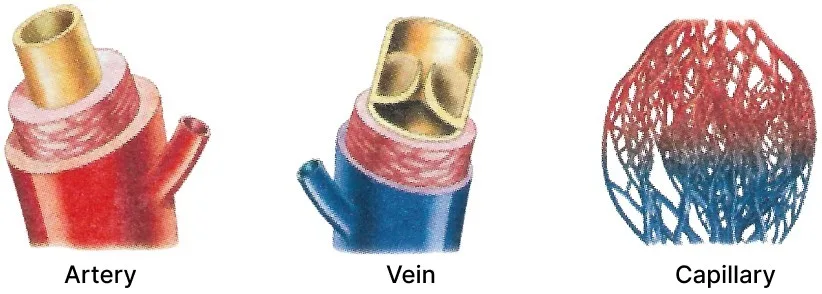
The three kinds of blood vessels found in human beings are Arteries, Veins and Capillaries.
Below diagram shows the differences between Artery, Vein and Capillaries:
Name the three kinds of blood vessels found in human beings. With the help of suitable diagrams, differentiate between them. The Circulatory System, Concise Biology Solutions ICSE Class 6.
| Arteries | Veins | Capillaries |
|---|---|---|
| An artery is a vessel which carries the blood away from the heart to other parts of the body. | A vein is a vessel which carries the blood from an organ towards the heart. | Capillaries are the terminal branches of an artery, which rejoin to form a vein. |
| An artery has thick, elastic and more muscular walls. | A vein has thin and less muscular walls with valves. | Walls of the capillary are made up of single layer of cells (endothelium) with no muscles. |
| The blood in it flows with jerk and under great force. | The valves prevent the back flow of the blood flowing towards the heart. | The wall of capillary is very thin, to enable an exchange of nutrients waste products and gases between the blood and the body fluids. |
2Question 2State briefly, the difference between white blood cells and the red blood cells.+
State briefly, the difference between white blood cells and the red blood cells.
Difference between White blood cells and Red blood cells:
| White Blood Cells | Red Blood Cells |
|---|---|
| WBCs are amoeboid having irregular shape. | RBCs are circular or biconcave disc shaped. |
| WBCs have distinct oval or lobed nucleus. | RBCs do not have nucleus at maturity. |
| WBCs are larger than RBCs. | RBCs are small in size. |
| WBCs are colourless and they lack haemoglobin. | RBCs have red colour due to the presence of haemoglobin protein. |
| WBCs provide immunity by destroying the disease causing germs and producing antibodies. | RBCs carry oxygen from lungs to all the body tissues and cells and remove carbon dioxide produced in the cells and carry it back to the lungs. |
3Question 3You can see some blood vessels on the outside of the hands specially in older people. Are those veins or arteries? How can you confirm your answer?+
You can see some blood vessels on the outside of the hands specially in older people. Are those veins or arteries? How can you confirm your answer?
These blood vessels seen on the outside of the hands are Veins. Usually, arteries are deeply placed in the body whereas Veins are placed more superficially.
4Question 4Given alongside is a diagram of human heart showing its internal structure. Label the parts marked 1 to 5, and answer the following questions. Given alongside is a diagra+
Given alongside is a diagram of human heart showing its internal structure. Label the parts marked 1 to 5, and answer the following questions.
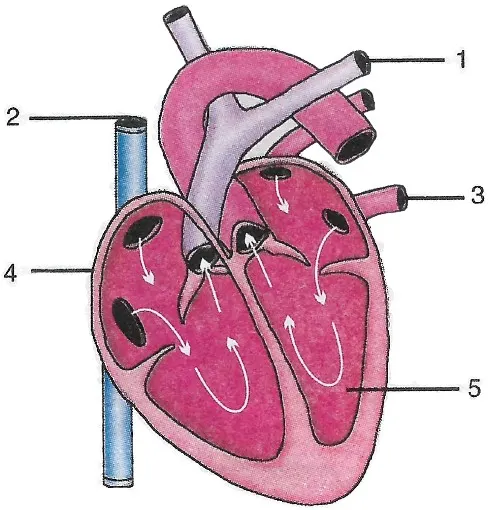
Given alongside is a diagram of human heart showing its internal structure. Label the parts marked 1 to 5. The Circulatory System, Concise Biology Solutions ICSE Class 6.
The marked parts are:
Left pulmonary artery
Superior vena cava
Left pulmonary vein
Right auricle
Left ventricle
a) Deoxygenated blood is carried by the blood vessel marked 2 (Superior vena cava).
b) Aorta
c) Left auricle
5Question 5(i)Distinguish between arteries and veins on the basis of their structure.+
Distinguish between arteries and veins on the basis of their structure.
Differences between arteries and veins on the basis of their structure:
| Arteries | Veins |
|---|---|
| Arteries have thick, elastic and muscular walls to withstand high pressure. | Veins have thin and less muscular walls as the blood pressure is lower. |
| They lack valves (except the pulmonary trunk and the aorta). | Valves are usually present to prevent the backflow of blood. |
| Arteries are usually, deeply placed in the body. | Veins are usually placed more superficially. |
6Question 5(ii)Distinguish between atria and ventricles on the basis of their location in the heart.+
Distinguish between atria and ventricles on the basis of their location in the heart.
Differences between atria and ventricles on the basis of their location in the heart:
| Atria | Ventricles |
|---|---|
| The atria are the two upper chambers of the heart. | The ventricles are the two lower chambers of the heart. |
7Question 5(iii)Distinguish between Blood groups 'AB' and 'O' on the basis of antigens.+
Distinguish between Blood groups 'AB' and 'O' on the basis of antigens.
Differences between Blood groups 'AB' and 'O' on the basis of antigens:
| Blood group 'AB' | Blood group 'O' |
|---|---|
| The persons whose RBCs have both types of antigens, i.e. both A and B, belong to the 'AB' blood group. | The persons whose RBCs have no antigens, i.e., neither A nor B have the 'O' blood group. |
8Question 5(iv)Distinguish between pulmonary and systemic circulation on the basis of direction of blood flow.+
Distinguish between pulmonary and systemic circulation on the basis of direction of blood flow.
Differences between pulmonary and systemic circulation on the basis of direction of blood flow:
| Pulmonary Circulation | Systemic Circulation |
|---|---|
| In pulmonary circulation, the blood flows from the heart to the lungs and back to the heart. | In systemic circulation, the blood flows from the heart to the entire body (except lungs) and back to the heart. |
9Question 5(v)Distinguish between pulmonary artery and pulmonary vein on the basis of the kind of blood they carry.+
Distinguish between pulmonary artery and pulmonary vein on the basis of the kind of blood they carry.
Differences between pulmonary artery and pulmonary vein on the basis of the kind of blood they carry:
| Pulmonary Artery | Pulmonary Vein |
|---|---|
| The pulmonary artery carries deoxygenated blood from the heart to the lungs. | The pulmonary vein carries oxygenated blood from the lungs back to the heart. |
Case Study Question
Apply circulatory-system concepts to Kritika’s real-life situation.
1Question 1Kritika is a 12-year-old girl who recently began feeling unusually tired and short of breath. She loves sports and normally plays and runs with ease. But these days, even+
Kritika is a 12-year-old girl who recently began feeling unusually tired and short of breath. She loves sports and normally plays and runs with ease. But these days, even simple activities like climbing stairs or walking to school leave her out of breath. One evening, she feels her heart racing and beating fast. She can even feel the thumping in her chest. Answer the following questions:
Frequently Asked Questions
Quick revision answers for the most important chapter concepts.
What is the circulatory system?+
The circulatory system is the body system made up of the heart, blood and blood vessels. It transports oxygen, nutrients, hormones and wastes throughout the body.
What are the three main types of blood vessels?+
The three main types are arteries, veins and capillaries.
What is the function of red blood cells?+
Red blood cells contain haemoglobin and transport oxygen from the lungs to body tissues.
What is the function of white blood cells?+
White blood cells protect the body by destroying disease-causing germs and producing antibodies.
Why are platelets important?+
Platelets help blood to clot, reducing blood loss from cuts and wounds.
Which artery carries deoxygenated blood?+
The pulmonary artery carries deoxygenated blood from the right ventricle to the lungs.
Which vein carries oxygenated blood?+
The pulmonary veins carry oxygenated blood from the lungs to the left atrium of the heart.
Which instrument measures blood pressure?+
A sphygmomanometer is used to measure blood pressure.





0 Comments