
Cell — The Structure and Functions
Learn cell structure through animated cards, instant-answer quizzes, comparison tables, diagram placeholders and exam-ready explanations.

Quick Concept Map
Revise the chapter in less than a minute.
Multiple Choice Questions
Select an option and check your answer instantly.
Identify the part which contains pigment:
Plastids are special organelles found in plant cells. Chloroplasts and chromoplasts contain pigments, while leukoplasts are colourless.
The organelle that controls all activities in a cell is:
The nucleus regulates and coordinates the life processes of the cell, so it is called the control centre of the cell.
A cell described as spherical in this textbook exercise is:
The expected textbook answer is red blood cell. Scientific note: a mature human red blood cell is actually a biconcave disc and appears circular in a front view.
The vacuole contains:
Vacuoles contain cell sap, which is mainly water with dissolved salts, sugars, pigments and other substances.
The microscope commonly used in school laboratories is:
A compound microscope uses more than one lens and is commonly used to observe prepared slides, cells and microorganisms.
Which lens is used in a simple microscope?
A simple microscope uses one convex or biconvex lens to produce a magnified image.
Which of the following is not a unicellular organism?
Spirogyra is a multicellular, filamentous green alga made of many cells joined end-to-end.
The outer boundary of an animal cell is known as:
The plasma membrane, also called the cell membrane, surrounds the cytoplasm and controls movement of substances into and out of the cell.
The definite number of chromosomes in a human body cell is:
A normal human body cell has 46 chromosomes arranged in 23 pairs. A human gamete has 23 single chromosomes.
Which of the following is treated as a non-living cell inclusion in this chapter?
In this school-level classification, vacuoles and their stored cell sap are treated as non-living inclusions of the cytoplasm.
Assertion–Reason Questions
Open each card to compare the assertion and reason.
Question 2(1) — Assertion and Reason
Assertion: Every organism, whether big or small, begins its life as a single cell.
Reason: The size of a single cell varies among different organisms.
Both A and R are true, but R is not the correct explanation of A.
Most multicellular organisms begin as one cell, such as a zygote. Cell size does vary, but that fact does not explain why life begins from a single cell.
Question 2(2) — Assertion and Reason
Assertion: Root hairs are important because they absorb water and dissolved minerals needed for photosynthesis.
Reason: Photosynthesis occurs in the chloroplasts of leaf cells.
Both A and R are true, but R is not the correct explanation of A.
Root hairs absorb water and minerals, while photosynthesis mainly occurs in leaf chloroplasts. The reason is true but does not directly explain the role of root hairs.
Question 2(3) — Assertion and Reason
Assertion: The cell membrane is selectively permeable because it allows only certain substances to enter or leave.
Reason: The cell membrane acts as a rigid barrier protecting cells from mechanical injury and pathogen attack.
A is true, but R is false.
The cell membrane is flexible and selectively permeable. In plant cells, the rigid cell wall provides major mechanical support and protection.
Question 2(4) — Assertion and Reason
Assertion: The nucleus contains a definite number of chromosomes in the body cells of each species.
Reason: Chromosomes carry genes that transmit characteristics from parents to offspring.
Both A and R are true, and R is the correct explanation of A.
Chromosomes are present in the nucleus and carry genes, the hereditary units responsible for inherited characteristics.
Question 2(5) — Assertion and Reason
Assertion: Leukoplasts are colourless plastids because they do not contain pigments.
Reason: Leukoplasts have no important role in plants because they lack pigments.
A is true, but R is false.
Leukoplasts are colourless but important. They store food materials such as starch, proteins and oils.
Match the Following
Connect each cell or organism with its characteristic shape.
| Column A | Correct match |
|---|---|
| Paramecium | Slipper-shaped |
| White blood cell | Amoeboid |
| Smooth muscle cell | Spindle-shaped |
| Spirogyra | Cylindrical cells arranged in a filament |
| Red blood cell | Biconcave disc; appears circular in front view |
Fill in the Blanks
Tap or hover over each answer card while revising.
Identify the Cellular Structure
Use each clue to recall the correct term.
1. Colourless, translucent, viscous liquid between the cell membrane and nuclear membrane.
Cytoplasm
2. It contains chromosomes.
Nucleus — the chromosomes lie in the nucleoplasm inside the nucleus.
3. It traps solar energy for photosynthesis.
Chloroplast
4. Selectively permeable, thin, delicate and flexible membrane.
Cell membrane or plasma membrane
5. Hereditary unit located on chromosomes.
Gene
Name the Scientist
Textbook-oriented answers for this chapter.
| Contribution | Scientist |
|---|---|
| Developed powerful simple microscopes | Antonie van Leeuwenhoek |
| Used a compound microscope to observe cork and coined “cell” | Robert Hooke |
Short Answer Questions
Open each question for a clean, exam-ready answer.
1. Name the scientist who developed a powerful simple microscope.
Antonie van Leeuwenhoek developed powerful simple microscopes and used them to observe microscopic life.
2. Who coined the term “cell”?
Robert Hooke coined the term cell after observing thin slices of cork.
3. Describe the three essential parts of a cell.
The three essential parts are the cell membrane, cytoplasm and nucleus.
- Cell membrane: A thin, living, flexible and selectively permeable boundary around the cell.
- Cytoplasm: A semi-liquid, colourless and translucent substance between the cell membrane and nucleus.
- Nucleus: Usually a rounded structure that regulates and coordinates cell activities and helps in cell division.
4. Why is the cell membrane called selectively permeable?
It allows only certain substances to enter or leave the cell while restricting others.
5(i). Differentiate between nucleus and nucleolus.
| Nucleus | Nucleolus |
|---|---|
| A usually spherical structure located in the cytoplasm. | A small, darker body present inside the nucleus. |
| Controls and coordinates cell activities. | Helps form ribosomes and supports protein synthesis. |
5(ii). Differentiate between cytoplasm and protoplasm.
| Cytoplasm | Protoplasm |
|---|---|
| The semi-liquid substance inside the cell membrane but outside the nucleus. | The total living substance of the cell. |
| Excludes the nucleus. | Includes the cytoplasm and nucleus. |
5(iii). Differentiate between cell wall and cell membrane.
| Cell wall | Cell membrane |
|---|---|
| Present in plant cells. | Present in both plant and animal cells. |
| Non-living and rigid. | Living, thin and flexible. |
| Freely permeable. | Selectively permeable. |
6. List the major differences between plant and animal cells.
| Plant cell | Animal cell |
|---|---|
| Has a cell wall. | Has no cell wall. |
| Usually has a thin layer of cytoplasm near the boundary. | Cytoplasm is generally denser and fills more of the cell. |
| Plastids are present. | Plastids are absent. |
| Usually has one large, prominent vacuole. | Usually has small, temporary vacuoles. |
7. Explain the importance of chromosomes.
Chromosomes contain genes. Genes carry hereditary information and help transmit characteristics from parents to offspring.
8. Fill in the blanks using: pigments, wall, pre-existing, cell, vacuoles.
- The cell is the structural unit of all living things.
- All cells arise from pre-existing cells.
- Animal cells have no cell wall.
- Plastids contain pigments.
- Vacuoles are filled with water and dissolved substances.
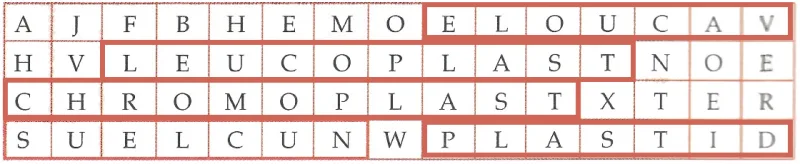
9. Find four cell organelles hidden in the maze.
Answers: Vacuole, Leucoplast, Chromoplast and Plastid.
10. Name the following.
- Three essential parts: Cell membrane, cytoplasm and nucleus.
- Three types of plastids: Chloroplasts, chromoplasts and leukoplasts.
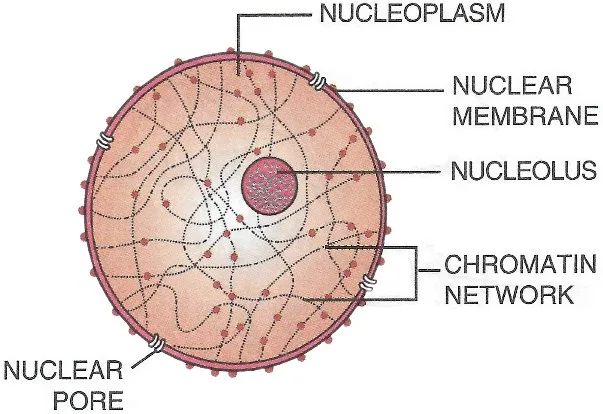
- Five parts of a nucleus: Nuclear membrane, nucleoplasm, nucleolus, chromatin network and nuclear pores.
- Two structures found only in plant cells: Cell wall and plastids.
- Two membranes based on permeability: Freely permeable cell wall and selectively permeable cell membrane.
11. Write one important role of each structure.
12. Define cell, cytology, protoplasm, cytoplasm and chloroplast.
- Cell
- The basic structural and functional unit of all living organisms.
- Cytology
- The scientific study of cells, including their structure and functions.
- Protoplasm
- The living substance of a cell, consisting of cytoplasm and nucleus.
- Cytoplasm
- A semi-liquid, colourless and translucent substance between the cell membrane and nucleus.
- Chloroplast
- A green plastid containing chlorophyll that traps solar energy for photosynthesis.
Long Answer Questions
Detailed answers with responsive diagram placeholders.
1. Describe the structure of the nucleus and mention two functions.
The nucleus is usually a small, rounded structure located near the centre of the cytoplasm. It is enclosed by a delicate, porous nuclear membrane. The inside contains nucleoplasm, a darker nucleolus and chromosomes made of chromatin.
Functions:
- It regulates and coordinates the life processes of the cell.
- It plays an important role in cell division.
2. Who coined the term “cell”? How many lenses did he use and what did he observe?
Robert Hooke coined the term “cell”. He used a compound microscope with two lenses. He examined a thin slice of dead cork and saw many small, box-like compartments arranged together.
3. Name the three essential parts of a cell and describe the cell membrane.
The three essential parts are cell membrane, cytoplasm and nucleus.
The cell membrane, also called the plasma membrane, surrounds the cell. It is thin, delicate, living and flexible. Fine pores and transport proteins allow only selected substances to pass through, so it is described as selectively permeable.
4. Write four points showing the significance of cell division.
Cell division produces new cells needed for:
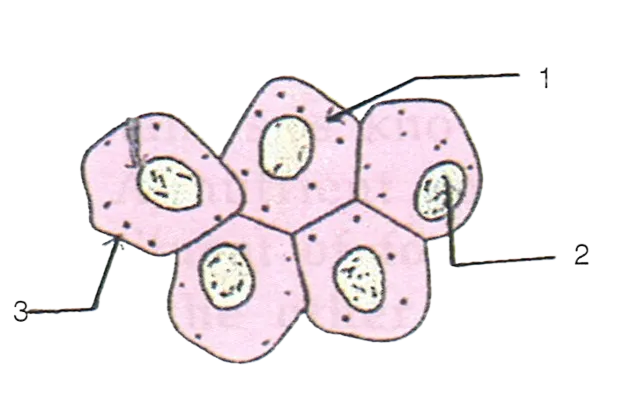
5. Study the diagram of human cheek cells and answer.
- Cell type: Human cheek cells.
- Labels: 1 → Cytoplasm, 2 → Nucleus, 3 → Cell membrane.
- Control centre: Part 2, the nucleus.
- Stain: Methylene blue.
- Chromosomes: 46 chromosomes, arranged in 23 pairs, in a normal human cheek cell nucleus.
6. Study the animal-cell diagram and answer.
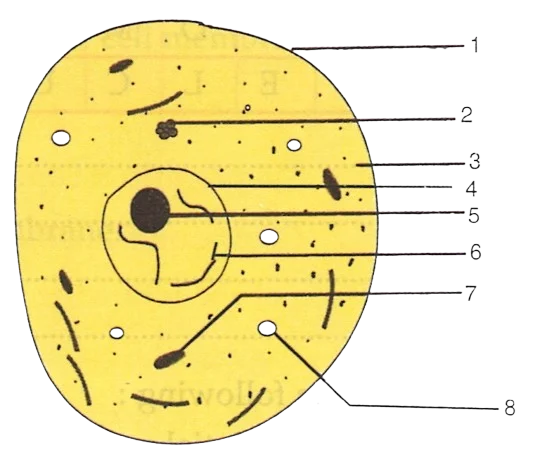
- Cell type: Animal cell, because it has no cell wall or plastids and has small vacuoles.
- Labels: 1 Cell membrane; 2 Centrosome; 3 Cytoplasm; 4 Nucleus; 5 Nucleolus; 6 Chromosomes; 7 Mitochondria; 8 Vacuole.
- Different sizes in plant and animal cells: Vacuole.
- Covering of part 4: Nuclear membrane.
- Any two organelles: Mitochondria and vacuoles.
Case Study Question
Pond-water organisms and the relationship between cell shape and function.
Classroom Pond-Water Activity
Students collected dirty, greenish pond water. They could not see organisms with the naked eye, but under a microscope they observed tiny organisms moving without visible hands or legs.
Frequently Asked Questions
Fast revision answers for common doubts.
What is a cell?+
A cell is the basic structural and functional unit of all living organisms.
What are the three essential parts of a cell?+
The three essential parts are the cell membrane, cytoplasm and nucleus.
Why is the cell membrane selectively permeable?+
It permits only certain substances to enter or leave the cell while restricting others.
Which structures are found only in plant cells?+
A cell wall and plastids are characteristic structures of plant cells.
What is the function of the nucleus?+
The nucleus regulates and coordinates cell activities and plays an important role in cell division.
What are the three types of plastids?+
The three main types are chloroplasts, chromoplasts and leukoplasts.
How many chromosomes are present in a human body cell?+
A normal human body cell has 46 chromosomes arranged in 23 pairs.
Why do cells have different shapes?+
A cell's shape is adapted to the particular function it performs.





0 Comments