
Interactive ICSE Learning • Class 6
Water Concise Chemistry Solutions
Explore the states of water, natural sources, solutions, purification, pollution, conservation and case studies through animated notes, instant MCQ checking and revealable answers.

Educational water image from Unsplash.
Interactive states of water
Select a state to observe how the particle arrangement changes.
Water-cycle pathway
Follow the continuous circulation of water in nature.
Class 6 Chemistry • Water
Exercise I — Objective Type Questions
According to the textbook, the approximate water content of the human body is:
View answer and explanation
The purest form of natural water is:
View answer and explanation
Sea water contains a large amount of dissolved salts and impurities. River water contains suspended particles, microorganisms, and dissolved substances. Lake water contains impurities like mud, algae, and microorganisms.
When the water vapour changes into tiny droplets of water near the ground, it is called:
View answer and explanation
Water is a:
View answer and explanation
Which of the following is a source of underground water?
View answer and explanation
Under normal conditions, water exists as a:
View answer and explanation
The most suitable source of water for domestic and industrial uses is :
View answer and explanation
Sea water is not suitable directly because it contains high amounts of salt and needs expensive desalination. Spring water is limited in quantity and not sufficient for large-scale industrial use. Rain water is seasonal and not continuously available in required amounts.
Class 6 Chemistry • Water
Exercise I — One word answer type
What are the three states of water?
Tap to reveal the answer
The three states of water are
Class 6 Chemistry • Water
Exercise I — Short Answer Type Questions
Name:
Tap to reveal the answer
- Surface water
- Underground water
- River and lake water
- Ocean water
- Well water
- Spring water
List three major impurities present in river water.
Tap to reveal the answer
- Clay
- Sand particles
- Harmful bacteria
Answer the following questions in brief:
Tap to reveal the answer
Find the percentage of water in the following:
Tap to reveal the answer
Class 6 Chemistry • Water
Exercise I — Long Answer Type Questions
What is water cycle? State two important roles of water cycle in nature.
Tap to reveal the answer
The change of water from one form to another in nature, which results in its continuous circulation from earth's surface to the atmosphere and from the atmosphere back to the earth's surface is called water cycle.
Two important roles of water cycle in nature :
Water cycle helps in restoring the lost water from the earth's surface and maintaining the balance of underground water.
The rain water is very important because agricultural production depends mainly on rains in many parts of the world.
Give reason:
Rain water is considered the purest form of natural water.
Tap to reveal the answer
Rain water is the purest form of water, formed by the evaporation of water from water bodies on the earth's surfaces, followed by condensation of its vapour. The only impurities present in rain water are dust and dissolved, non-poisonous gases of air.
Give reason:
Spring water is pure enough for drinking but unsuitable for laboratory use.
Tap to reveal the answer
Spring water may be comparatively clear because layers of soil and rock filter many suspended particles. However, it can still contain dissolved minerals, salts and microorganisms. It should be tested or treated before drinking, and it is unsuitable for laboratory work because it is not chemically pure.
Give reason:
The taste of spring water differs at different places.
Tap to reveal the answer
The dissolved impurities in well water and spring water depend on the nature of the soil surrounding the spring or well. Therefore, the taste of spring water differs at different places.
Give reason:
Ice, water and steam are considered to have the same chemical composition.
Tap to reveal the answer
Ice, water and steam seem to be different substances, because they have different physical properties. However, chemically, they are identical. Therefore, ice, water and steam are said to be the same chemical substance in different physical states.
How are the following formed ?
Tap to reveal the answer
Class 6 Chemistry • Water
Exercise II — Objective Type Questions
Common salt is obtained from sea water by:
View answer and explanation
Distillation is used to obtain pure water from a solution, not to collect salt. Crystallisation can be used to purify salts further, but the basic method of obtaining salt from seawater is evaporation. Sublimation is used for solids that directly change into gas (like camphor), not for salt.
The substance which is insoluble in water :
View answer and explanation
Sugar, sodium carbonate and salt are soluble in water and dissolves easily.
A substance in which another substance is dissolved to form a solution is called:
View answer and explanation
A solute is the substance that gets dissolved (e.g., salt in saltwater). A precipitate is an insoluble solid that separates out from a solution.
The most frequently used solvent is:
View answer and explanation
Alcohol is used as a solvent in some cases, but not as common as water. Vinegar is a solution itself (acetic acid in water), not a general solvent. Carbon disulphide is a specialized solvent used in limited industrial applications.
The substance which gets dissolved in a solvent to form a solution is called :
View answer and explanation
Residue is the solid left behind after filtration or evaporation. Sediment is the solid that settles at the bottom of a liquid. Sublimate is a substance that directly changes from solid to gas on heating.
The solubility of most solid solutes in water generally:
View answer and explanation
Class 6 Chemistry • Water
Exercise II — Short Answer Type Questions
Identify the solute and solvent in the following solutions:
Tap to reveal the answer
Define:
Tap to reveal the answer
Why is water called a universal solvent ?
Tap to reveal the answer
Water has the ability to dissolve most of the solid, liquid and gaseous substances in itself, therefore it is often termed as the universal solvent.
Class 6 Chemistry • Water
Exercise II — Long Answer Type Questions
Tap to reveal the answer
Class 6 Chemistry • Water
Exercise III — Objective Type Questions
Chlorination of water is done to :
View answer and explanation
Suspended impurities are removed by filtration or sedimentation, not chlorination. Dissolved impurities are removed by processes like distillation, not chlorination.
A method used to kill harmful germs present in water is:
View answer and explanation
The settling of suspended solid matter at the bottom of a liquid is called sedimentation. Germs cannot exist at the temperature of boiling water. Filtration removes suspended particles but does not reliably kill germs.
Sea water is not fit for drinking because it contains a large amount of:
View answer and explanation
Sea water may contain some, but this is not the main reason it is unfit to drink. Sea water does not contain sugar in significant amounts.
The gas which adds taste to water is:
View answer and explanation
Dissolved oxygen is important for aquatic life but does not affect the taste of water. Nitrogen is mostly inert and does not change the taste of water. Hydrogen does not exist freely in water in a way that affects taste.
Distilled water is:
View answer and explanation
Saltiness comes from dissolved salts, which are absent in distilled water. Sugar is not present in water naturally. Sour taste comes from acids, which are not present in distilled water.
Which of the following is a water-borne disease?
View answer and explanation
Influenza is an airborne disease spread through droplets in the air. COVID-19 is an air-borne disease, spread through respiratory droplets. Malaria spreads by the bite of infected mosquitoes, not water.
Class 6 Chemistry • Water
Exercise III — Short Answer Type Questions
Name:
Tap to reveal the answer
Define:
Tap to reveal the answer
What is the taste of distilled water? Why is it not potable ?
Tap to reveal the answer
Distilled water is nearly tasteless because dissolved salts and minerals have been removed. Properly prepared distilled water can be safe to drink, but it has a flat taste and is not normally chosen as everyday drinking water. Potable water must mainly be free from harmful germs and unsafe impurities.
Answer in brief:
Tap to reveal the answer
Class 6 Chemistry • Water
Exercise III — Long Answer Type Questions
Name the steps involved in the purification of drinking water supplied in cities and towns.
Tap to reveal the answer
Steps involved in the purification of drinking water are:
Give reason:
Ice floats on water.
Tap to reveal the answer
Ice is less dense than liquid water because its molecules form a more open structure on freezing. Therefore, ice floats on water.
Give reason:
Marine life is able to survive in colder regions.
Tap to reveal the answer
The anomalous property of ice to float on water enables aquatic plants and animals to survive in colder regions of the world because even when the water of ponds, lakes and rivers freezes, it freezes on the top but remains liquid below the ice layer.
Give reason:
Water droplets can be seen outside a chilled water bottle.
Tap to reveal the answer
Fine water droplets get deposited on the outer wall of the water bottle. Due to the cold surface of the chilled water bottle, the water vapour present in the air condenses into water droplets.
What is potable water? List four characteristics of potable water.
Tap to reveal the answer
Water fit for drinking purposes is called potable water.
Drinking water should have the following characteristics:
It should be colourless and odourless.
It should be transparent.
It should be free from harmful micro-organisms or germs which cause infections and diseases.
It should be free from suspended impurities and other harmful substances.
What are the three methods of removing germs from natural water? Explain.
Tap to reveal the answer
The process of removing germs from water is called sterilization.
It can be done by following three methods :
Class 6 Chemistry • Water
Exercise IV — Objective Type Questions
Water pollution is caused due to the addition of:
View answer and explanation
One of the methods to control water pollution is:
View answer and explanation
Excess rainfall may cause:
View answer and explanation
Conservation of water can be done by :
View answer and explanation
Rainwater harvesting collects and stores rainwater for future use. Planting trees and plants. Plants help in maintaining the water cycle and increasing groundwater recharge. Prevent unnecessary wastage of water.
Class 6 Chemistry • Water
Exercise IV — Assertion Reason Type Questions
Assertion: The sea water is saline.
Reason: The sea water contains many dissolved salts and minerals.
View answer and explanation
R is true as sea water contains many dissolved salts and minerals.
Therefore, Both A and R are true and R is the correct explanation of A is the correct option.
Assertion: Water is a universal solvent.
Reason: Water has the ability to dissolve most of the solid, liquid and gaseous substances in it.
View answer and explanation
R is true as water can dissolve a large number of substances.
Therefore, Both A and R are true and R is the correct explanation of A is the correct option.
Assertion: Water is a mixture.
Reason: Water is made up of hydrogen and oxygen combined together in a 2:1 ratio by volume.
View answer and explanation
Therefore, A is false and R is true is the correct option.
Assertion: Seeds need water to germinate and grow into plants.
Reason: Ice, liquid water and steam have different physical and chemical properties.
View answer and explanation
Therefore, A is true and R is false is the correct option.
Class 6 Chemistry • Water
Exercise IV — Fill in the Blanks
Fill in the blanks:
Tap to reveal the answer
Class 6 Chemistry • Water
Exercise IV — State True or False
Write true or false for the following statements:
Tap to reveal the answer
Class 6 Chemistry • Water
Exercise IV — Match the Following
Match the following:
| Column A | Column B |
|---|---|
| (a) A solution in which more solute can be dissolved. | (1) Solution |
| (b) A medium in in which a substance dissolves. | (2) Unsaturated solution |
| (c) A homogeneous mixture. | (3) Solvent |
Tap to reveal the answer
| Column A | Column B |
|---|---|
| (a) A solution in which more solute can be dissolved. | (2) Unsaturated solution |
| (b) A medium in in which a substance dissolves. | (3) Solvent |
| (c) A homogeneous mixture. | (1) Solution |
Class 6 Chemistry • Water
Exercise IV — Short Answer Type Questions
Name two water-borne diseases.
Tap to reveal the answer
Two water-borne diseases are:
- Typhoid
- Cholera
What are effluents?
Tap to reveal the answer
The waste chemicals from industries are called effluents. They get dissolved in water bodies and are toxic to aquatic plant and animal life. They make water unfit for human consumption as well.
What is rainwater harvesting?
Tap to reveal the answer
It is a process where rainwater is collected from the roofs of buildings and then carried with the help of pipes to underground tanks for storage.
What causes
Tap to reveal the answer
Class 6 Chemistry • Water
Exercise IV — Long Answer Type Questions
What are the three main causes of water pollution ?
Tap to reveal the answer
The three main causes of water pollution are :
State four steps to be taken to prevent water pollution.
Tap to reveal the answer
Steps to be taken to prevent water pollution :
The polluted water from industries should be passed through effluent treatment plants so that all the harmful chemicals present are removed from it.
Sources of underground water, like wells, should be covered properly to keep them clean.
Washing and cleaning of utensils and clothes should not be done near sources of water.
Bathing and cleaning of animals in or near sources of water like rivers, lakes and ponds should not be done.
Tap to reveal the answer
The amount of water needed for all the living organisms is not available on earth in abundance.
In agriculture, water is needed in large quantities.
A large amount of water is required in industries.
Wastage of water should be avoided, for example, taps should never be left open.
Do not allow water to drip from defective taps.
More plantations should be done as plants help in bringing rain.
We should use drip irrigation or spray-irrigation system for crops.
Class 6 Chemistry • Water
Case Study Type Questions
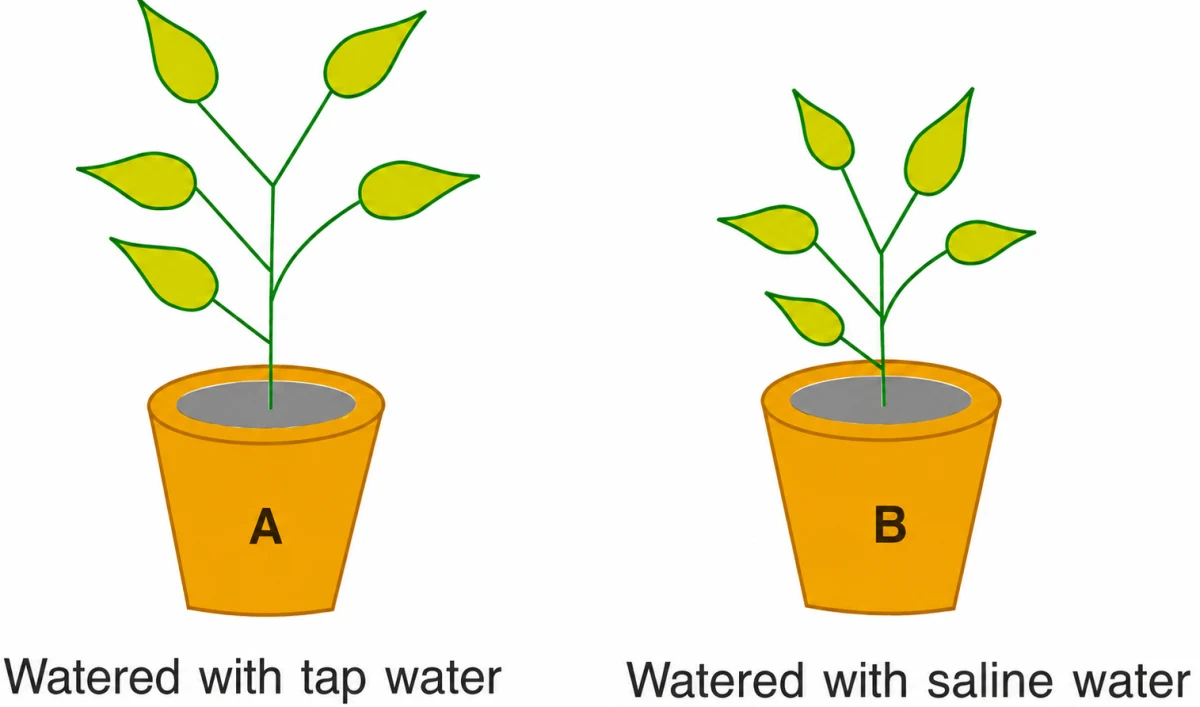
Siya kept two healthy potted plants A and B in sunlight. She watered plant A with tap water and plant B with saline water for a few days regularly. She observed that one of the plants grew well, the other could not.
Tap to reveal the answer
This is because it was watered with saline water, which contains excess salts. High salt concentration makes it difficult for roots to absorb water (due to osmosis), leading to poor growth or even damage to the plant.
During summer, Radha noticed that the ponds near her house became dry. But in the rainy season, those same ponds overflow with water. Curious, she asked her teacher why this happens. Her teacher explained that heat from the sun changes water from rivers, lakes and ponds into water vapour. Water vapour then rises up and forms clouds. When clouds become heavy, they release water back to the earth as rain. This natural process keeps water circulating on the earth.
Tap to reveal the answer
Frequently Asked Questions
What is the chemical formula of water?
The chemical formula of water is H2O. Each molecule contains two hydrogen atoms and one oxygen atom.
Why is water called a universal solvent?
Water is called a universal solvent because it can dissolve a very large number of solid, liquid and gaseous substances.
What is the water cycle?
The water cycle is the continuous movement of water between the earth's surface and the atmosphere through evaporation, condensation, precipitation and collection.
What is potable water?
Potable water is water that is safe and fit for drinking. It should be clear, free from disease-causing microorganisms and free from harmful impurities.
How is drinking water purified in cities?
City water treatment commonly includes sedimentation or loading, filtration, aeration, disinfection such as chlorination, and safe storage.
How can students conserve water?
Students can close taps properly, repair or report leaks, reuse suitable water, avoid unnecessary wastage and support rainwater harvesting.
Learn faster with Speed Up Science
Follow for visual science explanations, quizzes and study updates.
Follow @speedupscience_ on Instagram




0 Comments