
Air and Atmosphere
Explore the composition of air, oxygen and nitrogen, photosynthesis, respiration, combustion, rusting, air pollution and solved textbook exercises.

What is air made of?
Air is a mixture of gases. Its major components retain their own properties and can be separated by physical methods.
Exercise I — Objective Type Questions
Question 1(i) Air consists of:
Air consists of:
only oxygen
only nitrogen
only carbon dioxide
all of these.
all of these.
Reason — The main gases present in air are nitrogen and oxygen. Besides these two gases, air also contains small quantities of carbon dioxide, water vapour, dust particles, smoke and traces of inert gases like helium, neon, argon, etc.
Air contains oxygen, but it is only about 21%, not the only component. Nitrogen is the major part (about 78%), but air also contains other gases. Carbon dioxide is present in a very small amount (about 0.04%) in air.
Question 1(ii) The most abundant gas in Earth's atmosphere is:
The most abundant gas in Earth's atmosphere is:
oxygen
nitrogen
carbon dioxide
argon
nitrogen
Reason — The most abundant gas in Earth's atmosphere is nitrogen. Nitrogen forms about 78% of dry air.
Oxygen is about 21% of the atmosphere, important for breathing, but not the most abundant. Carbon dioxide is present in a very small amount (about 0.04%) in air. Argon makes up about 0.93% of the atmosphere.
Question 1(iii) Which of the following gases supports burning?
Which of the following gases supports burning?
oxygen
nitrogen
carbon dioxide
water vapour
oxygen
Reason — The 'active part' of air, which is used up when substances burn, is called oxygen. It is present about one-fifth of the total volume of the air. Nitrogen does not support burning. It is mostly inactive and even helps in preventing rapid burning. Carbon dioxide does not support burning; it is used in fire extinguishers to put out fires. Water vapour does not support burning; it can actually help in reducing or stopping fire.
Question 1(iv) Air is a mixture because:
Air is a mixture because:
the components of air retain their individual properties.
energy change takes place when the components of air are mixed together.
the composition of air remains the same everywhere.
the components of air cannot be separated by simple physical methods.
the components of air retain their individual properties.
Reason — Air is a mixture because the components of air retain their individual properties. Other options are not true because no energy change takes place, the composition of air varies from place to place and the components of air can be separated by physical methods.
Formation of air does not involve any energy change. The composition of air can vary slightly depending on location. Components of air can be separated by physical methods like fractional distillation of liquid air.
Question 1(v) Oxygen in air is:
Oxygen in air is:
4/5 parts
1/5 parts
1/3 parts
negligible
1/5 parts
Reason — The 'active part' of air i.e., oxygen is present about one-fifth (1/5) of the total volume of the air.
Exercise I — Name the Following
Question 2 Write the chemical name of:
Write the chemical name of:
(a) Lime water
(b) The white insoluble solid formed on reaction of carbon dioxide with lime water.
(a) Calcium hydroxide
(b) Calcium carbonate
Exercise I — Short Answer Type Questions
Question 1 What is atmosphere?
What is atmosphere?
The Earth is surrounded by a thick blanket of gases called the atmosphere. It extends for hundreds of kilometres, becomes progressively thinner with height and gradually merges into space.
Question 2 Why can't we see air?
Why can't we see air?
We cannot see air, because it is colourless, odourless, tasteless, and transparent gaseous matter.
Question 3 What is wind?
What is wind?
Fast moving air is called wind. We can feel the presence of wind.
Question 4 What would have happened if there would have been no atmosphere around the Earth?
What would have happened if there would have been no atmosphere around the Earth?
Atmosphere protects us from harmful rays from the Sun. We could be burnt or frozen if there was no atmosphere around the Earth.
In the absence of the atmosphere, the earth would get very hot during the day and very cold at night that we would not be able to survive.
There would be no life on Earth under such a condition.
Question 5 What do you observe when
What do you observe when
(a) Ice cold water is filled in a glass tumbler.
(b) A burning candle is covered with an inverted jar.
(c) Carbon dioxide gas is passed through lime water.
(d) A beam of light is allowed to enter in a closed dark room through a small hole.
(a) When ice cold water is filled in a glass tumbler, we will observe that fine water droplets get deposited on the outer wall of the glass tumbler. This is due to the cold surface of the glass tumbler, the water vapour present in air get condensed as water droplets. This proves that air contains water vapour.
(b) When we cover the burning candle with an inverted jar, we will notice that after a few minutes, the flame gets extinguished. This is because the oxygen in the air trapped in the inverted jar is used up and the candle does not get any more oxygen for burning.
(c) Carbon dioxide reacts with lime water to form white insoluble calcium carbonate which gives milky white appearance to the solution. This confirms the presence of carbon dioxide in air.
(d) A beam of light is allowed to enter in a closed dark room through a small hole. We will observe randomly moving dust particles in the beam of light. This confirms the presence of dust particles in the air.
Exercise I — Long Answer Type Questions
Question 1 Why is air called a mixture? Give five facts in support of your answer.
Why is air called a mixture? Give five facts in support of your answer.
Air is called a mixture because it is made up of several different gases, dust particles, water vapour, smoke and other impurities that are physically combined, not chemically bonded.
Five facts which show that air is a mixture :
The composition of air varies from place to place and from time to time.
No energy change occurs when the components of air are mixed together.
The components of air retain their individual properties.
Air cannot be represented by a formula as its constituents are not in a fixed proportion.
The components of air can be separated by simple physical methods.
Question 2 What are the main components of air? Write down the composition of the three main gases present in air by volume.
What are the main components of air? Write down the composition of the three main gases present in air by volume.
The main gases present in air are nitrogen and oxygen. Besides these two gases, air also contains small quantities of carbon dioxide, water vapour, dust particles and traces of inert gases like helium, neon, argon, etc. Air also contains smoke as a pollutant.
| Gases | Percentage |
|---|---|
| Nitrogen | 78% |
| Oxygen | 21% |
| Carbon dioxide | 0.03-0.04% |
Exercise II — Objective Type Questions
Question 1(i) Rust is:
Rust is:
hydrated iron oxide
hydrated copper sulphate
anhydrous iron oxide
none of the above
hydrated iron oxide
Reason — The reddish brown powdery mass that gets coated on the surface of some iron object when kept in moist air for a few days is called as rust. It is chemically know as hydrated iron oxide (Fe2O3 · xH2O).
Question 1(ii) Photosynthesis is a process in which plants:
Photosynthesis is a process in which plants:
take in oxygen and give out carbon dioxide
take in carbon dioxide and give out oxygen
take in nitrogen and give out oxygen.
none of the above
take in carbon dioxide and give out oxygen
Reason — Photosynthesis is a process through which green plants prepare their food in presence of sunlight with the help of carbon dioxide and water. In this process carbon dioxide is consumed and oxygen is released.
Question 1(iii) Fuels which do not leave any residue on burning are:
Fuels which do not leave any residue on burning are:
coal and wood
coal and LPG
wood and CNG
LPG and CNG
LPG and CNG
Reason — LPG and CNG are modern day fuels which do not leave any residue on burning.
Coal and wood leave behind ash and smoke after burning, so they produce residue. Coal leaves residue, even though LPG burns cleanly. Wood leaves ash, while CNG burns cleanly.
Question 1(iv) Respiration :
Respiration :
is a slow process
is a natural and continuous process
takes place at body temperature
all of the above
all of the above
Reason — Respiration is a slow, natural and continuous process, and takes place at body temperature.
Question 1(v) Which of the following is common in combustion and respiration?
Which of the following is common in combustion and respiration?
oxygen
release of heat and light
natural process
nitrogen.
oxygen
Reason — Oxygen present in air is required for respiration of all living organisms and without oxygen, burning cannot take place. Hence oxygen is common in combustion and respiration.
Combustion releases heat and light, but respiration releases energy without light. Respiration is a natural biological process, but combustion is not always natural (it can be man-made). Nitrogen does not play a direct role in combustion or respiration.
Question 1(vi) Which gas present in air is required for the synthesis of proteins in plants?
Which gas present in air is required for the synthesis of proteins in plants?
Oxygen
Nitrogen
Ozone
Carbon dioxide
Nitrogen
Reason — Nitrogen is needed to prepare a vital nutrient 'protein'.
Oxygen is used in respiration, not directly for protein synthesis. Ozone does not play a role in protein synthesis. Carbon dioxide is used in photosynthesis to make food (glucose), not proteins directly.
Question 1(vii) Which component of air controls the climatic conditions?
Which component of air controls the climatic conditions?
Inert gases
Oxygen
Water vapour
Nitrogen
Water vapour
Reason — Water vapour present in the air provides moisture and helps in predicting climatic conditions of a particular area. Its amount varies from place to place from time to time.
Inert gases do not actively affect climate. Oxygen is important for respiration, but does not control climate. Nitrogen is most abundant gas, but largely inactive in affecting climatic conditions.
Exercise II — Name the Following
Question 2 Name two important processes supported by oxygen present in air.
Name two important processes supported by oxygen present in air.
Two important processes supported by oxygen present in air are given below:
Respiration
Burning (combustion)
Question 3 Name the gas used in:
Name the gas used in:
(a) weather balloons
(b) traffic lights
(c) electric bulbs
(a) Helium
(b) Neon
(c) Argon
Exercise II — Short Answer Type Questions
Question 1 State the full forms of LPG and CNG
State the full forms of LPG and CNG
The full forms of LPG and CNG are given below:
- LPG — Liquefied Petroleum Gas
- CNG — Compressed Natural Gas
Question 2 Define the following:
Define the following:
(a) Respiration
(b) Photosynthesis
(c) Combustion.
(a) Respiration is a chemical process that takes place in all living beings. In this process, oxygen that we breathe in with air reacts with the digested food in our body. This results in the release of energy, carbon dioxide and water.
(b) Photosynthesis is a process in which carbon dioxide is used by green plants to prepare their food. Oxygen is released during this process which is then used for respiration by both plants and animals.
(c) Burning (Combustion) is a process in which a substance reacts chemically with oxygen and gets oxidised, with the release of energy in the form of heat and light.
Question 3 What are fuels? Give two examples of modern fuels.
What are fuels? Give two examples of modern fuels.
Substances which are burnt to produce large amount of energy in the form of heat and light are known as fuels.
Examples :
Liquefied Petroleum Gas (LPG)
Compressed Natural Gas (CNG)
Question 4 Give two uses of the following components present in air:
Give two uses of the following components present in air:
(a) oxygen
(b) nitrogen
(c) carbon dioxide
(d) water vapour
(a) Oxygen
For respiration in plants and animals
Oxygen is an essential component of burning or combustion
(b) Nitrogen
Nitrogen is needed to prepare a vital nutrient protein.
Nitrogen is used for food packaging and storing food.
(c) Carbon dioxide
Dry ice (solid carbon dioxide) is used as a refrigerant.
Carbon dioxide is used to prepare fizzy drinks like soda-water.
(d) Water vapour
Water vapour present in the air provides moisture for both plants and animals.
It also helps in predicting climatic conditions of a particular area.
Question 5 How is air useful to:
How is air useful to:
(a) water boats
(b) agriculture
(c) windmills
(d) scooters and cars?
(a) Air helps sailboats move. The wind fills the sails and pushes the boat forward.
(b) Air speeds up drying up of wet agricultural products like grains, pulses, fruits and air helps in pollination of flowers and dispersal of seeds.
(c) Windmills move due to the movement of air. They are also used to generate electricity.
(d) Air is filled in tyres of vehicles like cars, scooters, trucks, buses, bicycles, etc. for their smooth movement.
Question 6 What is the importance of dust particles present in air?
What is the importance of dust particles present in air?
Dust particles present in air cause rain as water vapour gets condensed on these particles.
Exercise II — Long Answer Type Questions
Question 1(a) Give reason:
Give reason:
Aquatic animals and plants are able to survive in water.
Oxygen present in air is required for respiration by all living organisms. Aquatic plants and animals use the air (oxygen) dissolved in water for respiration.
Question 1(b) Give reason:
Give reason:
A burning candle stops burning if covered with a glass tumbler.
A burning candle stops burning if covered with a glass tumbler because the oxygen in the air trapped in the inverted glass is used up and the candle does not get any more oxygen for burning.
Question 1(c) Give reason:
Give reason:
Mountaineers and divers carry oxygen cylinders with them.
At higher altitudes, air pressure is lower, so less oxygen enters the lungs with each breath and breathing becomes difficult. Divers cannot breathe atmospheric air underwater, and people in oxygen-deficient enclosed spaces may also need breathing equipment. Therefore, mountaineers and divers carry suitable oxygen or compressed-air breathing systems.
Question 1(d) Give reasons:
Give reasons:
When water is heated, we see bubbles rising up.
When water is heated, we see bubbles rising up because these bubbles come from the air dissolved in water.
Question 2 State two similarities and two differences between respiration and burning.
State two similarities and two differences between respiration and burning.
The similarities and differences between respiration and burning are given below:
Respiration Burning (Combustion)
Similarities 1. Oxygen is required
2. Carbon dioxide and water vapour are formed. 1. Oxygen is required
2. Carbon dioxide and water vapour are formed.
Differences 1. It is a slow process
2. A natural and continuous process 1. It is a fast process
2. An artificial and discontinuous process.
Question 3 Define rusting. What are the two necessary conditions for rusting of iron? Give the chemical name of rust.
Define rusting. What are the two necessary conditions for rusting of iron? Give the chemical name of rust.
Rusting is a chemical process which takes place in presence of moist air. When some iron objects like iron scraps or bright iron nails are kept in moist air for a few days, their surface gets coated with a reddish brown powdery mass which is commonly called rust.
Conditions for rusting :
Presence of Air (oxygen)
Presence of Moisture (water)
Chemical name of rust : Hydrated iron oxide (Fe2O3 · xH2O)
Question 4 Name the processes which maintain the balance between oxygen and carbon dioxide in the air. How is it done?
Name the processes which maintain the balance between oxygen and carbon dioxide in the air. How is it done?
Photosynthesis and respiration together help maintain the balance of oxygen and carbon dioxide in air. Green plants use carbon dioxide and release oxygen during photosynthesis, while living organisms use oxygen and release carbon dioxide during respiration. Combustion also uses oxygen and releases carbon dioxide. Photo means light and synthesis means putting together.
It is a process through which green plants prepare their food in presence of sunlight with the help of carbon dioxide and water. The food is prepared in the form of glucose (a carbohydrate) with the release of oxygen gas.
In photosynthesis, plants use carbon dioxide from the air, water from the soil and give out oxygen.
This process takes place only in green plants because they contain a green pigment called chlorophyll which is able to trap solar energy from the sun.
Question 5 (a) Why is nitrogen important to all living beings?
(a) Why is nitrogen important to all living beings?
(b) What is nitrogen fixation?
(a) Importance of Nitrogen
Nitrogen is needed to prepare a vital nutrient 'protein'. Every living being needs proteins for its growth.
Nitrogen dilutes the effect of oxygen present in air. Thus, it controls combustion as it does not support burning.
Manufacture of fertilizers and various nitrogenous products.
Nitrogen is used in the food industry for food packaging and storing food in containers as it is inert and prevents food from becoming stale.
(b) Nitrogen fixation is the process by which free nitrogen of air is converted into nitrogen compounds like nitrites and nitrates which are useful plant nutrients to produce proteins.
Exercise III — Objective Type Questions
Question 1(i) Air pollution is caused due to :
Air pollution is caused due to :
cutting of green plants
smoke given out by factories
gases like carbon monoxide, sulphur dioxide, etc.
all of the above.
all of the above
Reason — Air pollution is the presence of harmful substances in the air that can affect human health, animals, plants, and the environment. It is caused by cutting green plants, smoke given out by factories and harmful gases like carbon monoxide and sulphur dioxide.
Question 1(ii) The gases which cause acid rain are:
The gases which cause acid rain are:
sulphur dioxide and oxygen
nitrogen and oxygen
carbon dioxide and water vapour
nitrogen dioxide and sulphur dioxide.
nitrogen dioxide and sulphur dioxide
Reason — Gases like sulphur dioxide and nitrogen dioxide (pollutant) get mixed in rain water to form acid rain.
Oxygen alone does not cause acid rain. Nitrogen and oxygen are normal components of air and do not form acid rain under usual conditions. Carbon dioxide and water vapour can form weak carbonic acid, but this is not the main cause of acid rain.
Question 1(iii) Which of the following is not a greenhouse gas?
Which of the following is not a greenhouse gas?
Carbon dioxide
Sulphur dioxide
Methane
Nitrous oxide
Sulphur dioxide
Reason — Greenhouse gases are carbon dioxide, methane and nitrous oxide, which trap more heat from sunlight. In contrast, sulphur dioxide is not a greenhouse gas.
Carbon dioxide is an important greenhouse gas that contributes to global warming. Methane is a very powerful greenhouse gas released from sources like wetlands and livestock. Nitrous oxide also contributes to global warming.
Question 1(iv) Common air pollutants that cause respiratory diseases are:
Common air pollutants that cause respiratory diseases are:
ozone
inert gases
dust and smoke
water vapour
dust and smoke
Reason — Common air pollutants like dust and smoke cause respiratory, skin and eye problems. Ground-level ozone can be harmful. Inert gases are harmless and do not affect breathing. Water vapour is a natural component of air and does not cause respiratory diseases.
Question 1(v) The gas responsible for ozone depletion is:
The gas responsible for ozone depletion is:
oxygen
chlorofluorocarbons
carbon dioxide
sulphur dioxide
chlorofluorocarbons
Reason — Air pollutants like chlorofluorocarbons (CFCs) react with the ozone in the atmosphere and reduce the density of ozone in the stratosphere.
Oxygen is a normal component of air and does not cause ozone depletion. Carbon dioxide is a greenhouse gas, not responsible for ozone depletion. Sulphur dioxide causes acid rain, not ozone depletion.
Exercise III — Assertion Reason Type Questions
Question 2(i) Assertion: Air is necessary for burning and respiration.
Assertion: Air is necessary for burning and respiration.
Reason: Air contains oxygen as one of its constituent gases.
Both A and R are true and R is the correct explanation of A.
Both A and R are true and R is not the correct explanation of A.
A is true and R is false.
A is false and R is true.
Both A and R are true and R is the correct explanation of A.
Reason — A is true because air is needed for both burning and respiration.
R is true because air contains oxygen, which supports combustion (burning) and is essential for respiration in living beings.
Therefore, Both A and R are true and R is the correct explanation of A is the correct option.
Question 2(ii) Assertion: Plants release oxygen into the atmosphere.
Assertion: Plants release oxygen into the atmosphere.
Reason: Plants need carbon dioxide for photosynthesis.
Both A and R are true and R is the correct explanation of A.
Both A and R are true and R is not the correct explanation of A.
A is true and R is false.
A is false and R is true.
Both A and R are true and R is not the correct explanation of A.
Reason — A is true as plants release oxygen during the process of photosynthesis.
R is true as plants require carbon dioxide for photosynthesis.
Therefore, Both A and R are true and R is not the correct explanation of A is the correct option.
Question 2(iii) Assertion: Rusting and burning are similar processes in terms of consuming oxygen.
Assertion: Rusting and burning are similar processes in terms of consuming oxygen.
Reason: Rusting is a fast process, while burning is a slow process.
Both A and R are true and R is the correct explanation of A.
Both A and R are true and R is not the correct explanation of A.
A is true and R is false.
A is false and R is true.
A is true and R is false.
Reason — A is true as both rusting and burning involve reaction with oxygen (oxidation), so they are similar in that sense.
R is false as rusting is a slow process, while burning is a fast process.
Therefore, A is true and R is false is the correct option.
Question 2(iv) Assertion: Mountaineers carry oxygen cylinders with them.
Assertion: Mountaineers carry oxygen cylinders with them.
Reason: The density of air is less at higher altitudes.
Both A and R are true and R is the correct explanation of A.
Both A and R are true and R is not the correct explanation of A.
A is true and R is false.
A is false and R is true.
Both A and R are true and R is the correct explanation of A.
Reason — A is true as mountaineers carry oxygen cylinders at high altitudes.
R is true as at higher altitudes, the air is less dense, so it contains less oxygen per unit volume.
Therefore, Both A and R are true and R is the correct explanation of A is the correct option.
Question 2(v) Assertion: Nitrogen is used for food packaging and storing food.
Assertion: Nitrogen is used for food packaging and storing food.
Reason: Nitrogen is relatively unreactive under ordinary conditions and provides a protective atmosphere.
Both A and R are true and R is the correct explanation of A.
Both A and R are true and R is not the correct explanation of A.
A is true and R is false.
A is false and R is true.
Both A and R are true and R is the correct explanation of A.
Reason — A is true as nitrogen is used in the food industry for food packaging and storing food in containers.
R is true as nitrogen is inactive and behaves like an inert gas, so it provides an inert atmosphere and prevents food from becoming stale or rotten.
Therefore, Both A and R are true and R is the correct explanation of A is the correct option.
Exercise III — Fill in the Blanks
Question 3 Fill in the blanks:
Fill in the blanks:
(a) The layer of air around the Earth is called the ............... .
(b) Although we cannot see air, we can ............... it.
(c) Air is a ............... of gases.
(d) Plants and animals maintain the balance of ............... and ............... in air.
(e) Polluted air is ............... for health.
(f) The supporter of combustion in air is ............... .
(g) Green plants need ............... to prepare food.
(h) Oxygen is used in ............... of the food to get ............... .
(i) Aquatic plants and animals use ............... in water.
(j) The reddish brown powder on the surface of iron nails exposed to air and moisture is called ............... .
(a) The layer of air around the Earth is called the atmosphere.
(b) Although we cannot see air, we can feel it.
(c) Air is a mixture of gases.
(d) Plants and animals maintain the balance of oxygen and carbon dioxide in air.
(e) Polluted air is harmful for health.
(f) The supporter of combustion in air is oxygen.
(g) Green plants need carbon dioxide to prepare food.
(h) Oxygen is used in the oxidation of food during respiration to release energy.
(i) Aquatic plants and animals use dissolved oxygen in water.
(j) The reddish brown powder on the surface of iron nails exposed to air and moisture is called rust.
Exercise III — State True or False
Question 4 Write 'true' or 'false' for the following:
Write 'true' or 'false' for the following:
(a) Air is a compound. ...............
(b) Carbon dioxide is given out during photosynthesis. ...............
(c) Respiration needs nitrogen. ...............
(d) The composition of air was discovered by Lavoisier. ...............
(e) The major component of air is oxygen. ...............
- (a) False
- Correct Statement — Air is a mixture.
- (b) False
- Correct Statement — During photosynthesis, oxygen is released and carbon dioxide is absorbed by plants to make food.
- (c) False
- Correct Statement — Respiration needs oxygen.
(d) True
- (e) False
- Correct Statement — The major component of air is nitrogen (78%).
Exercise III — Match the Following
Question 5 Match the following
Match the following
| Column A | Column B |
|---|---|
| (a) Nitrogen | (i) Respiration |
| (b) Dust particles | (ii) Fertilizers |
| (c) Carbon dioxide | (iii) Combustion |
| (d) Heat and light | (iv) Responsible for rain |
| (e) Oxygen | (v) Photosynthesis |
| Column A | Column B |
|---|---|
| (a) Nitrogen | (ii) Fertilizers |
| (b) Dust particles | (iv) Responsible for rain |
| (c) Carbon dioxide | (v) Photosynthesis |
| (d) Heat and light | (iii) Combustion |
| (e) Oxygen | (i) Respiration |
Exercise III — Short Answer Type Questions
Question 1 What is air pollution?
What is air pollution?
Air pollution is the presence of harmful substances in the air that can affect human health, animals, plants, and the environment.
Question 2 Name two air pollutants which
Name two air pollutants which
(a) affect our health,
(b) cause acid rain,
(c) cause global warming.
(a) Dust, smoke
(b) Sulphur dioxide, Nitrogen dioxide
(c) Carbon dioxide, methane
Question 3 Name three greenhouse gases.
Name three greenhouse gases.
Three greenhouse gases are given below:
Carbon dioxide
Methane
Nitrous oxide
Exercise III — Long Answer Type Questions
Question 1 What is meant by ozone depletion?
What is meant by ozone depletion?
Ozone depletion refers to the gradual thinning and reduction of the ozone layer in the Earth's stratosphere due to the release of certain harmful chemicals, especially CFCs (chlorofluorocarbons).
Question 2 Mention five causes of air pollution.
Mention five causes of air pollution.
Five causes of air pollution are given below:
Increase in human population.
Indiscriminate cutting of forests (deforestation).
Burning of fossil fuels.
Emission of harmful gases from vehicles.
An increase in the number of industries near the residential areas.
Question 3 State four steps to be taken to control air pollution.
State four steps to be taken to control air pollution.
Four steps to be taken to control air pollution are given below:
Growing more trees and plants in big cities and towns. Trees absorb carbon dioxide, release oxygen during photosynthesis and can trap some airborne dust on their leaves.
Factories and power plants should install filters, electrostatic precipitators or scrubbers to remove dust and harmful gases before emissions are released.
Vehicles should be maintained regularly, checked for emissions and operated with cleaner fuels or electric power wherever suitable. Public transport and shared travel also help reduce total emissions.
Use cleaner sources such as solar, wind, biogas and electricity generated from low-pollution or renewable sources instead of directly burning fossil fuels.
Question 4 Study the diagram and name the processes A, B and C.
Study the diagram and name the processes A, B and C.
Study the diagram and name the processes A, B and C. Air Atmosphere, Concise Chemistry Solutions ICSE Class 6.
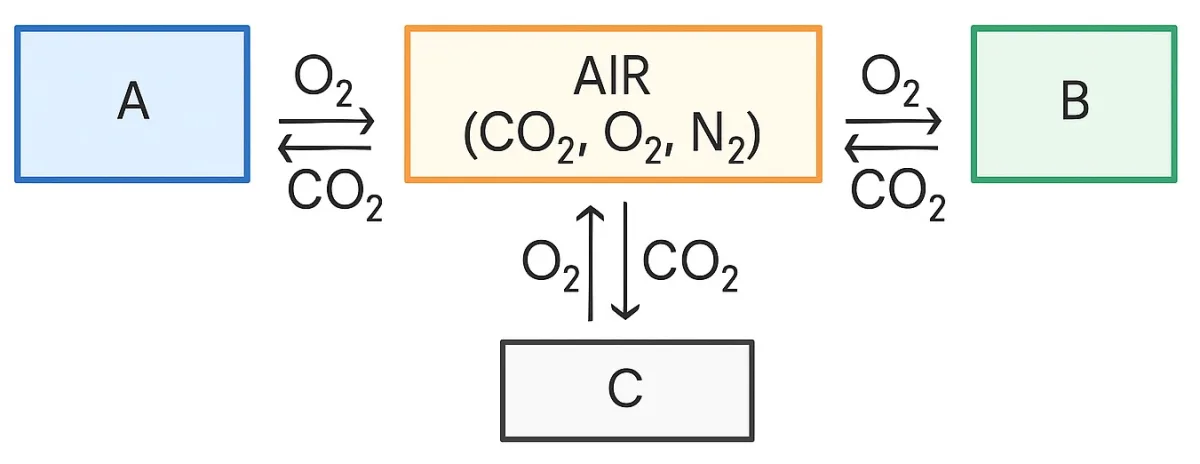
- A is Respiration — Respiration is a chemical process that takes place in all living beings. In this process, oxygen that we breathe in with air reacts with the digested food in our body. This results in the release of energy, carbon dioxide and water.
- B is Photosynthesis — Photosynthesis is a process in which carbon dioxide is used by green plants to prepare their food. Oxygen is released during this process which is then used for respiration by both plants and animals.
- C is Burning of fuels — Burning (Combustion) is a process in which a substance reacts chemically with oxygen and gets oxidised, with the release of energy in the form of heat and light.
Question 5 In an experiment done with a burning candle, the apparatus was set up as shown below. Initially, the candle burns but after sometime…
In an experiment done with a burning candle, the apparatus was set up as shown below. Initially, the candle burns but after sometime it gets extinguished.
In an experiment done with a burning candle, the apparatus was set up as shown below. Initially, the candle burns but after sometime it gets extinguished. Air Atmosphere, Concise Chemistry Solutions ICSE Class 6.
Look at the diagram and answer the questions given below.
(a) Label A and B.
(b) Why does the candle burn in (I) but gets extinguished in (II)?
(c) Why does the water level rise after sometime?
(d) What conclusion is drawn by the experiment show above?
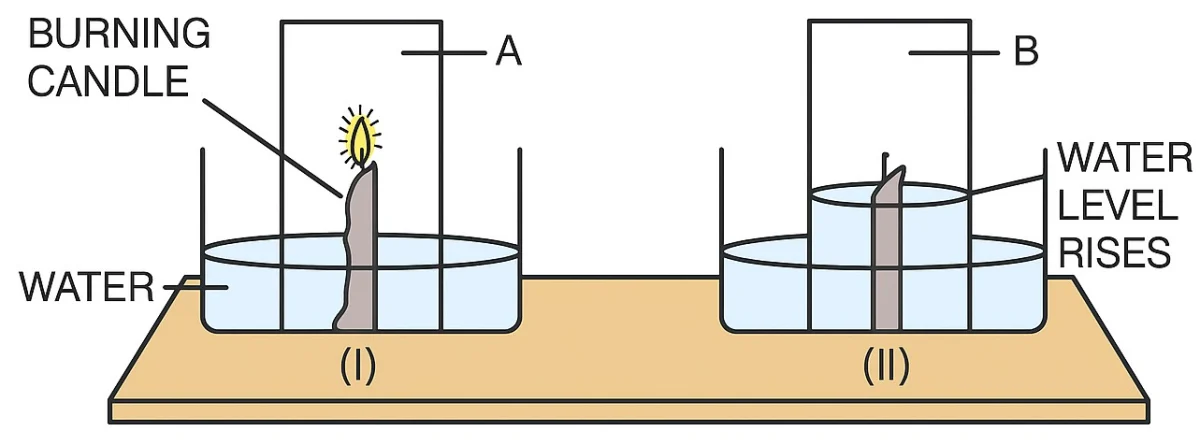
(a) In the given diagram A and B are:
A → Air
B → Inactive air
(b) The candle burns in (I) because of the presence of 'active air' that contains oxygen, which is used by the candle to burn. The candle does not burn in case of (II), because the jar consists of 'inactive air', consists mainly of nitrogen, which does not support burning.
(c) When the candle burns, it uses oxygen from the trapped air. After the flame goes out, the enclosed gases cool and the pressure inside the jar decreases; some carbon dioxide may also dissolve in the water. Water therefore rises inside the jar. In this simplified school experiment, the rise is often described as approximately one-fifth, showing that oxygen forms roughly one-fifth of air.
(d) This proves that air contains both oxygen and nitrogen. It clearly explains that air is made up of an 'active' part and an 'inactive' part. The 'active' part of air, which is used up when substances burn, is about one-fifth of the total volume of the air. It is a gas called oxygen. The 'inactive' part, which does not support burning, consists mainly of a gas called nitrogen, constituting four-fifths (4/5) of air by volume.
Case Study Type Questions
Question 1 Riya was travelling with her parents in a big city. She noticed that the sky looked hazy and the buildings far away were not clearly…
Riya was travelling with her parents in a big city. She noticed that the sky looked hazy and the buildings far away were not clearly visible. Her mother explained that this happens because harmful gases and tiny particles like smoke, soot and dust get mixed with the air. These come mainly from vehicles, burning of fuels and factories. Breathing such polluted air can make people sick and also harm animals and plants.
(a) Define air pollution?
(b) Why is the air in big cities often less clear than in small towns or villages?
(c) Mention two common health problems that people may suffer from due to air pollution.
(d) Suggest two ways in which we can reduce harmful substances mixing in the air.
(e) How are solar energy and electrical energy better than using fossil fuels?
(a) Air pollution is the mixing of harmful substances in the air that make the air unsafe for living beings.
(b) The air in big cities is often less clear because there are more vehicles, industries, and burning of fuels. These release large amounts of smoke, soot, and harmful gases into the air, making it hazy compared to cleaner air in villages.
(c) Two common health problems caused by air pollution are coughing and eye irritation.
(d) Two ways in which we can reduce harmful substances mixing in the air:
Growing more trees and plants. Trees clean the environment and also help in bringing more rains which make the atmosphere free from pollutants.
Industries should be located far away from residential areas.
(e) Solar energy produces no smoke during use. Electricity can also reduce local air pollution, especially when it is generated from renewable sources. Both can reduce the direct burning of fossil fuels.
60-Second Knowledge Check
Which gas forms the largest part of Earth's dry atmosphere?




0 Comments