From Solid to Gas: Understanding the States of Matter

Speed Up Science
0

🧊💧💨 From Solid to Gas: Understanding the States of Matter

Explore solids, liquids and gases with animated particles, examples, state changes, video lesson, quiz and HOTS questions.

States of Matter Solid Liquid Gas Change of State

📌 Learning Map

🎯 Learning Objectives

  • Understand the three common states of matter.
  • Compare solids, liquids and gases.
  • Explain particle arrangement in each state.
  • Understand melting, freezing, evaporation and condensation.

🧩 Competencies

  • Observation Skills
  • Scientific Reasoning
  • Conceptual Understanding
  • Application Skills

📊 Learning Outcomes

  • Defines matter correctly.
  • Identifies solid, liquid and gas examples.
  • Explains particle spacing and movement.
  • Describes changes of state with heat.

🌈 5W-1H + 1U

🔴 What: Matter is anything that has mass and occupies space.
🟠 Why: States of matter help us understand the behaviour of materials around us.
🟡 When: Matter changes state when heat is added or removed.
🟢 Where: States of matter are seen in ice, water, steam, air, food, metals and clouds.
🔵 Who: Students, scientists, cooks, doctors and engineers use this concept.
🟣 How: Particle arrangement and movement decide whether matter is solid, liquid or gas.
1U: The same substance can exist as solid, liquid and gas, like ice, water and steam.

🖼️ Image Section

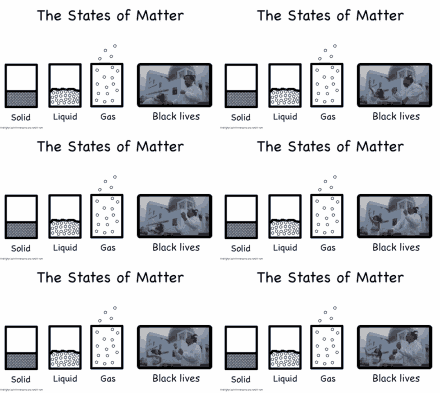
States of Matter Image Placeholder

▶ Watch: From Solid to Gas

Watch the video and then explore the interactive particle animations below.

Embedded YouTube video included as requested.

⚛️ Animated Particle Model

🧊 Solid

Particles are tightly packed and vibrate in fixed positions.

💧 Liquid

Particles are close but can slide over one another.

💨 Gas

Particles are far apart and move freely in all directions.

Solid

A solid has a fixed shape and fixed volume.

🔥 Interactive State Change Simulator

Move the heat slider and observe the state of matter.

Low Heat: Solid 🧊
Particles have low energy and remain closely packed.

🔥 Melting

Solid changes into liquid on heating.

❄️ Freezing

Liquid changes into solid on cooling.

💨 Evaporation

Liquid changes into gas on heating.

🌧️ Condensation

Gas changes into liquid on cooling.

🌀 Sublimation

Solid changes directly into gas.

⬇️ Deposition

Gas changes directly into solid.

✅ States of Matter Quiz

Select the correct answer and click submit to check your score.

1. Matter is anything that has:
2. A solid has:
3. A liquid has:
4. A gas has:
5. Solid changing into liquid is called:
6. Liquid changing into gas is called:
7. Gas changing into liquid is called:
8. Particles in gas are:
9. Ice changing into water is an example of:
10. Water vapour changing into water droplets is:

🧠 HOTS Questions

Click each question to reveal the answer.

1. Why do gases fill the entire container?
Gas particles are far apart and move freely in all directions, so they spread throughout the container.
2. Why does a solid keep its shape?
Solid particles are tightly packed and can only vibrate in fixed positions.
3. Why does water take the shape of a glass?
Liquid particles can slide over one another, so liquids take the shape of their container.
4. Why does evaporation happen faster on heating?
Heating gives particles more energy, so more particles escape from the liquid surface as gas.
5. Can the same substance exist in all three states?
Yes. Water can exist as ice, liquid water and steam.
  • Newer

    From Solid to Gas: Understanding the States of Matter

Post a Comment

0Comments

Post a Comment (0)